

Maddie Chang is a student at Harvard Law School.
In today’s Tech@Work, the House announces a new bipartisan task force on AI; Rep. Ro Khanna hosts labor leaders at AI roundtable; and Amazon is accused of union busting in the UK.
In general tech news, this week the House of Representatives launched a new bipartisan task force focused on developing guardrails for AI. The group’s 24 lawmakers (12 Democrats and 12 Republicans) have been tasked with producing a report detailing actions Congress should take to respond to growing concerns and excitement about AI. In announcing the task force alongside House Minority Leader Hakeem Jeffries, House Speaker Mike Johnson said: “As we look to the future, Congress must continue to encourage innovation and maintain our country’s competitive edge, protect our national security, and carefully consider what guardrails may be needed to ensure the development of safe and trustworthy technology.” The group’s Democratic co-chair Representative Ted Lieu summarized: “the question is how to ensure AI benefits society instead of harming us.” Congress has yet to pass any legislation that would tackle AI despite various bipartisan efforts. Following a Senate proposal in the same vein, earlier this year House Republican Representatives Zach Nunn and Marcus Molinaro and Democratic Representatives Don Beyer and Lieu introduced a bill that would leverage the federal government’s procurement power to establish standards for federal vendors and within agencies. The House proposal follows President Biden’s Executive Order in October of last year and White House listening sessions on AI, including with union leaders.
Meanwhile, separately and prior to the announcement of the task force, House Rep. Ro Khanna hosted a roundtable on AI, which included both labor leaders and AI experts. Khanna, whose district covers Silicon Valley, took the opportunity to focus on the impact of AI on work and workers. He told the Washington Post: “There needs to be thought about how AI cannot just increase productivity but increase the economic prospects for workers.” Khanna hopes that the roundtable insights will feed into a bill he’s contemplating that would seek to address the relationship between workers and AI. It would change the tax code to offer companies adopting AI tax credits if they give workers equity in the company. Presumably this could dissipate a tension between adopting AI technology and supporting the workforce. He’s also looking into getting workers a seat at the table in company decisions about the implementation of AI at work, including a possible requirement that workers be represented on company boards.
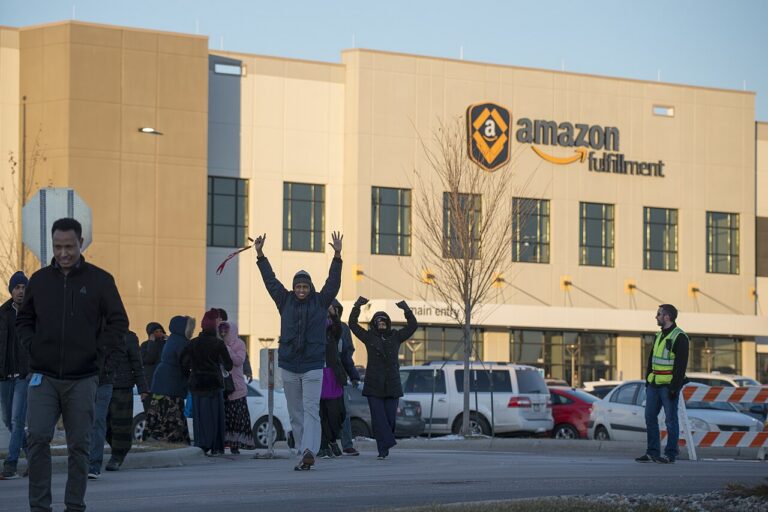
Finally, the Guardian reports that the British union GMB has accused Amazon of union busting in its Coventry, England warehouse. Ahead of a planned Valentine’s Day strike, Amazon posted flyers on warehouse bulletin boards saying, “We want to speak with you. A union wants to speak for you.” Another poster read: “Before you vote or join a union, we encourage you to seek out the facts for yourself. The best relationships are the direct ones.” Workers at the Amazon warehouse are primarily asking for a £15 hourly wage. GMB has been seeking formal recognition at the Coventry location for at least the past year. The union withdrew its original application for recognition after Amazon brought on 1,000 new workers. The union said the influx of workers was meant to dilute its majority. Amazon denies this claim, saying the workers were hired as part of normal business operations. Readers of OnLabor may be familiar with GMB, which represents workers across sectors, from its 2016 employment tribunal victory which held that UK Uber drivers were workers and not independent contractors. That decision was later upheld by the UK’s Supreme Court.

Daily News & Commentary
Start your day with our roundup of the latest labor developments. See all
July 3
Unions seek a preliminary injunction to prevent USDA downsizing; the D.C. District Court issues a preliminary injunction against new student loan regulations; Matt Bruenig releases an analysis of Starbucks’ ongoing legal battle against Starbucks Workers United.
July 2
First Circuit denies federal worker unions’ mandamus petition; federal court denies preliminary injunction against new union reporting rule; House introduces the Securing Agriculture’s Workforce Act.
July 1
Trump nominates Keith Sonderling as Labor Secretary; DOL eliminates disparate-impact liability from Title VI regulations; OPM finalizes rule allowing suitability-based removal of federal employees for post-appointment conduct.
June 30
SCOTUS ends removal protections for agencies; staff at NYC cocktail bar vote to unionize.
June 29
In today’s News and Commentary, student-athletes file a class action suit challenging the NCAA’s new Age-Based Rule, a federal judge declines to issue a preliminary injunction against FEMA’s reduction in force but expedites proceedings, and Gavin Newsom opposes California’s proposed billionaire tax in favor of a federal approach. On Thursday, DeJuan Campbell, at basketball player […]
June 28
Philadelphia utility workers announce July 4 strike; national parks workers vote to unionize; Michigan considers “right to disconnect” bill.