
Michelle Berger is a student at Harvard Law School.
In today’s News and Commentary: the NLRB affirms findings that Starbucks violated the NLRA; the Supreme Court denies cert in a case that sought to challenge the constitutionality of California’s worker classification law; and a new conservative nonprofit weighs in on unions.
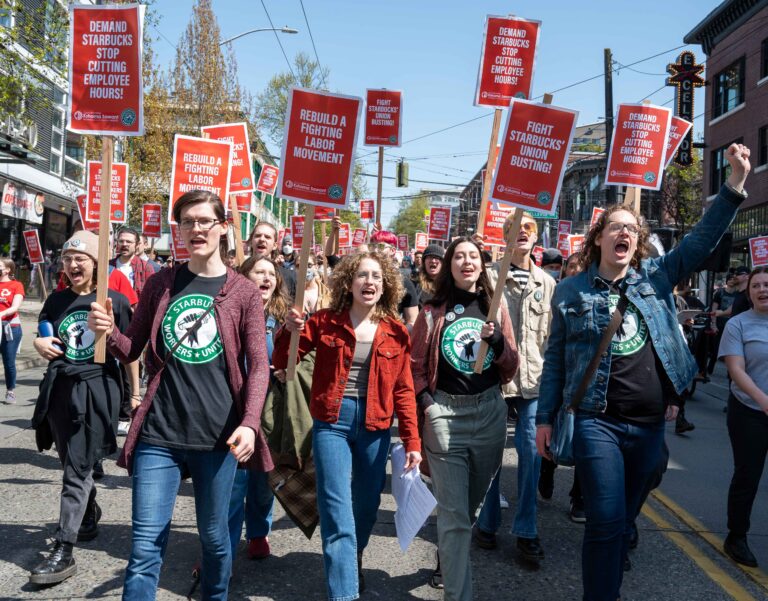
On Tuesday, a bipartisan three-member panel of the NLRB affirmed an ALJ decision from last year that found Starbucks violated the NLRA in connection with its conduct at a retail store in Seattle. In the case, baristas had received subpoenas to testify at an NLRB representation hearing. The baristas alleged – and the ALJ found – that Starbucks management told them the subpoenas did not excuse them from work and that, if they missed work for the hearing, they would face discipline unless they could find someone to cover their shift. The ALJ concluded that Starbucks’ conduct interfered with the baristas rights and violated Section 8(a)(1) of the Act.
Also on Tuesday, the Supreme Court denied a petition for certiorari in a case seeking to strike down A.B. 5, the California law intended to prevent misclassification of employees as independent contractors. Petitioners contended that A.B. 5 is unconstitutional under the First Amendment for its application to political canvassers. The Court’s denial of cert puts an end to this particular attack against the law, which has been a lightning rod for attacks from business interests in California. I wrote about A.B. 5 in the context of a constitutional challenge to the law on equal protection grounds in March.
In an article published yesterday, Timothy Noah of The New Republic reviews and critiques a self-proclaimed “handbook for conservative policymakers” produced by a new right-wing nonprofit, American Compass. Noah’s article, “Conservatives Aren’t Serious About Empowering the Working Class,” credits the American Compass publication – “Rebuilding American Capitalism” – for “capably identif[ying] the problems facing the working class,” including many of the sources of economic inequality. He credits American Compass, too, for recognizing the conservative case for labor unions (“conservatives … prefer private ordering to government dictates,” Noah quotes) and endorsing sectoral bargaining. (For more commentary on sectoral bargaining, see The Clean Slate Agenda). But ultimately, Noah observes, American Compass’ labor platform falls flat. It offers nothing by way of strengthening government protection for unionization. And alarmingly, it calls for curbing the political influence of unions –– which would, in effect, be “leaving politics to corporations.” The platform’s ambivalence (at best) toward labor leads Noah to conclude that American Compass “has some good ideas about what ails America, but it balks at furnishing the means to fix it.”


Daily News & Commentary
Start your day with our roundup of the latest labor developments. See all
October 22
SCOTUS declines Wilcox appeal; Penn State research assistants win bargaining rights; SEIU sued over military leave firing.
October 21
DOL withdraws tipped-worker rule; Instacart settles hiring-bias claims; Phillips 66 locks out New Jersey refinery workers.
October 20
Korean unions oppose labor exemption bill; Portland city workers prepare for strike; UPenn grad student union looks to dismiss university filing
October 19
FDA reverses course on policy prohibiting off-duty union activity; FAA and NATCA reach deal to secure pay increase for air traffic controllers.
October 18
Federal judge again halts cancellation of the Bureau of Prisons’ CBA; tabletop gaming workers face roadblocks in union recognition.
October 16
Department of Labor reduces wage-and-hour enforcement at unionized workplaces; Fain's victory poses question of federal monitor's extension.