
Andrew Strom is the Legal and Policy Director for the American Guild of Musical Artists (AGMA), and has been contributing to OnLabor since 2014. The views he expresses on this blog are his personal opinions and should not be attributed to AGMA.
The right to wear union insignia on the job has been one of the most heavily litigated labor law questions. This is somewhat surprising because the one Supreme Court case that addressed the issue, Republic Aviaton Corp. v. NLRB, upheld the National Labor Relations Board’s determination that “the right of employees to wear union insignia at work has long been recognized as a reasonable and legitimate form of union activity, and [an employer’s] curtailment of that right is clearly violative of the [NLRA].” Somehow, most judges have been unable to wrap their heads around the notion that workers simply have the right to wear union insignia, and instead, as a recent Second Circuit case involving Starbucks demonstrates, they insist on the need for a complicated balancing test that undermines this basic right.
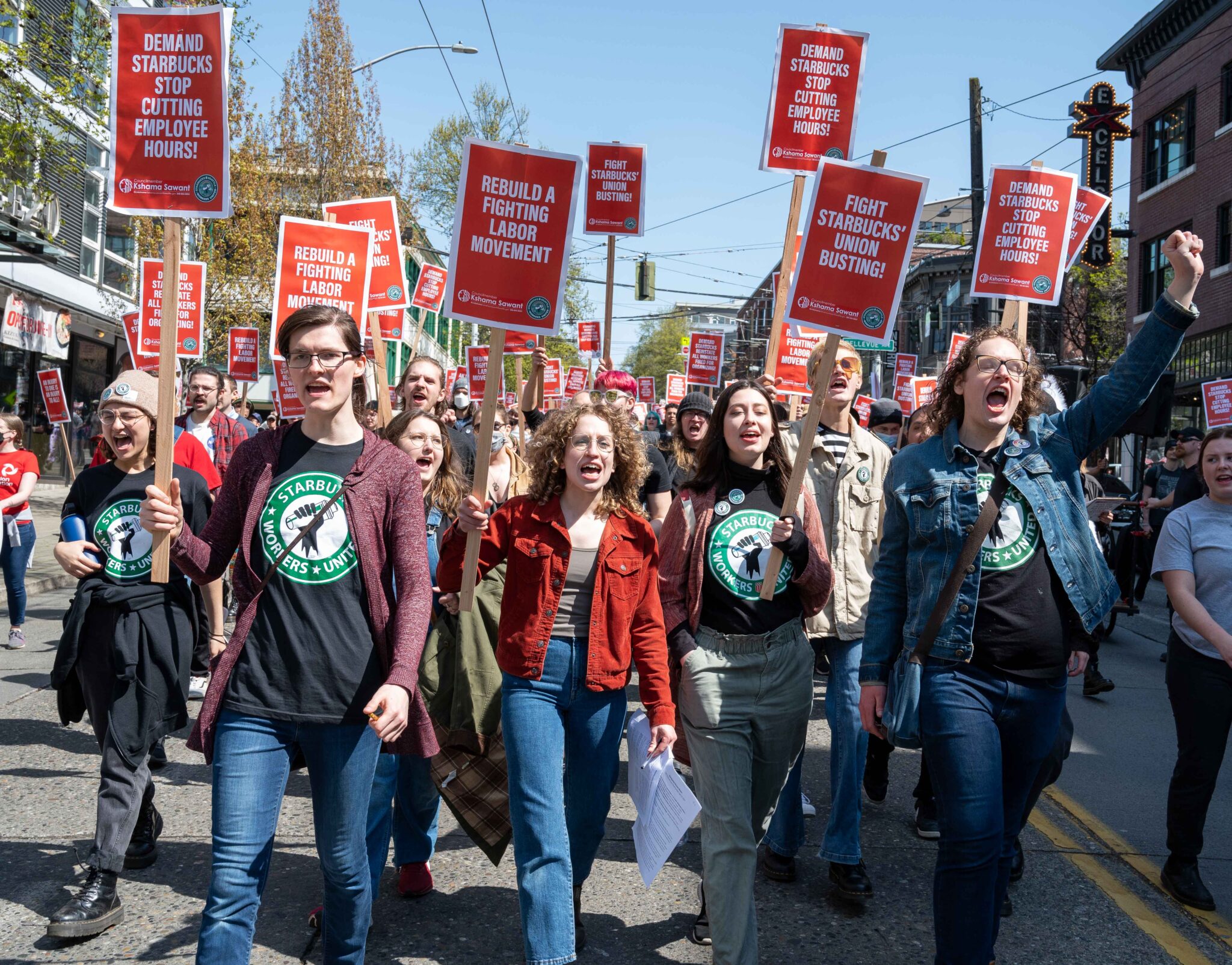
The Starbucks case arose at one of its “Reserve Roastery” stores. These are locations where Starbucks attempts to evoke a “hipster chic” or “steampunk” vibe. Starbucks’ standard dress code does not apply at these stores. Workers are allowed to wear a variety of different kinds of hats, they can wear shirts with patterns or prints, they can accessorize with their own handkerchiefs, ties, and bowties, and they can also wear t-shirts representing a dozen different employee affiliation groups. These affiliation groups, which Starbucks calls “partner networks,” represent shared identities and experiences. There is an African-American one, a Pan-Asian one, a disability advocacy one, and an armed forces one. Starbucks allowed workers to wear an unlimited number of pins representing partner networks or Black Lives Matters, but it only allowed workers to wear a single union pin. Starbucks also prohibited workers from wearing any t-shirts with logos or writing other than t-shirts representing partner networks. Finally, Starbucks prohibited workers from wearing pins or buttons that advocate for a political, religious, or personal issue, again with an exception for partner network pins. Starbucks conceded that this rule would bar buttons advocating for a higher minimum wage.
After two Starbucks workers were threatened with discipline if they refused to remove union t-shirts, their union filed a charge against Starbucks challenging the union t-shirt ban, the one union pin policy, and the policy against wearing buttons advocating for political, religious, or personal issues. The NLRB found that all three rules were illegal. Applying a test it developed in Tesla, Inc., the Board held that Starbucks failed to establish that its rules were narrowly tailored to address special circumstances that outweigh the workers’ right to wear the insignia. The Board found that Starbucks allowed workers to wear so many other pins and adornments that it failed to establish special circumstances that would justify limiting workers to a single union button. The NLRB similarly found that Starbucks failed to justify the ban on union t-shirts. Starbucks had argued that the ban on t-shirts with logos or writing was necessary to ensure that workers don’t “stand out.” The Board rejected this argument because the partner network t-shirts that Starbucks allowed workers to wear “seemingly contradict the stated purpose of the Roastery dress code as they draw customer’s eyes to causes that the [worker] identifies with and in effect makes the [worker] stand out.” The Board further held that Starbucks’ rule against buttons advocating political, religious, or personal issues infringed on workers’ NLRA rights to advocate for issues like a higher minimum wage, and Starbucks had failed to justify why it should be allowed to ban political messages relating to workers’ rights while allowing workers to wear Black Live Matters buttons.
Almost four years after the workers were told they were not allowed to wear union t-shirts, the Second Circuit refused to enforce the Board’s order. The court held that a prior court case barred the NLRB from challenging the one-pin rule, and it inexplicably held that test the Board announced in Tesla is inconsistent with the principles established in Republic Aviation.
It seems that the Second Circuit judges just couldn’t believe that the Supreme Court actually meant what it said about union insignia in Republic Aviation. To give them the benefit of the doubt, they could have been confused because Republic Aviation addressed two different issues – workers’ right to wear union insignia, and workers’ right to engage in union solicitation at the workplace. The Board has long recognized that “working time is for work.” What this means is an employer may lawfully prohibit all off-topic conversations during working time even if it infringes on workers’ right to organize. While an employer may have other legitimate reasons for wanting to restrict the right to wear union insignia, workers should be able to continue focusing on their tasks when working side-by-side with someone wearing a union pin. If you don’t realize that these are separate issues raising distinct concerns, then you could make the mistake of applying Republic Aviation’s discussion of the solicitation issue to the insignia issue. Needless to say, if the judges didn’t understand the difference between these issues, maybe they should have heeded Republic Aviation’s observation that Congress assigned the Board “the work of applying the Act’s general prohibitory language in light of the infinite combinations of events which might be charged as violative of its terms.”
The judges in the Starbucks case repeatedly cite to the portion of Republic Aviation that addresses solicitation to justify their ruling, refusing to acknowledge that in Republic Aviation, the Court actually approved of the Board’s unqualified statement that “curtailment” of the right to wear union insignia is illegal. The Board has long since abandoned the notion that workers have an unqualified right to wear union insignia, recognizing that employers may limit this right for a variety of “special circumstances.” One of those “special circumstances” is where wearing union insignia would “unreasonably interfere with a public image that the employer has established, as part of its business plan, through appearance rules for its employees.” Where the judges parted ways with the Board was their objection to the notion that any restriction on displaying union insignia must be narrowly tailored to the special circumstances justifying the restriction. But, if the goal is to balance an employer’s legitimate interests against its employees’ statutory right to wear union insignia, why shouldn’t any restriction on that right be narrowly tailored? The judges are apparently saying that as long as an employer has a legitimate basis for imposing some restriction on wearing union insignia, if the prohibition is broader than necessary to account for the employer’s interests, too bad for the workers.
The court remanded the case to the Board with instructions to develop a “more evenly measured balancing test.” Apart from the fact that a test that gives more weight to employer interests will unnecessarily restrict workers’ rights, a murkier test will simply mean that in many cases workers will have no effective right to wear union insignia. Recall that this Second Circuit decision comes four years after workers were ordered to remove their union t-shirts. Workers desperately need a rule that lets them know up front that they can wear union buttons or t-shirts, not one that tells them four years later what their rights were.



Daily News & Commentary
Start your day with our roundup of the latest labor developments. See all
October 8
NLRB judge finds UPS unlawfully restricted union insignia; Harvard graduate workers authorize second strike; OSHA orders Union Pacific to pay $300,000 in damages in whistleblower case.
October 7
DOL scraps plan to remove decades-old wage-and-hour guidance from federal regulations; New York enacts personnel records access law; Starbucks loses bid to dismiss Workers United trademark suit.
October 6
Protect College Sports Act dampens athlete unionization outlook; Stanford RA union decides to withdraw petition
October 5
Delaware bans captive audience meetings; EEOC settles remote work national origin discrimination claim; First Circuit stays enforcement order in VA's dispute with AFGE.
October 4
Boston nurses announce open-ended strike; federal judge restores federal prison workers' union protections; St. Louis workers form the first movie theater union in Missouri.
October 2
Gov. Newsom signs bill regulating AI in workplace; federal judge blocks Trump's $100,000 H-1B visa fee.