
Yoorie Chang is the Project Manager for the Clean Slate for Worker Power Project at Harvard Law School’s Center for Labor and a Just Economy.

Max Kiefel is a fellow at the Center for Labor and a Just Economy at Harvard Law School.
Note: This post builds on a series launched in December on how states and cities can expand worker power in the United States. The series is grounded in a set of working papers and policy briefs that offer creative approaches for state and local action at a time when the federal labor law framework is increasingly unreliable. You can find the working papers compiled on the Center for Labor and a Just Economy’s website.
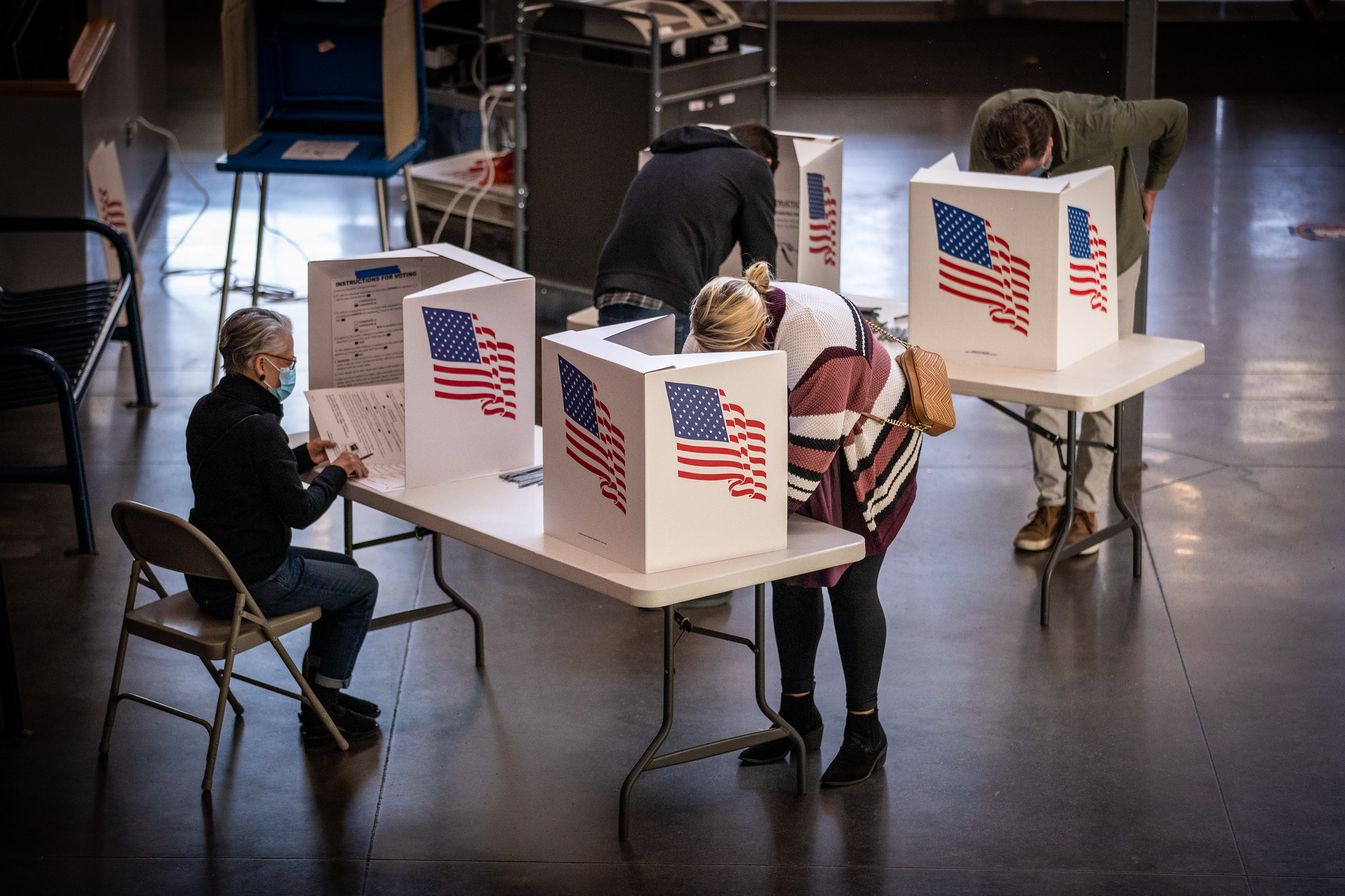
Under the prevailing single-member Congressional district, winner-take-all electoral system, American voters’ choices at the ballot box are funneled toward either of two dominant political parties. This is a system that is unpopular; nearly half of voters report dissatisfaction with the major parties. This is likely because the majority of American voters, especially working class voters, do not feel represented by their political representatives. As Lani Guinier argued, winner-take-all elections, which grant representation in a given district to the candidate who receives the most votes, tend to box out candidates and viewpoints that sit outside the institutionalized two party system, which is underpinned by corporate interests that use their funding to influence the range of acceptable policies.
Despite the high public support for pro-worker policies like increasing the minimum wage and strengthening collective bargaining rights, the federal minimum wage has stagnated at $7.25 per hour (which applies in 20 states with no minimum wage laws or a minimum wage at or below the federal floor), and the last time comprehensive collective bargaining reform passed at the federal level was nearly 70 years ago. This gap between the preferences of working class voters and policy outcomes tracks with empirical findings on the relationship between affluence and political influence: the interests of low- and moderate-income citizens (particularly when they diverge from those of economic elites) have virtually no bearing on policymaking. It is little wonder that, across party lines, most American voters believe the U.S. political system needs major reform.
This year, in primary results from Florida to New York we have seen candidates who are union members prevail. This can be interpreted as voter appetite for a different type of candidate. But even if they are to win their races in November, they will enter Congress as just a few of 434 members.
Contrast this with a proportional representation (PR) system, as is used in many other wealthy democracies. Under our winner-take-all, single-member district system, a labor-aligned party can struggle to win any seats even with substantial support, because that support is rarely concentrated enough to outpoll the two major parties in a given race. Under a PR system, seats are allocated across multi-member districts in proportion to each party’s share of the vote. The major difference is that a party that wins 10% of the vote in the former system will not come away with any seats, whereas they very well could under a PR system. So, a labor party doesn’t need geographically concentrated strength or an outright majority to win representation. A handful of seats won this way can still translate into real bargaining power that could extract binding commitments on wages, collective bargaining rights, or industrial policy as the price of its support. It also provides a better foundation from which to build a new majority.
Recent polling has indicated that American voters are open to embracing change in our electoral systems, as bipartisan support for solutions to address disproportionate governance, gerrymandering, and political polarization gains traction. Moreover, calls for electoral reform have become more urgent in light of the Supreme Court’s decision in Louisiana v. Callais dismantling provisions of the Voting Rights Act of 1965 this past term, which set off redistricting efforts in statehouses across the country threatening representation for communities of color.
In the latest working paper for the Center for Labor and a Just Economy’s State and Local Labor Policy Series, we explore how PR electoral systems at the state and local levels offer a promising solution to the representational failures that undermine working-class political power in the U.S. By creating conditions for multi-party representation in state legislatures and city councils, PR systems can pave the way for candidates representing working class interests to win seats with less access to traditional campaign resources and open up viability for third parties (including a potential Labor Party) at the state and local levels.
PR systems are prevalent in most modern democracies around the world, but forms of PR have existed (and continue to exist in cities including Cambridge, MA; Minneapolis, MN; and Arlington, VA) at subfederal levels throughout U.S. history. Historically, organized labor was often a driving force behind the adoption of PR in cities like New York City and Cincinnati.
While not a panacea for every structural barrier to working class representation in politics, proportional representation offers a path away from the two-party status quo that forces voters into artificial binary choices that often fail to reflect their actual policy preferences. At a time in which there is clear appetite for new avenues for democratic practice, workers and advocates pushing for pro-worker policymaking efforts at the state and local levels should consider such proposals seriously.
Check out “Proportional Representation and an Electoral Voice for Labor” and other papers in our State and Local Working Papers Series on the CLJE website.





Daily News & Commentary
Start your day with our roundup of the latest labor developments. See all
October 22
SCOTUS declines Wilcox appeal; Penn State research assistants win bargaining rights; SEIU sued over military leave firing.
October 21
DOL withdraws tipped-worker rule; Instacart settles hiring-bias claims; Phillips 66 locks out New Jersey refinery workers.
October 20
Korean unions oppose labor exemption bill; Portland city workers prepare for strike; UPenn grad student union looks to dismiss university filing
October 19
FDA reverses course on policy prohibiting off-duty union activity; FAA and NATCA reach deal to secure pay increase for air traffic controllers.
October 18
Federal judge again halts cancellation of the Bureau of Prisons’ CBA; tabletop gaming workers face roadblocks in union recognition.
October 16
Department of Labor reduces wage-and-hour enforcement at unionized workplaces; Fain's victory poses question of federal monitor's extension.