

Andrew Strom is the Legal and Policy Director for the American Guild of Musical Artists (AGMA), and has been contributing to OnLabor since 2014. The views he expresses on this blog are his personal opinions and should not be attributed to AGMA.
I remember sitting in a fast-food restaurant years ago, noticing a sign on the wall proclaiming that the restaurant was an equal opportunity employer. I thought it was notable that employers never publicly advertise that they don’t discriminate based on union activity. I spent a fair amount of time thinking about why there seemed to be so much more compliance with laws against race and sex discrimination than the law prohibiting discrimination for engaging in union activity. But, a few years ago I started to notice something that made me question whether my assumption was true. I live in New York City, a place with a reputation as a bastion of liberalism. And yet, I kept seeing gender-specific help wanted signs in stores and restaurants like these:


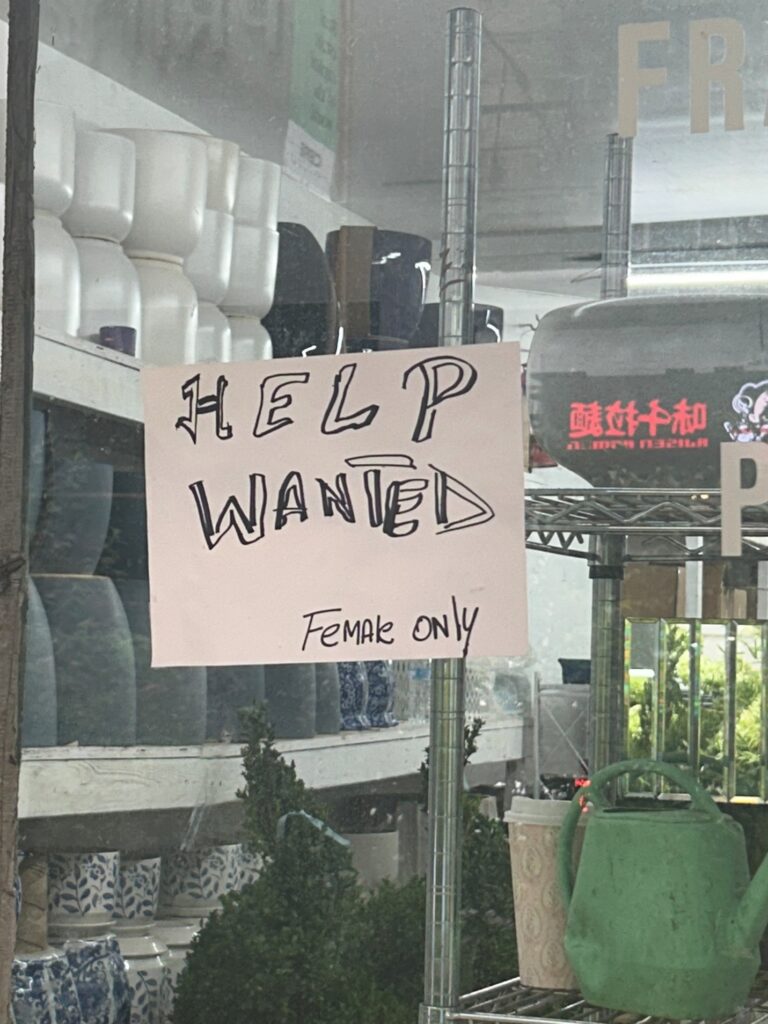

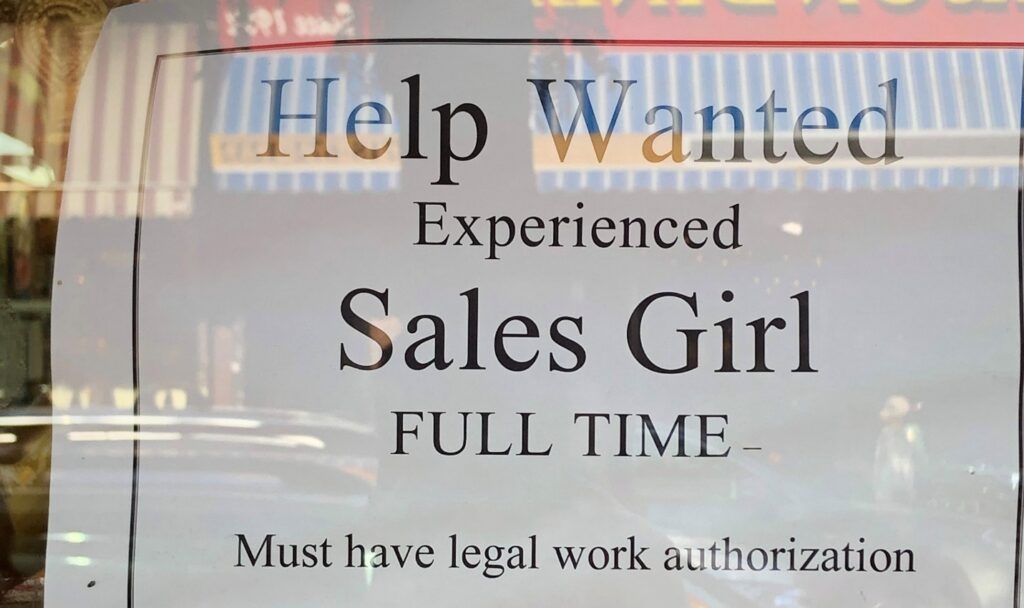

Since Congress enacted Title VII of the Civil Rights Act in 1964, it has been illegal for employers to discriminate on the basis of sex. There is a narrow exception to this rule for “bona fide occupational qualifications,” but that exception is limited to positions like restroom attendant or certain acting roles, and has been specifically rejected where the argument is that customers prefer a male or female individual. At first, I was surprised to see signs in my neighborhood seeking a “delivery boy,” or a “counter girl,” but I’ve seen so many of them that I’m almost more surprised when signs feature gender neutral language. Just the other day, I saw two signs in a restaurant window: one said “waitress wanted,” and the other said “bus boy wanted.” It’s possible that the person who made the “bus boy” sign just thought of that as the job title for someone who clears tables, but when placed next to a sign seeking a “waitress,” it seems more likely that the restaurant was actually seeking a young man. At any rate, regardless of intent, use of the term “bus boy” sends a message that this is not a job for a woman. Some of you may know that Title VII only applies to businesses with at least fifteen employees, but state and local laws in New York extend Title VII’s prohibitions to smaller businesses. So, the problem is not that there are gaps in the law. Rather, the problem seems to be that we have just come to accept a certain amount of gender stereotyping.
Discrimination in hiring is ordinarily quite hard to prove. You may think you deserved to get a job, but it can be hard to measure qualifications, let alone who made the best impression in an interview. I don’t find it surprising that a bar owner might prefer to have a female bartender or a store owner might think it makes sense to hire a man as a stock person to lift heavy boxes. But I’ve been taken aback by these businesses openly advertising that they plan to disregard such well-settled law. And, while I know from long experience that customers don’t go out of their way to inquire about working conditions at places where they do business, I can’t help thinking that if a business advertised that it planned to pay women less than men someone would speak up to stop them. Yet the proliferation of these signs, and the length of time some of them have remained up, suggests that no one is blowing a whistle on any of these businesses. Apparently, gender stereotyping in hiring merits nothing more than a shrug.
It may be tempting to explain away these signs as the product of individuals who are unfamiliar with U.S. laws. But even if the signs are merely the result of ignorance, it raises the question of why these business owners would be ignorant about this particular aspect of the law. None of the businesses with these signs are operating out of the back of a truck. New York City is not an easy place to open a business, and it takes a certain amount of sophistication to obtain the necessary licenses and permits. If someone opens a store or a restaurant, we expect them to comply with all relevant federal, state, and local laws. When the health department inspects restaurants, it doesn’t lower standards based on how long the restaurant owner has been in the country. Somehow, business owners learn how to comply with other laws – why haven’t these businesses learned that they can’t discriminate in hiring based on sex?
Donald Trump is probably more a symptom than a cause of this flouting of Title VII, but Trump and his minions have often emphasized sex stereotypes. Trump regularly talks about his appointees looking the part, reinforcing the notion that a particular appearance is itself a qualification for a job. Pete Hegseth has denied promotions to female military officers, and he has suggested that the military had lowered standards to allow women to serve in combat roles. Observers have even coined the term “Mar-a-Lago face” to describe a certain exaggerated look that many women in the Trump orbit have adopted.
While the U.S. has come a long way from the days before Title VII when women were largely relegated to certain jobs, there’s still a long way to go. Ninety-seven percent of pre-school and kindergarten teachers are women. By contrast, only two percent of electricians are women. Clearly, having laws on the books isn’t enough to change behavior. And while the feminist movement did succeed in breaking down many barriers, many parents still buy different toys and outfits for boys and girls starting at birth. In recent years, it even seems that we are backsliding when it comes to breaking down gender stereotypes. The Barbie movie may have been a satire with a feminist message, but it also acted as a billion dollar advertisement for a doll that famously reinforces gender stereotypes. And Democrats in Maine were so eager to find a candidate who fit their image of a working class guy that they initially nominated Graham Platner for U.S. Senate despite his many obvious flaws.
It’s been almost forty years since the Supreme Court decided Price Waterhouse v. Hopkins, affirming a lower court ruling that Price Waterhouse violated Title VII when it denied Ann Hopkins a partnership at the firm because she did not conform to sex stereotypes. Hopkins had been told she should “walk more femininely, talk more femininely, wear make-up, have her hair styled, and wear jewelry.” Today, managers at large corporations attend trainings where they learn not to say things like that, but do we really believe that people have stopped having those thoughts? The United States is still a heavily gendered place where too many of us still expect men and women to act in certain ways, and where we apparently still think there are male jobs and female jobs.







Daily News & Commentary
Start your day with our roundup of the latest labor developments. See all
October 21
DOL withdraws tipped-worker rule; Instacart settles hiring-bias claims; Phillips 66 locks out New Jersey refinery workers.
October 20
Korean unions oppose labor exemption bill; Portland city workers prepare for strike; UPenn grad student union looks to dismiss university filing
October 19
FDA reverses course on policy prohibiting off-duty union activity; FAA and NATCA reach deal to secure pay increase for air traffic controllers.
October 18
Federal judge again halts cancellation of the Bureau of Prisons’ CBA; tabletop gaming workers face roadblocks in union recognition.
October 16
Department of Labor reduces wage-and-hour enforcement at unionized workplaces; Fain's victory poses question of federal monitor's extension.
October 15
New reporting examines the rollback of child labor protections; California tries to block a strike; NLRB charges Wisconsin mental health provider with firing workers during union drive.