
Caroline Koclanes is a student at Harvard Law School and a member of the Labor and Employment Lab.
“Trust me, I’m upset with the driver, I’m upset with the carrier, but if we don’t go after the broker, this is going to continue happening.” These are the words of Marcus Coleman, a truck driver himself whose daughter was almost killed in a truck crash. The Colemans are suing the broker (the middleman who connects sellers with carriers) for “fail[ing] to perform an in-depth safety review” of the carrier. “[It] is not hard at all,” Mr. Coleman explained. “Within thirty seconds, we found out how many … violations [the carrier] had, how many suspensions, car accidents.” Last Term, in Montgomery v. Caribe Transport II, LLC, the Supreme Court made suits like these possible. Resolving a circuit split, the Court held that federal law does not bar state-law negligence claims against brokers for trucking crashes –– brokers can be held liable. This ruling offers hope to an industry that has historically disincentivized safety –– hope for workers and for families like the Colemans.
Landscape: The Trucking Industry
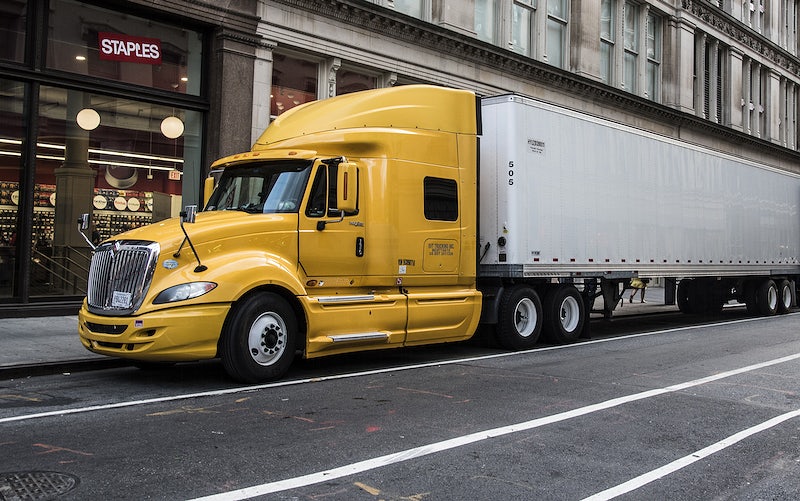
The United States trucking industry moves about 38.8 million tons of freight every day. The industry is made up of four actors: sellers, brokers, carriers, and drivers. When a seller (say, Walmart) needs goods moved, it contacts a broker, who connects it to a carrier, who in turn hires a driver to haul the goods. Brokers are the “transportation industry’s matchmakers, connecting sellers of goods to the carriers who move them.” Roughly 28,000 brokers arrange transportation for more than 780,000 carriers, which employ 3.58 million drivers.
Brokers are often well-capitalized –– some Fortune 500 companies with over $16 billion in annual revenue. In contrast, most carriers are small (91.5% operate fewer than ten trucks) and judgment-proof (the carrier cannot afford to pay damages in a lawsuit). Federal regulations require carriers to hold only $750,000 in liability insurance, a sum inadequate given the catastrophic nature of many trucking injuries, which can easily reach eight- or nine-figures. And these cases are not rare. More than 100 people die every week in truck crashes. The broker’s insurance, by contrast, is often $10 to $25 million.
These accidents are not inevitable. Rather, they are often the consequence of persistent incentives favoring profits over safety and drivers. Pay-by-the-mile compensation, for example, rewards long hours over sleep and safety. Economic sociologist Steve Viscelli has documented how drivers turn to dangerous practices, including drug use, to stay awake, all to work more hours and earn more money. Most companies turn a blind eye to such violations, welcoming the profits.
The worst offenders are chameleon carriers: fleets that rack up safety violations, flout federal regulations, and, at the brink of collapse, reincarnate as new, “clean,” carriers, erasing their atrocious records. Between 10% and 20% of the nation’s carriers operate somewhere on the chameleon carrier spectrum. Daniel Sanchez, a driver of twenty-five years, described these carriers: “They don’t care if I got a violation or went to jail … the next day they’d have another driver in that truck. … You are not a human being for them. You’re just a number.”
Facing exploited drivers and judgment-proof carriers, the question becomes: who can be held liable for devastating crashes and interrelated dismal labor conditions? Suits against sellers have largely failed as causation can be difficult to prove. Sellers intentionally insulate themselves from liability through two middlemen (brokers and carriers). In Miller v. C.H. Robinson, Inc., for example, a crash victim initially sued all four actors (seller, broker, driver, and carrier) but later dismissed claims against Costco, the seller. Brokers may prove to strike the right balance: large enough to wield real influence and close enough to the harm to satisfy causation. Yet several circuits have held that federal law preempts state-law challenges against brokers, leaving injured parties unable to sue them. Last Term, the Supreme Court changed this.
Broker Liability: Montgomery v. Caribe Transport
In a unanimous 9-0 opinion, the Supreme Court held that state-law negligent-hiring claims against brokers are not preempted by federal law –– injured parties can in fact sue the broker.
In Caribe Transport, a trucker veered off the road and struck Shawn Montgomery’s truck which was stopped on the shoulder. Montgomery suffered severe injuries, including the amputation of his leg. The driver worked for Caribe Transport, a carrier. The country’s largest freight broker, C.H. Robinson, had coordinated the shipment. Montgomery sued the driver, Caribe Transport, and C.H. Robinson, alleging that C.H. Robinson, negligently hired Caribe Transport despite its “conditional” safety rating; history of deficient drivers; and poor inspection, maintenance, and crash rate.
C.H. Robinson argued that the Federal Aviation Administration Authorization Act (“FAAAA”) expressly preempted the claim. The District Court and Seventh Circuit agreed. Enacted in 1994, the FAAAA broadly preempts state laws related to trucker prices, routes, and services. However, the statute contains an important exception: The preemption provision “shall not restrict the safety regulatory authority of a State with respect to motor vehicles” (emphasis added). The question before the Court was whether Montgomery’s claim against the broker was “with respect to motor vehicles.” The Court held that it was.
The Court reasoned that Congress designed the FAAAA safety exception to ensure that preempting state economic regulation over motor vehicles did not restrict the “traditional state police power over safety” (i.e. traditional state sovereignty to promulgate safety regulations). Taking a textualist approach, because the FAAAA does not define “with respect to,” the Court “g[a]ve the phrase its ordinary meaning” (“concerning” or “regarding”) and remarked that the Act defines “motor vehicle” broadly. “Putting the pieces together,” a claim falls within the exception if it “‘concerns’ or ‘regards’ the vehicles used in transportation.” Requiring a broker to exercise ordinary care in selecting a carrier, the Court concluded, “concerns” motor vehicles –– “most obviously, the trucks that will transport the goods.”
Implications: A New Hope
Many labor groups have come out in support of the Court’s holding. Teamsters General President Sean M. O’Brien praised the opinion: “[u]ntil now, … bad employers have been able to outsource their legal obligations to third parties because of a loophole in federal law.” The Teamsters President continued, “[we] commend the Court for its decision, which will force the largest logistics employers in the country to finally prioritize worker and motorist safety over profits.”
Brokers now have a strong incentive to do business with safe, reliable carriers. Before, the fly-by-night carrier, with low capitalization, terrible working conditions, and a willingness to do anything for profits, had the advantage. To brokers, it did not matter how the job got done, only that it got done. Liability will mean that brokers can no longer turn a blind eye. Instead, liability will increase the chances that safety, throughout the chain, becomes the priority. As one driver put it, “[y]our safety record will be vital to your survival as a business.” This protects not only other motorists but also workers, pushing out low-road employers who exploit their drivers, cut corners, and amass safety violations. While Caribe Transport is a limited ruling –– the Court held only that claims against brokers may be brought, not that claims against brokers will win –– it remains a meaningful step to a trucking industry that is safe for all.




Daily News & Commentary
Start your day with our roundup of the latest labor developments. See all
November 17
Amazon workers in Canada win company's first union contract in North America; NY law gives employees access to personnel records; D.C. Circuit looks to overturn Trump joint employer rule
November 16
FMCSA ordered to disburse $73 million in withheld highway funds to New York; Department of Labor final rule regarding large union financial disclosures issued six years after initial withdrawal is upheld; Department of Labor issues enforcement alert for physician ghost networks maintained by health plans.
November 15
Unions oppose Chuck Schumer for Senate Majority Leader; Rockstar staff vote on unionization ahead of Grand Theft Auto VI’s release; New Jersey Education Association faces federal investigation.
November 12
Harvard graduate students go on strike; New York city mayor prepares to negotiate with the city's largest public union; the Trump administration proposes stringent rules for workers seeking benefits.
November 11
MIT grad union avoids strike, Colombian union clashes with Nestlé, and DOL proposes stricter UI requirements.
November 10
The White House nominates new EEOC and FTC commissioners; casino workers at Encore Boston Harbor ratify a new contract ending a two-month strike.