

Julio Colby is a student at Harvard Law School.
In Today’s News & Commentary: an Administrative Law Judge finds Starbucks illegally fired five of the “Memphis Seven” union activists; the Sixth Circuit hears oral argument in a challenge to the court order reinstating the Memphis Seven; Washington Governor Jay Inslee signs worker productivity quota limits into law.
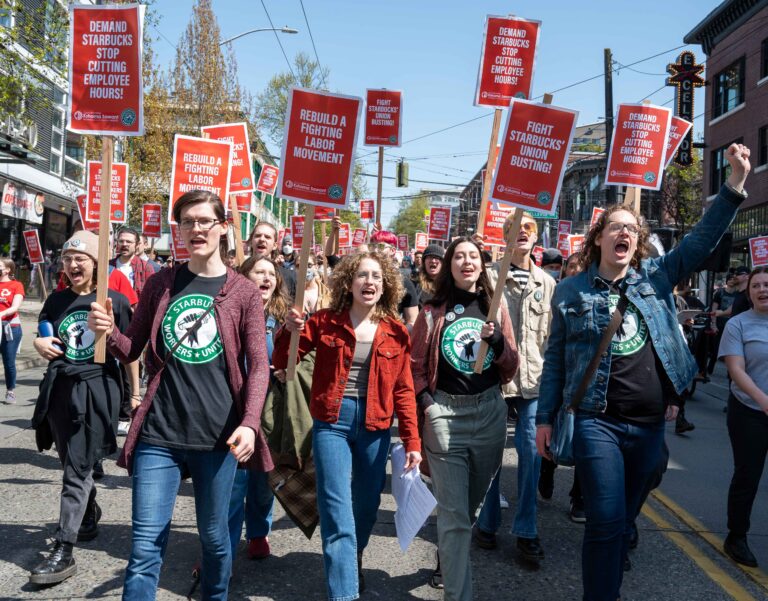
On Thursday, an Administrative Law Judge ruled that Starbucks illegally fired five union activists in Memphis, Tennessee. The five were part of a group of workers known as the “Memphis Seven” who were fired in February 2022 after filming a television news segment at their store after hours. NLRB prosecutors established that the seven workers engaged in protected activity, Starbucks knew about it, and the company was motivated by anti-union animus. The company was able to show, however, that it would have fired two of the workers regardless of their protected activity for serious violations of company policy that occurred during the ordeal. Starbucks also committed unfair labor practices by temporarily closing the store to stop a union demonstration, hiring more managers and supervising workers more closely, and stripping pro-union materials from a bulletin board. The decision, which Starbucks can challenge before the full Board, is the eleventh against the company so far, while it has prevailed only once.
The same day, the Sixth Circuit heard oral arguments in a case brought by Starbucks challenging the federal court order that reinstated the Memphis Seven while the hearing for the unfair labor practice charges played out. Last year, a district judge in Tennessee found that the NLRB had satisfied the two-part test for granting an injunction under Section 10(j) of the NLRA, showing “reasonable cause” to believe that unfair labor practices had occurred and that relief was “just and proper.” Starbucks challenged the second prong of the test, arguing that the agency failed to show why the relief was necessary since the union won its election 11-3 with no evidence of impact on bargaining. The argument seemed to win favor with some of the panel, as Circuit Judge Readler pushed back on NLRB attorney claims that the firings had a chilling effect on unionization efforts. Given the successful certification, Judge Readler asked the agency to provide a more “concrete harm” than “employee support” and called it “pretty speculative” to suggest that the firings would have any effect on bargaining efforts.
Finally, Washington Governor Jay Inslee signed into law a bill limiting worker productivity quotas of the sort utilized in Amazon warehouses. The law, which mirrors similar measures introduced in New York and California in 2021, comes as a result of the Seattle-based company’s use of productivity metrics that prioritize speed over safety and result in high injury rates among workers. The law covers companies employing 100 or more workers at a single warehouse or 1000 or more across multiple in the state, requires companies to ensure that any productivity metrics do not prevent workers from taking meal, rest, or bathroom breaks, and commands that companies give workers notice of quotas and keep records of worker productivity data made available to both workers and the state labor agency.

Daily News & Commentary
Start your day with our roundup of the latest labor developments. See all
October 20
Korean unions oppose labor exemption bill; Portland city workers prepare for strike; UPenn grad student union looks to dismiss university filing
October 19
FDA reverses course on policy prohibiting off-duty union activity; FAA and NATCA reach deal to secure pay increase for air traffic controllers.
October 18
Federal judge again halts cancellation of the Bureau of Prisons’ CBA; tabletop gaming workers face roadblocks in union recognition.
October 16
Department of Labor reduces wage-and-hour enforcement at unionized workplaces; Fain's victory poses question of federal monitor's extension.
October 15
New reporting examines the rollback of child labor protections; California tries to block a strike; NLRB charges Wisconsin mental health provider with firing workers during union drive.
October 14
Eleventh Circuit overturns ERISA exhaustion rule; DHS finalizes removal of automatic renewal for work permits; AFGE challenges SSA over flexible scheduling policy.