
Elias Decker is a student at Harvard Law School.
In today’s news and commentary, Brigham and Women’s Hospital locks out 4,000 nurses after one-day strike, and appeal filed challenging agency-shop agreements.
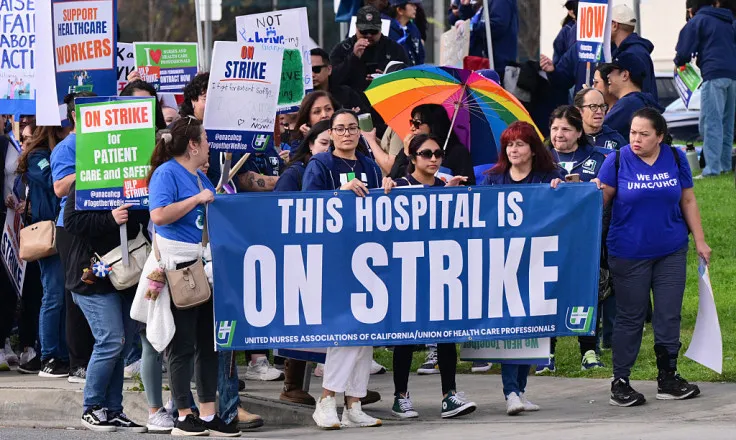
After a one-day strike on Wednesday July 8th, Brigham and Women’s Hospital has locked out over 4,000 nurses organized with the Massachusetts Nurses Association. In mid-June, 99.6% of the nurses voted to authorize the strike, the largest such vote in Massachusetts history. The ensuring strike was also the largest such strike in Massachusetts history. Striking nurses’ demands center on wages and healthcare costs. To maintain service, Brigham signed a five-day contract for temporary replacement workers. In a tense moment on the morning of July 9th, a large crowd of striking nurses approached the hospital’s front doors and announced that they would like to return to work. At the door, guarded by police and security officers, a hospital representative informed the crowd that they would not be returning to work and were being locked out. It seems both parties anticipated a lockout, with the MNA preemptively announcing on July 6th that both strike and lockout were on Brigham’s “Board Billionaires”. The lockout will last for the four days that remain in the hospital’s contract with temporary replacements.
On July 9, Graduate Students for Academic Freedom filed their opening brief in the Seventh Circuit Court of Appeals, challenging the constitutionality of agency-shop agreements. The appeal arises from the lower court’s dismissal of GSAF’s complaint against Graduate Students United at the University of Chicago, UE Local 1103, and UE. The complaint argues this unconstitutionality in third steps: First, it argues that the NLRA creates a presumption in favor of agency-shop agreements. Second, GSAF argues that this constitutes such strong encouragement for union-shop agreements as to constitute government compulsion of private actors, which generates the state action required for a First Amendment claim. Without this, the First Amendment would not normally regulate the actions of private parties, like unions and private universities. Lastly, GSAF claims that its members are required, under the union’s agency-shop provision, to fund UE and UE Local 1103, whose political positions they find unacceptable, in order to engage in the First Amendment-protected conduct of research and teaching, which violates their First Amendment rights. Judge John Kness of the Northern District of Illinois rejected this argument, saying that “the agency fee arrangement negotiated between the University of Chicago and the Union does not satisfy the state action requirement and thereby does not raise a First Amendment issue.” GSAF’s opening brief is docket entry 14 in case number 26-1911.


Daily News & Commentary
Start your day with our roundup of the latest labor developments. See all
October 8
NLRB judge finds UPS unlawfully restricted union insignia; Harvard graduate workers authorize second strike; OSHA orders Union Pacific to pay $300,000 in damages in whistleblower case.
October 7
DOL scraps plan to remove decades-old wage-and-hour guidance from federal regulations; New York enacts personnel records access law; Starbucks loses bid to dismiss Workers United trademark suit.
October 6
Protect College Sports Act dampens athlete unionization outlook; Stanford RA union decides to withdraw petition
October 5
Delaware bans captive audience meetings; EEOC settles remote work national origin discrimination claim; First Circuit stays enforcement order in VA's dispute with AFGE.
October 4
Boston nurses announce open-ended strike; federal judge restores federal prison workers' union protections; St. Louis workers form the first movie theater union in Missouri.
October 2
Gov. Newsom signs bill regulating AI in workplace; federal judge blocks Trump's $100,000 H-1B visa fee.