
James Blanchfield is a student at Harvard Law School.
In today’s News and Commentary, federal prosecutors move to dismiss charges against the president of the SEIU, Massachusetts nurses file an unfair labor practice against Brigham and Women’s Hospital, and Democratic lawmakers push to remove 35-year-old caps on damages in employment discrimination cases.
In Los Angeles, federal prosecutors moved to dismiss the criminal charges against David Huerta, president of SEIU California, more than a year after his arrest during protests against the Trump administration’s immigration enforcement operations. Under the agreement, the case will be fully dropped by the end of August provided Huerta continues meeting his pretrial release conditions. Huerta was arrested in June 2025 outside a Los Angeles business where agents were executing a search warrant. Authorities alleged he blocked a driveway gate and encouraged others to obstruct access. Prosecutors initially brought a felony obstruction charge, downgraded it to a misdemeanor in October, and have now abandoned it. Huerta said he was tackled, pepper-sprayed and detained for exercising his constitutional right to protest. He called it part of the Trump administration’s broader “weaponization of the judicial system.” His attorneys made a similar statement, saying this case sought to “silence criticism of the administration’s improper immigration actions.”
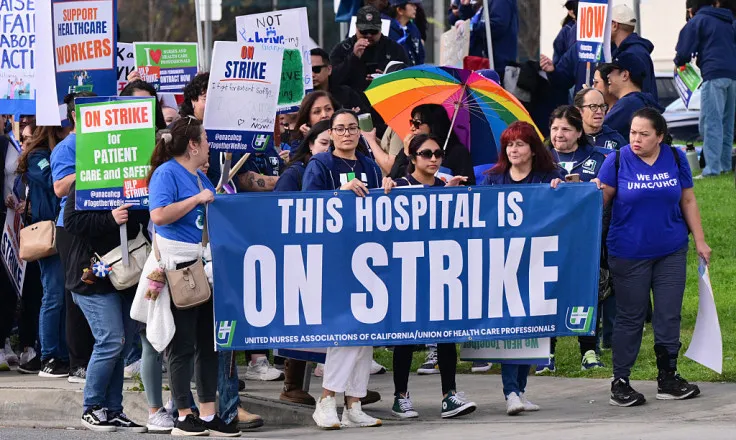
On Monday, the Massachusetts Nurses Association filed an unfair labor practice charge with the NLRB against Brigham and Women’s Hospital, alleging that management unlawfully prevented neonatal ICU nurses from walking out at the start of the July 8 strike. The union, which represents roughly 4,000 nurses at the hospital, says NICU staff were told they could not leave because of patient safety concerns. The one-day walkout, as Elias wrote about here, was the largest nurses strike in Massachusetts history and was followed by a four-day lockout during which agency nurses acted as temporary replacements. Union leaders argue the hospital manufactured the safety problem by relying on temporary replacements, pointing to the contradiction between blocking experienced nurses from striking and then depending on agency nurses for days afterward. The hospital disputes the account, saying no nurses were prevented from leaving, that oriented agency nurses were in place, and that state health officials monitored the transition. As contract talks continue, the union is continuing to push for “meaningful limits on the hospital’s reliance on temporary nurses,” but claims that the hospital is refusing to negotiate on that front.
Congressional Democrats have reintroduced legislation to eliminate the damages ceilings that have limited what workers can recover in federal employment discrimination suits since 1991. The Equal Remedies Act, filed this summer by Sen. Ed Markey of Massachusetts and Reps. Suzanne Bonamici of Oregon and Bobby Scott of Virginia, would get rid of the caps on compensatory and punitive damages under Title VII of the Civil Rights Act and the Americans with Disabilities Act. The bill is before committees in both chambers. In 2024, a version of the bill was proposed but died without a vote. The current limits run from $50,000 to $300,000 depending on employer size but have never been adjusted for inflation. If indexed, the top tier would exceed $725,000. The gap between jury verdicts and final judgments can be vast, with panels having awarded $25 million against Omni Hotels, $36 million against Werner Enterprises and $366 million against FedEx, only to have judges reduce those figures. Worker advocates say the limits blunt deterrence and discourage plaintiffs from bringing cases to court because “nobody wants to waste their time.” The bill faces a tough road through the current legislature, but commentators see it as “one to watch” if Democrats retake Congress.





Daily News & Commentary
Start your day with our roundup of the latest labor developments. See all
October 19
FDA reverses course on policy prohibiting off-duty union activity; FAA and NATCA reach deal to secure pay increase for air traffic controllers.
October 18
Federal judge again halts cancellation of the Bureau of Prisons’ CBA; tabletop gaming workers face roadblocks in union recognition.
October 16
Department of Labor reduces wage-and-hour enforcement at unionized workplaces; Fain's victory poses question of federal monitor's extension.
October 15
New reporting examines the rollback of child labor protections; California tries to block a strike; NLRB charges Wisconsin mental health provider with firing workers during union drive.
October 14
Eleventh Circuit overturns ERISA exhaustion rule; DHS finalizes removal of automatic renewal for work permits; AFGE challenges SSA over flexible scheduling policy.
October 13
Chicago hotel workers remain on strike; a coalition of Democratic states sues the Labor Department over canceled unemployment insurance grants; the Federal Labor Relations Authority establishes a new mediation framework for federal worker disputes.