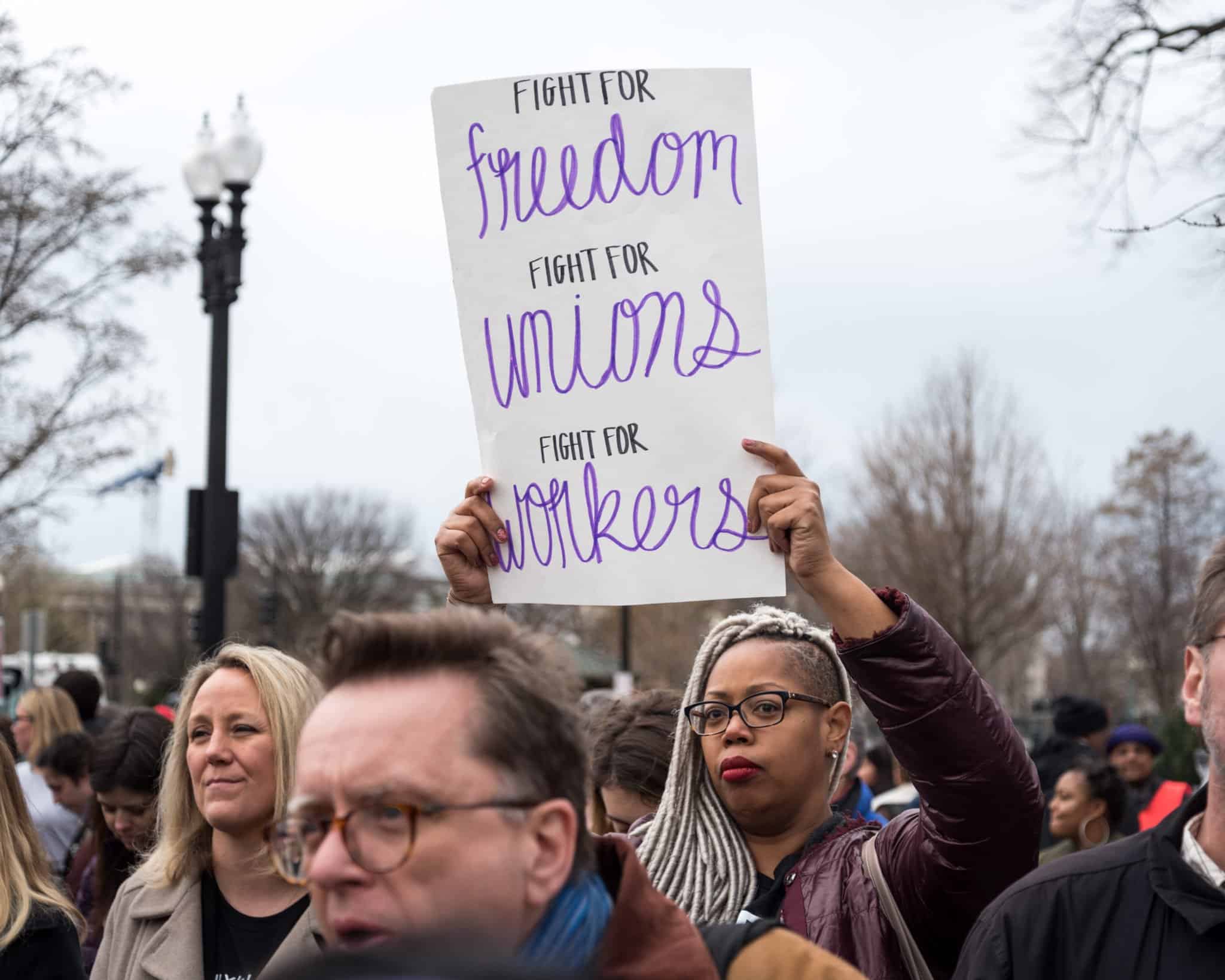

Esther Ritchin is a student at Harvard Law School.
In today’s news and commentary, AFGE and AFSCME sue Trump for an Executive Order stripping protections from government employees, Trump fires members of the Equal Employment Opportunity Commission, and Amazon shutters operations in the entirety of Quebec in response to union successes.
On Wednesday, two unions representing government employees–American Federation of Government Employees (AFGE) and American Federation of State, County and Municipal Employees (AFSCME)–filed a lawsuit against Trump’s Executive Order stripping job protections from federal workers. AFSCME’s President, Lee Saunders, has referred to this Executive Order as “a shameless attempt to politicize the federal workforce by replacing thousands of dedicated, qualified civil servants with political cronies.” The complaint asserts that the Executive Order is illegal in many respects, including in that it “exceeds the President’s authority under the Civil Service Reform Act, purports to deprive federal employees of property rights without due process required by the Fifth Amendment, and requires federal agencies to violate the Administrative Procedure Act.”
Continuing his efforts to obstruct rights and protections in the workplace, Trump fired two Equal Employment Opportunity Commission (EEOC) commissioners and the General Counsel late Monday night. The EEOC is an independent agency in charge of enforcing civil rights and anti-discrimination laws in the workplace. The two fired commissioners, Jocelyn Samuels and Charlotte Burrows, are both Democrats, and their firing upends the Democratic majority on the Commission. The Commission is intended to be a bipartisan group with staggered terms, and the firings go against the tradition of leaving commissioners in place through the transition of administrations. The firings leave one Democrat and one Republican on the Commission, with three vacancies to be filled by Trump. These firings also come amidst conservative attacks on the constitutionality of independent agencies like the EEOC, and recent firings of an NLRB commissioner and General Counsel.
Last week, Amazon announced plans to close all their warehouses in Quebec, Canada’s largest province. While the company claimed the decision was motivated by cost considerations–despite their $15 billion profit for the third quarter of 2024–the announcement comes in the wake of Amazon Canada’s first unionized warehouse, less than a year ago, in Laval, Quebec, and about a month after protestors at that warehouse demanded a $6 raise. Experts claim the decision is most likely influenced by Canadian labor law, which would have forced Amazon to reach a contract with the Laval union. Instead, they shuttered operations throughout the province and laid off thousands of employees. “The Quebec decision shows the company is so committed to avoiding unions, it will incur the cost of lighting up its five years’ worth of infrastructure spending in smoke rather than sit down and negotiate with the workers,” said Barry Eidlin, an associate professor of sociology at McGill University.




Daily News & Commentary
Start your day with our roundup of the latest labor developments. See all
October 25
Dallas Cowboys Cheerleaders unionize; Bureau of Prisons again pushes for union contract cancellation; CSU faculty votes on strike authorization.
October 23
Employers increasingly shift health care costs onto workers and NYC proposes placing restrictions on fully automated customer service.
October 22
SCOTUS declines Wilcox appeal; Penn State research assistants win bargaining rights; SEIU sued over military leave firing.
October 21
DOL withdraws tipped-worker rule; Instacart settles hiring-bias claims; Phillips 66 locks out New Jersey refinery workers.
October 20
Korean unions oppose labor exemption bill; Portland city workers prepare for strike; UPenn grad student union looks to dismiss university filing
October 19
FDA reverses course on policy prohibiting off-duty union activity; FAA and NATCA reach deal to secure pay increase for air traffic controllers.