
Gurtaran Johal is a student at Harvard Law School.
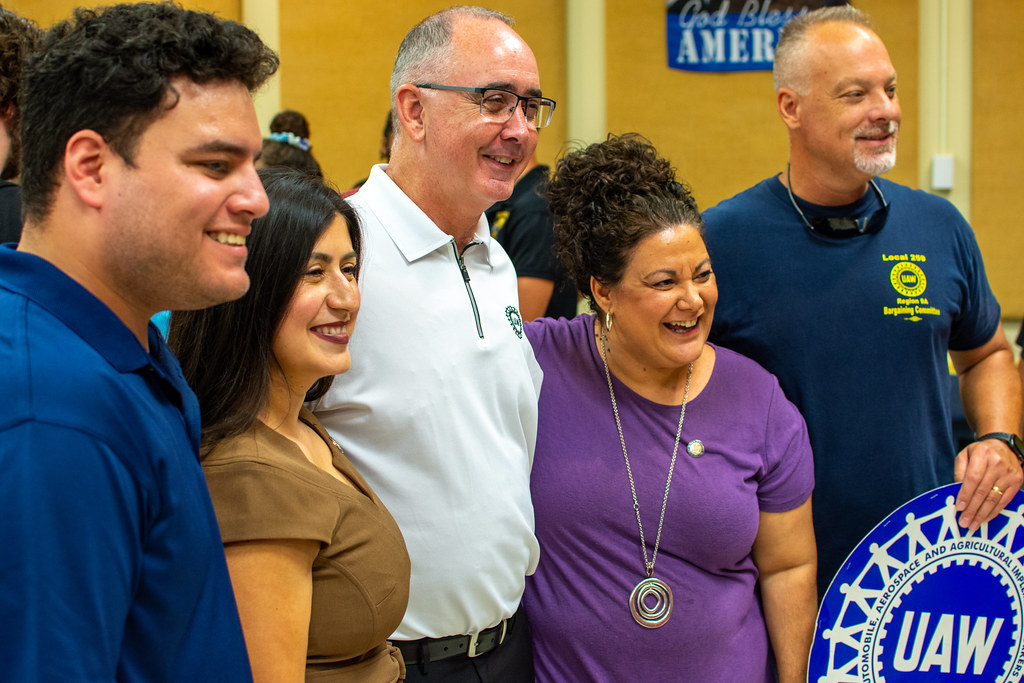
In today’s news and commentary, the United Auto Workers (UAW) seek to oust President Shawn Fain ahead of next year’s election; Columbia University files an unfair labor practice (ULP) charge against the Student Workers of Columbia-United Auto Workers for failing to bargain in “good faith”; and the Environmental Protection Agency (EPA) terminates its collective bargaining agreement with four unions representing its employees.
Bloomberg Law reports that members of the UAW are seeking to oust President Shawn Fain prior to next year’s election. Shawn Fain is a 29-year member of the UAW, holding the roles of UAW Negotiator and International Representative before becoming the UAW President on March 26, 2023. He became the first UAW President elected directly, rather than through representatives, by its members, after leading a set of successful strikes against General Motors, Ford, and Stellantis in 2023. Workers at several local unions have started the process to remove Fain from his position, bringing forth allegations of financial misconduct and workplace retaliation. They are calling for an internal trial of Fain’s misconduct, a request that will likely be approved by Neil Barofsky, a court-appointed monitor who has been conducting an investigation of Fain.
Meanwhile, Columbia University filed a ULP charge against the Student Workers of Columbia-United Auto Workers, which represents over 3,000 graduate and undergraduate students at the university, arguing that the union has not bargained in “good faith.” The original contract expired on June 30th, and the ULP comes after negotiations between the university and the union halted, with only one bargaining session taking place on March 28th. Columbia, in its filing, claims that the union violated Sections 8(b)(1), 8(b)(3), and 8(d) of the National Labor Relations Act (NLRA), arguing that the union withheld negotiations over permissive subjects in order to delay bargaining until after the contract’s expiration date such that the union could strike. Columbia also claims that the union is seeking to bargain over matters unrelated to terms and conditions of employment and bargaining virtually rather than through face-to-face negotiations. Columbia believes that these actions demonstrate a lack of good faith and no intention to enter a new contract primarily over the terms and conditions of employment of student workers.
Lastly, the EPA terminated its collective bargaining agreement with four unions representing its employees. These four unions are the American Federation of Government Employees, the National Association of Government Employees, the Engineers and Scientists of California, and the National Association of Independent Labor. This move comes after the Department of Veteran Affairs also terminated its collective bargaining agreement with unions representing its employees, except for police, firefighters, and security. This is part of the Trump Administration’s push to “end collective bargaining agreements within the federal government.”




Daily News & Commentary
Start your day with our roundup of the latest labor developments. See all
October 8
NLRB judge finds UPS unlawfully restricted union insignia; Harvard graduate workers authorize second strike; OSHA orders Union Pacific to pay $300,000 in damages in whistleblower case.
October 7
DOL scraps plan to remove decades-old wage-and-hour guidance from federal regulations; New York enacts personnel records access law; Starbucks loses bid to dismiss Workers United trademark suit.
October 6
Protect College Sports Act dampens athlete unionization outlook; Stanford RA union decides to withdraw petition
October 5
Delaware bans captive audience meetings; EEOC settles remote work national origin discrimination claim; First Circuit stays enforcement order in VA's dispute with AFGE.
October 4
Boston nurses announce open-ended strike; federal judge restores federal prison workers' union protections; St. Louis workers form the first movie theater union in Missouri.
October 2
Gov. Newsom signs bill regulating AI in workplace; federal judge blocks Trump's $100,000 H-1B visa fee.