
Jason Vazquez is a staff attorney at the International Brotherhood of Teamsters. He graduated from Harvard Law School in 2023. His writing on this blog reflects his personal views and should not be attributed to the Teamsters.
As I covered at the time, GC Abruzzo’s office filed a portentous motion in July 2022 which urged the Board to issue a monetary remedy in an 8(a)(5) case. Fashioning such a remedy would be significant, I wrote, as it would enable the Board “to more meaningfully redress and deter unlawful employer practices which fundamentally undermine the collective bargaining process.” Abruzzo’s motion was filed fifteen months ago and has been repeatedly renewed. Yet the Biden Board has yet to adopt the requested remedy. What’s the status of the GC’s Ex-Cell-O crusade?
The background here is familiar. Section 8(a)(5) of the Act requires that an employer “bargain collectively with the representative of his employees.” This means, as section 8(d) elaborates, “confer[ring] in good faith with respect to wages, hours, and other terms and conditions of employment.” The NLRB’s long-bemoaned incapacity to adequately enforce the Act is attributable in large part to its fundamental remedial deficiencies, which its conventional 8(a)(5) remedy — the bargaining order — exasperatingly epitomizes, merely instructing the employer to do something it was already statutorily obligated to do.
As the D.C. Circuit observed several decades ago, this approach is perverse. It operates to incentivize and “reward an employer’s refusal to bargain.” In that case, Tiidee Products, Inc., the court urged the Board to fashion a monetary remedy in the 8(a)(5) context, calculated to compensate employees in the amount of additional wages or benefits they would conceivably have secured had the employer engaged in good-faith bargaining as the Act directs. A few months later, in the infamous Ex-Cell-O Corp., the Nixon Board declined that invitation, defying the D.C. Circuit in holding that it lacked statutory authority to adopt the remedy the court envisioned.
The doctrine has persisted — decades of blistering academic criticism have not prompted the Board to reconsider. In a memo issued early in her tenure, though, GC Abruzzo signaled a commitment to finally dethroning the Ex-Cell-O regime and displacing the toothless bargaining order it prescribes with a robust compensatory remedy. This is what she asked the Board to do in her July 2022 motion.
The case Abruzzo initially identified as an appropriate vehicle to revisit Ex-Cell-O, Thrive Pet Healthcare, ultimately settled. But in the subsequent months the GC renewed her request persistently, in nearly a dozen cases, many of which the Board has adjudicated. The Board deployed the same strategy in each: “sever[ing]” the issue and reserving it “for further consideration.” Ultimately, the Board used this device to sidestep the GC’s remedial request in at least ten cases, writing, verbatim, the following:
In addition, the General Counsel requests that we adopt a compensatory remedy requiring the Respondent to make its employees whole for the lost opportunity to bargain at the time and in the manner contemplated by the Act. To do so would require overruling Ex-Cell-O Corp., and outlining a methodological framework for calculating such a remedy. The Board has decided to sever this issue and retain it for further consideration to expedite the issuance of this decision regarding the remaining issues in this case. The Board will issue a supplemental decision regarding a make-whole remedy at a later date.
Such a “supplemental decision” has yet to materialize in any of these cases, which continue to be litigated in the appellate courts. Reviewing judges, for their part, have declined to address the remedial issue on appeal. While some have expressly acknowledged that the GC “asked the Board to order a make-whole remedy whereby [the employer] would compensate the Union for its lost opportunity to bargain,” they have reasoned that the Board’s refusal to consider the issue forecloses them from doing so.
*
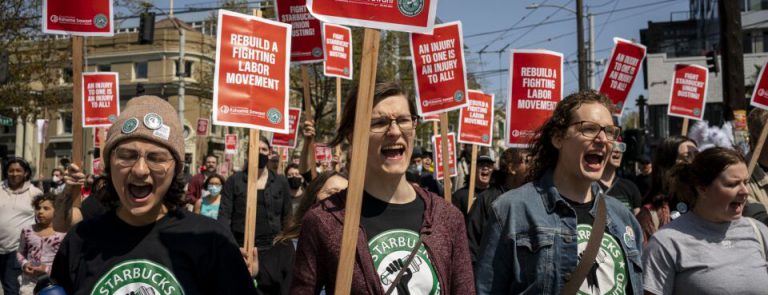
It is disappointing that the Biden Board has, for unarticulated reasons, exhibited reluctance to take advantage of the many opportunities the GC has furnished to dethrone the oppressive Ex-Cell-O regime. Refusing to bargain a first contract subverts the basic vision animating the NLRA and, as Starbucks’ relentless intransigence has recently showcased, can devastate a new union. It is possible the Board’s delay reflects nothing more than a careful effort to craft an 8(a)(5) make-whole remedy in a way likely to survive the judicial hostility it is certain to encounter. And the agency has been occupied with other useful work. Still, the Board must move relatively quickly if it wishes to address this important issue, as its prolabor majority is only guaranteed until next December.







Daily News & Commentary
Start your day with our roundup of the latest labor developments. See all
October 15
New reporting examines the rollback of child labor protections; California tries to block a strike; NLRB charges Wisconsin mental health provider with firing workers during union drive.
October 14
Eleventh Circuit overturns ERISA exhaustion rule; DHS finalizes removal of automatic renewal for work permits; AFGE challenges SSA over flexible scheduling policy.
October 13
Chicago hotel workers remain on strike; a coalition of Democratic states sues the Labor Department over canceled unemployment insurance grants; the Federal Labor Relations Authority establishes a new mediation framework for federal worker disputes.
October 12
Workers at the Obama Foundation begin organizing; MLB submits its latest collective bargaining agreement proposal; Brigham & Women's nurses postpone strike.
October 11
UAW President Shawn Fain succeeds in his reelection bid, and Spanish unions call for a general strike.
October 9
DHS proposes a $100k fee for the foreign grad employment program; Trump suspends tech company access to green card program; and private equity perpetuates poor working conditions for home care workers.