
Fred Messner is a student at Harvard Law School.
With Striketober rolling into Strikesgiving, the Washington Post published an overview of the various ongoing strikes and the forces animating the broader upsurge in labor activism. In total, the Post reports, “[s]ome 17,400 U.S. workers went on strike in October.” And the 119 union strikes launched since January, 15 have been “major” strikes, meaning they involved 1,000 or more workers. That figure nearly doubles the nine major strikes launched last year but still falls below 2019’s 30 major strikes. The Post attributes the strike wave to “new leverage workers hold in the nation’s tight job market.” “Having seen the massive profits their companies collected during the coronavirus pandemic,” the authors explain, “they want their contributions acknowledged in the form of better pay and working conditions.” Or, as President Biden put it yesterday in response to a question about the pace of labor force participation growth, “they’re able to negotiate for higher wages and move from one job to another.”
A ratification vote has been scheduled for Tuesday on the tentative agreement between the UAW and John Deere. As Kevin explained yesterday, the John Deere strike kicked off after workers resoundingly rejected an initial deal that provided for only trivial wage and bonus increases. According to a summary of the new terms released by the union over the weekend, the new agreement would provide 10% raises for this year, nearly double the 5–6% included in the initial offer. Other improvements over the first deal include 5% raises in both 2023 and 2025—a significant improvement over the initial 3% figure—and lump sum bonuses equal to 3% of pre-bonus pay in 2022, 2024, and 2026, a modest bump over the earlier offer’s 2%. John Deere is also offering employees a one-time $8,500 bonus if the deal passes Tuesday’s vote.
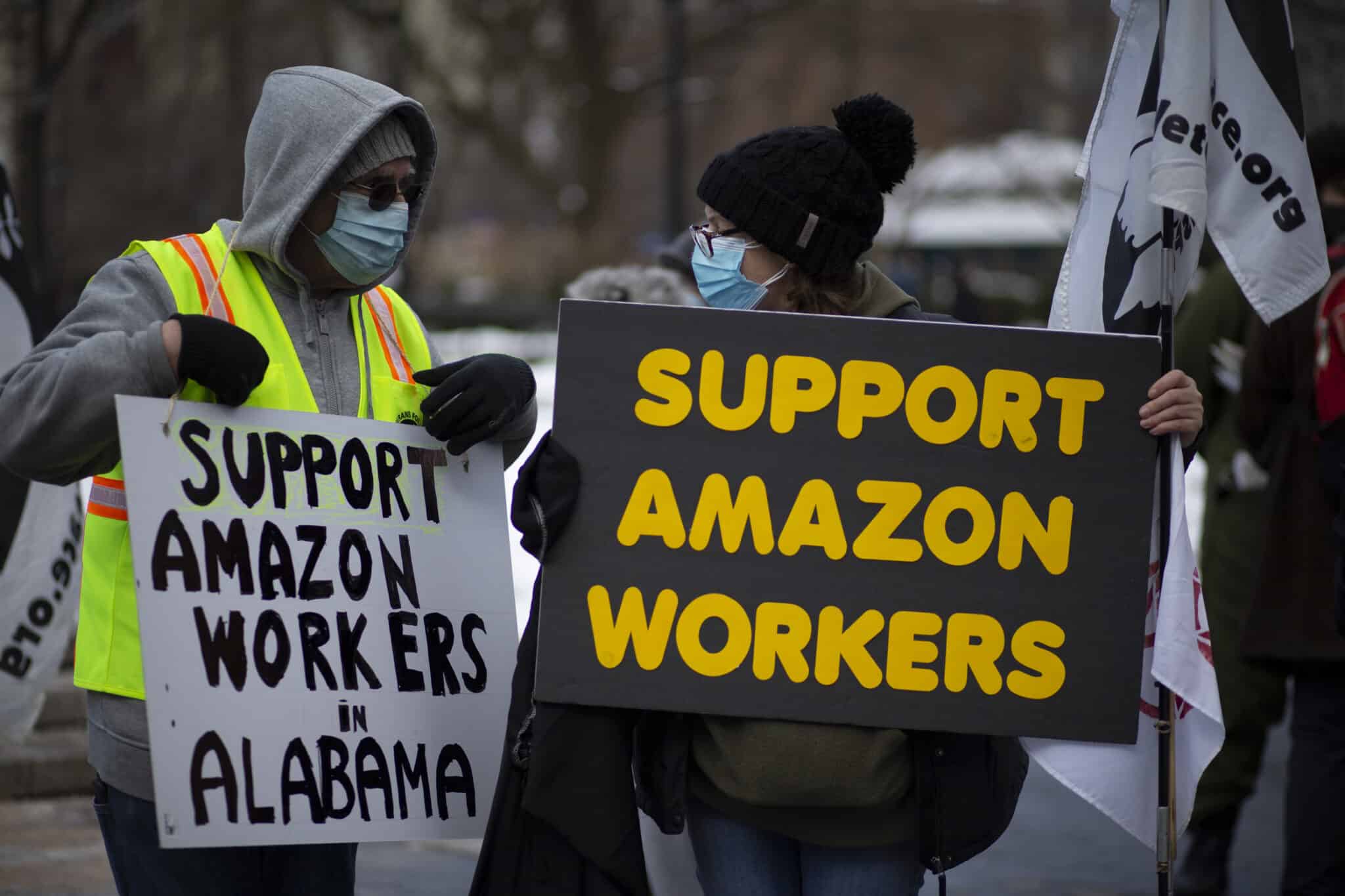
Elsewhere in strikes, workers at seven Amazon warehouses in Germany will walk off the job today in an ongoing dispute over wages and work conditions. Specifically, Amazon has refused to recognize local sectoral bargaining agreements that cover retail and delivery workers. As a union spokesman explained, “It is unacceptable that a multinational corporation worth billions earns itself silly and yet refuses to give its employees the wage increases that other companies pay their colleagues.” In an echo of its rhetoric on this side of the Atlantic, Amazon has defended its German pay scale as an improvement over the local statutory minimum wage, eliding entirely the fact that its workers earn far less than unionized workers in comparable nearby firms.
Finally, in other Amazon news, Vice reported this morning that Amazon’s outsourced “delivery service partners”—the local companies it contracts with to hire drivers for last-mile deliveries—are struggling to attract enough drivers to meet Amazon’s onerous delivery quotas, prompting the retail behemoth to threaten to terminate its relationships with many of them. As Vice explains, “Amazon delivery companies are legally independent from Amazon but if faced with trouble hiring, they can’t simply pay more—they receive a set amount of income from Amazon per delivery route, so they are functionally limited in what they can pay by what they are making from Amazon.” And like in the warehouse context, Amazon has arguably invited its own labor difficulties by setting wages below local benchmarks. As one Minnesota partner noted to Vice, the $20.25 wage Amazon sets for her region has failed to attract enough drivers to meet the company’s route quotas.





Daily News & Commentary
Start your day with our roundup of the latest labor developments. See all
October 16
Department of Labor reduces wage-and-hour enforcement at unionized workplaces; Fain's victory poses question of federal monitor's extension.
October 15
New reporting examines the rollback of child labor protections; California tries to block a strike; NLRB charges Wisconsin mental health provider with firing workers during union drive.
October 14
Eleventh Circuit overturns ERISA exhaustion rule; DHS finalizes removal of automatic renewal for work permits; AFGE challenges SSA over flexible scheduling policy.
October 13
Chicago hotel workers remain on strike; a coalition of Democratic states sues the Labor Department over canceled unemployment insurance grants; the Federal Labor Relations Authority establishes a new mediation framework for federal worker disputes.
October 12
Workers at the Obama Foundation begin organizing; MLB submits its latest collective bargaining agreement proposal; Brigham & Women's nurses postpone strike.
October 11
UAW President Shawn Fain succeeds in his reelection bid, and Spanish unions call for a general strike.