

Yesterday, Senator Patty Murray (D-WA) and Congressman Bobby Scott (D-VA) reintroduced the Child Care for Working Families Act, which dramatically expand access to high-quality child care to low- and middle-income families. The legislation would cap childcare expenses for all families making up to 150 percent of State Median Income, ensuring that no eligible family pays more than seven percent of their income on childcare. The bill would also provide incentives for states to invest in expanded or universal 3-K and Pre-K programs. Childcare costs have skyrocketed in recent years, putting immense stress on parents’ financial security. Today, the vast majority of families with young kids in states from Georgia to Massachusetts to Minnesota pay 10 percent or more (per child!) of their income on childcare. These burdens are especially harsh on parents earning low wages: in some cities, an averaged-price day-care would cost more than the total wages that a minimum-wage worker would make in a year. A massive federal childcare program — like the Child Care for Working Families Act — would thus alleviate a major barrier to work for parents, especially mothers. The Center for American Progress estimates that the bill would create 2.3 million new jobs by helping parents return to work and significantly expanding child care jobs.
On Tuesday, New York lawmakers introduced legislation to decriminalize sex work across the state, in a victory for the growing movement for sex workers’ rights. In an op-ed for the Daily News, State Senators Jessica Ramos and Julia Salazar write that they introduced the bill because “[c]riminalization exposes people to exploitation” and fails to address the economic and social needs that lead many people to trade sex. Enforcement of New York’s anti-sex-work laws is highly racialized: according to the Red Umbrella Project, a sex workers advocacy group, black women make up an estimated 94% of arrests for loitering for the purposes of prostitution in Brooklyn and Queens. Survival sex is also especially common among LGBTQ youth, especially runaway or homeless youth who turn to sex work because their families refuse to support them. To date, no U.S. state has fully decriminalized sex work.
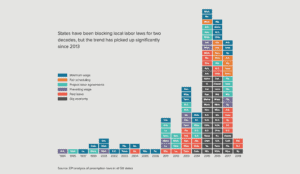
Activists are fighting to repeal a Colorado statute that preempts local wage increases. The law specifies that the state, rather than cities or counties, have the power to set the minimum wage — despite significant differences in the cost of living across the state. The campaign follows high-profile new local laws to raise the minimum wage, guarantee paid leave, and combat on-call scheduling. Colorado’s preemption statute dates back to 1999, but state legislatures’ use of preemption to vacate local ordinances protecting workers’ rights has markedly increased since 2013, according to the Economic Policy Institute. Colorado’s statewide minimum wage is currently set to rise to $12 by 2020.
The Supreme Court declined to hear an appeal from In-N-Out Burger, Inc., who hoped to argue that it could bar workers from wearing Fight for $15 buttons. Last year, the Fifth Circuit ruled that the burger chain violated the National Labor Relations Act when it told restaurant workers to remove their buttons. In-N-Out argued that its “no pins or stickers” rule was necessary to protect its “public image,” but the NLRB ruled that it was nonetheless a labor law violation to ask workers not to wear buttons about workplace conditions.
Today is the fifth day of the Oakland teacher strike. According to Oakland Unified School District officials, only six percent of students are attending school during the strike. At New York Magazine, Sarah Jones explains how rising inequality forced teachers out of the Bay Area, leading many to strike in the hopes of sharing a “community with the students [they] serve.”





Daily News & Commentary
Start your day with our roundup of the latest labor developments. See all
October 15
New reporting examines the rollback of child labor protections; California tries to block a strike; NLRB charges Wisconsin mental health provider with firing workers during union drive.
October 14
Eleventh Circuit overturns ERISA exhaustion rule; DHS finalizes removal of automatic renewal for work permits; AFGE challenges SSA over flexible scheduling policy.
October 13
Chicago hotel workers remain on strike; a coalition of Democratic states sues the Labor Department over canceled unemployment insurance grants; the Federal Labor Relations Authority establishes a new mediation framework for federal worker disputes.
October 12
Workers at the Obama Foundation begin organizing; MLB submits its latest collective bargaining agreement proposal; Brigham & Women's nurses postpone strike.
October 11
UAW President Shawn Fain succeeds in his reelection bid, and Spanish unions call for a general strike.
October 9
DHS proposes a $100k fee for the foreign grad employment program; Trump suspends tech company access to green card program; and private equity perpetuates poor working conditions for home care workers.