
Gurtaran Johal is a student at Harvard Law School.
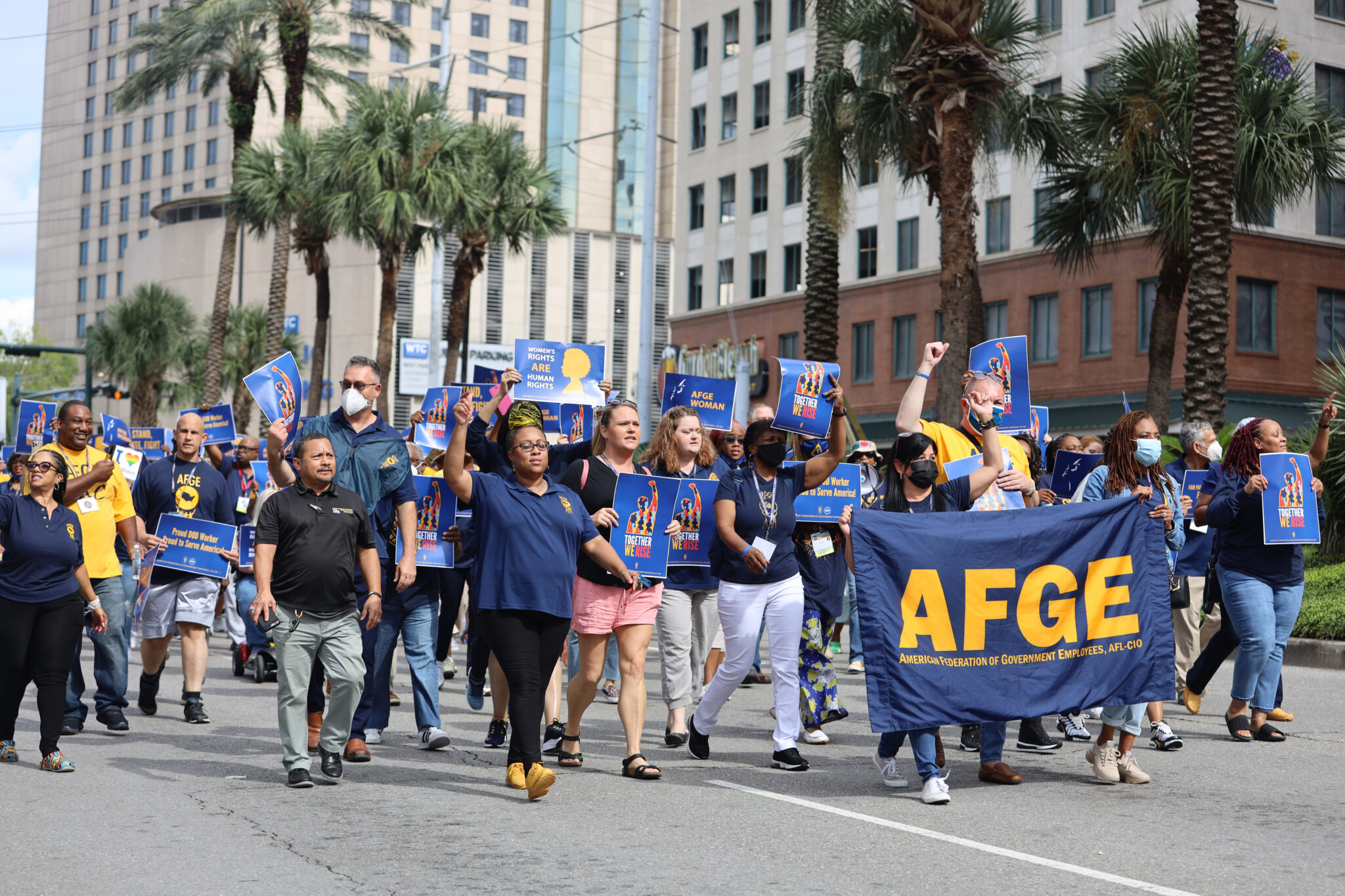
In today’s news and commentary, a federal judge from the Northern District of California denies a motion by the Trump Administration to dismiss a lawsuit led by the American Federation of Government Employees against President Trump for his mass layoffs of federal workers; the Supreme Court grants a stay on a federal district court order that originally barred Immigration and Customs Enforcement (ICE) agents from questioning and detaining individuals based on their presence at a particular location, the type of work they do, their race or ethnicity, and their accent while speaking English or Spanish; and a hospital seeks to limit the Occupational Safety and Health Administration’s (OSHA) ability to cite employers for failing to halt workplace violence without a specific regulation in place.
Bloomberg Law reports that Judge Susan Illston of the U.S. District Court for the Northern District of California denied the Trump Administration’s motion to dismiss a complaint that the American Federation of Government Employees filed, which claimed that the administration’s Executive Order 14210, which focuses on reducing and reorganizing the federal workforce, “usurps” Congressional authority, violates the Administrative Procedure Act (APA), and is arbitrary and capricious. Judge Illston held that although the plaintiffs’ claims against the Department of Government Efficiency (DOGE) are sufficient to survive a motion to dismiss, the plaintiffs must adequately identify the exact DOGE service if the claims are to move forward. Illston also reaffirmed that the court has jurisdiction over the claims.
Meanwhile, in Noem v. Vasquez Perdomo, the Supreme Court granted a stay temporarily halting a decision in the U.S. District Court for the Central District of California that barred ICE agents from detaining people based on their presence at a particular location, their occupation, their race or ethnicity, and their accent while speaking English or Spanish. In his concurrence, Justice Brett Kavanaugh noted that while “apparent ethnicity alone cannot furnish reasonable suspicion,” it “can be a ‘relevant factor’ when considered with other salient factors.” Justice Sotomayor, along with Justice Kagan and Justice Jackson, dissented, writing, “We should not have to live in a country where the Government can seize anyone who looks Latino, speaks Spanish, and appears to work a low wage job.” This decision, although not setting a nationwide precedent, will have significant effects on personal freedoms and immigration-related measures taken in the United States. Members of the Trump administration quickly hailed the decision as a major victory for the “safety and security of the American people.”
Lastly, Cedar Springs Hospital Inc., a behavioral health center in Colorado Springs, Colorado, is seeking to limit OSHA’s ability to cite employers for failing to halt workplace violence absent an explicitly outlined regulation. OSHA conducted an investigation on Cedar Springs Hospital and found that although its staff experienced physical assaults by patients, the hospital failed to provide worker violence protection. The U.S. Court of Appeals for the Tenth Circuit will question whether the Occupational Safety and Health (OSH) Act grants OSHA this broad authority to cite employers for failing to meet safety measures without an explicit regulation.





Daily News & Commentary
Start your day with our roundup of the latest labor developments. See all
October 19
FDA reverses course on policy prohibiting off-duty union activity; FAA and NATCA reach deal to secure pay increase for air traffic controllers.
October 18
Federal judge again halts cancellation of the Bureau of Prisons’ CBA; tabletop gaming workers face roadblocks in union recognition.
October 16
Department of Labor reduces wage-and-hour enforcement at unionized workplaces; Fain's victory poses question of federal monitor's extension.
October 15
New reporting examines the rollback of child labor protections; California tries to block a strike; NLRB charges Wisconsin mental health provider with firing workers during union drive.
October 14
Eleventh Circuit overturns ERISA exhaustion rule; DHS finalizes removal of automatic renewal for work permits; AFGE challenges SSA over flexible scheduling policy.
October 13
Chicago hotel workers remain on strike; a coalition of Democratic states sues the Labor Department over canceled unemployment insurance grants; the Federal Labor Relations Authority establishes a new mediation framework for federal worker disputes.