
Ajayan Williamson is a student at Harvard Law School.
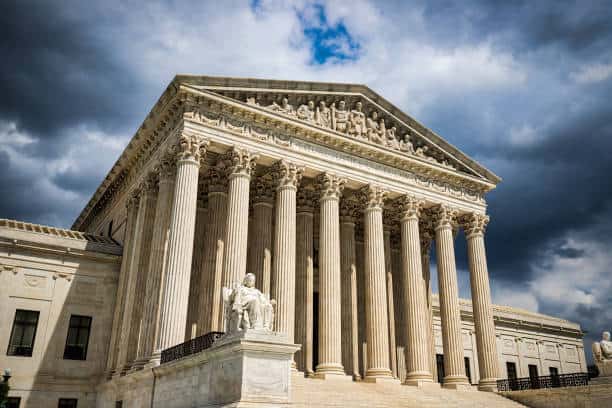
In today’s news and commentary, the Supreme Court kicks off its latest term, declining to take a number of labor and employment cases while granting certiorari in others that could have wide-ranging consequences.
Yesterday, the Supreme Court’s latest term began, and the Court declined to grant certiorari in several cases with labor and employment implications. It declined certiorari in Cestaro v. Rodriguez, a case where an administrative judge for the New York State Workers Compensation Board was denied a promotion after an off-duty altercation that was posted on Tik Tok; for now, the Court will pass on this opportunity to take a look at the scope of First Amendment rights for public employees. The Court also declined certiorari in Hood River Distillers v. NLRB, a case where the NLRB found that an employer had violated the NLRA by making unilateral changes during bargaining. The petition had presented questions both about substantive law — whether the employer’s actions were justified by alleged union delay tactics — as well as the appropriate standard of review when evaluating NLRB decisions. Finally, the Court also declined certiorari in Wessels Wells v. Texas Tech University, a sex discrimination suit by a student “program mentor” at Texas Tech. The Fifth Circuit held that the petitioner was not an employee for the purposes of Title VII, applying the “threshold-remuneration” test that has been adopted by several circuits; by denying cert, the Court declined to weigh in on the circuit split over the appropriate test to apply.
However, the Court has granted certiorari in several cases with potentially significant implications for labor and employment. Today, the Court is hearing oral argument in Chiles v. Salazar, a First Amendment challenge to professional licensing requirements in Colorado that restrict conversion therapy. Later this term, the Court will also take up the issue of removal protections for independent agencies — though the Court denied certiorari before judgment in Gwynne Wilcox’s suit over her removal from the NLRB, it granted certiorari in Trump v. Slaughter, presenting the same question in the context of the FTC. The Court’s ruling there will impact the NLRB, the Merit Systems Protection Board, and other independent agencies across the federal government. Similarly, the Court’s decisions in Little v. Hecox and West Virginia Board of Education v. B.P.J. could clarify the Equal Protection Clause’s protections for transgender workers in other cases. Finally, the Court will also take up a forced labor claim by a class of detainees against an ICE contractor; and an ERISA case about multiemployer pension plans. Given the explosive growth of the Court’s emergency docket, it’s also possible that more cases are still to come.





Daily News & Commentary
Start your day with our roundup of the latest labor developments. See all
October 18
Federal judge again halts cancellation of the Bureau of Prisons’ CBA; tabletop gaming workers face roadblocks in union recognition.
October 16
Department of Labor reduces wage-and-hour enforcement at unionized workplaces; Fain's victory poses question of federal monitor's extension.
October 15
New reporting examines the rollback of child labor protections; California tries to block a strike; NLRB charges Wisconsin mental health provider with firing workers during union drive.
October 14
Eleventh Circuit overturns ERISA exhaustion rule; DHS finalizes removal of automatic renewal for work permits; AFGE challenges SSA over flexible scheduling policy.
October 13
Chicago hotel workers remain on strike; a coalition of Democratic states sues the Labor Department over canceled unemployment insurance grants; the Federal Labor Relations Authority establishes a new mediation framework for federal worker disputes.
October 12
Workers at the Obama Foundation begin organizing; MLB submits its latest collective bargaining agreement proposal; Brigham & Women's nurses postpone strike.