
Otto Barenberg is a student at Harvard Law School and the former Digital Director of OnLabor.
In today’s news and commentary, 1199SEIU’s presidential campaign heats up, the Supreme Court lowers the bar for employer overtime exceptions, and an end-of-year report shows the EEOC recovered $700 million in 2024.
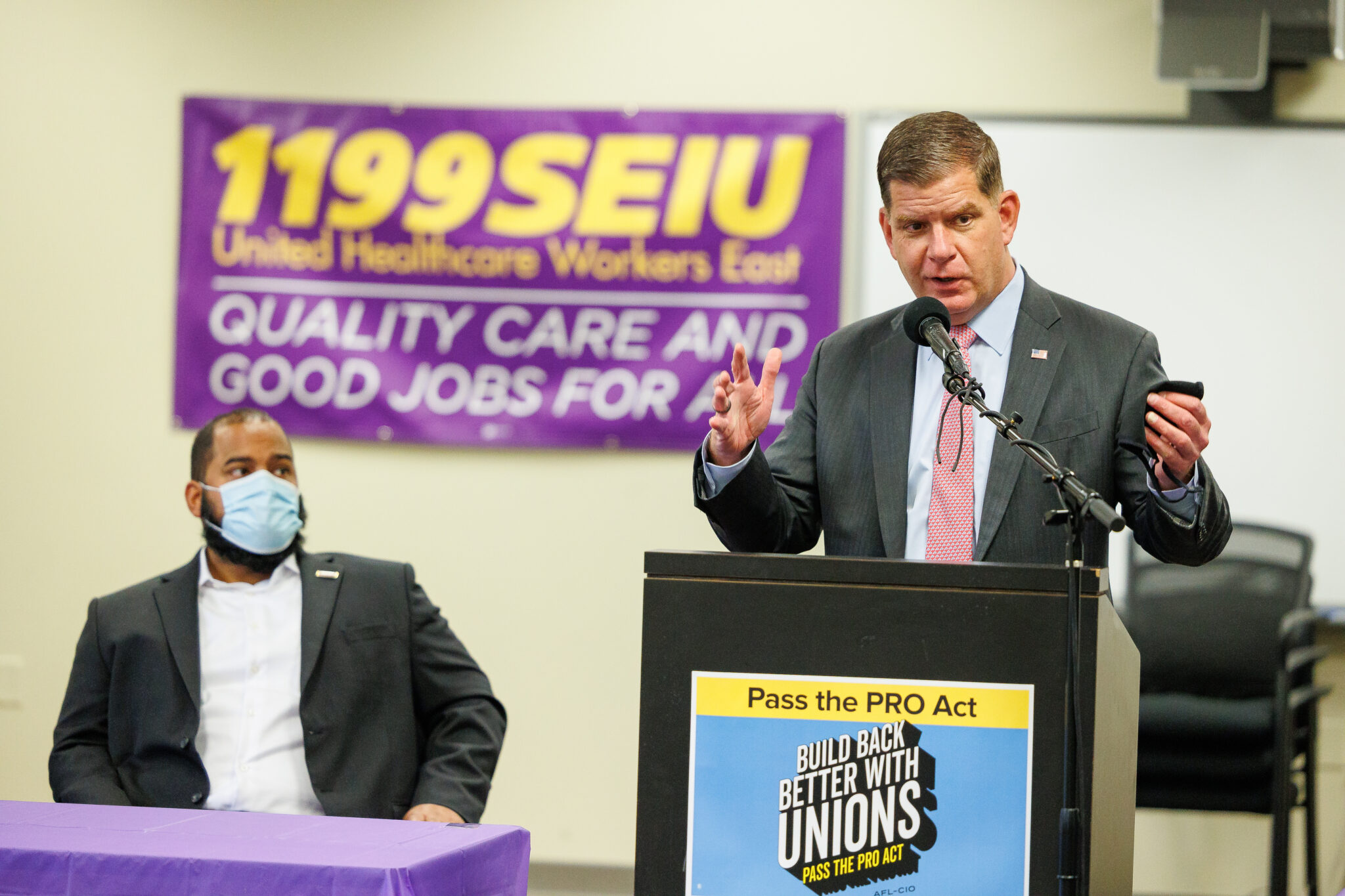
For the first time in decades, a competitive opposition slate is taking on 1199SEIU’s incumbent President. Threatened Medicaid cuts and mass deportations are animating the insurgent movement at the 400,000-strong healthcare workers union, with many disaffected members arguing George Gresham, the longtime President who has reneged on promises to step down, isn’t equipped to handle the looming political challenges. The Members First Unity Slate comprises hundreds of leaders across the union, including much of Gresham’s own executive team. It’s spearheaded by two 1199SEIU senior executive vice presidents: Yvonne Armstrong, vying for Gresham’s position, and Veronica Turner-Biggs, running for Secretary Treasurer. “We believe that our Union is punching below our weight class,” the slate’s website states. “The absence of a real shared decision-making process has silenced fresh ideas, alternative viewpoints, and new voices. This has led to divisiveness, and limited our power.” The opposition campaign marks a major shift for an organization that has long prioritized internal unity. One anonymous organizer told Politico the internal election could “rip the union in half;” Gresham’s support hasn’t entirely collapsed, and he retains an incumbency advantage. “I believe that an overwhelming number of 1199 members want to stay the course with experienced leadership, given the major accomplishments of my current term as president,” he said in an interview.
Last week, the Supreme Court ruled that the lenient “preponderance of the evidence” standard applies to employers seeking exemptions from the Fair Labor Standards Act’s minimum wage and overtime provisions. The unanimous decision, authored by Justice Kavanaugh, rejected the Fourth Circuit’s heightened “clear and convincing evidence” standard — an outlier among circuit courts. In “level[ing] the playing field,” the decision may embolden employers to classify “gray-area” positions as exempt from the FLSA’s requirements. But some employee advocates don’t expect substantial changes. One worker-side attorney told Bloomberg Law that the decision “will have no impact on workers’ litigation methods in FLSA cases given that employers still have the burden to prove their exemption defense as they always have.”
The EEOC’s annual performance report showed the agency collected $700 million on behalf of 21,000 workplace discrimination victims in 2024, a 5% increase over the year prior. Per EEOC Chair Charlotte Burrows, “the agency demonstrated that the EEOC’s work yields a high return on investment for the American people, recovering substantially more in monetary benefits for victims of discrimination than our $455 million budget.” Of particular note were the Commission’s efforts to tackle cases of systemic discrimination; the EEOC resolved 16 cases on behalf of over 4,000 victims, double 2023’s number.





Daily News & Commentary
Start your day with our roundup of the latest labor developments. See all
October 14
Eleventh Circuit overturns ERISA exhaustion rule; DHS finalizes removal of automatic renewal for work permits; AFGE challenges SSA over flexible scheduling policy.
October 13
Chicago hotel workers remain on strike; a coalition of Democratic states sues the Labor Department over canceled unemployment insurance grants; the Federal Labor Relations Authority establishes a new mediation framework for federal worker disputes.
October 12
Workers at the Obama Foundation begin organizing; MLB submits its latest collective bargaining agreement proposal; Brigham & Women's nurses postpone strike.
October 11
UAW President Shawn Fain succeeds in his reelection bid, and Spanish unions call for a general strike.
October 9
DHS proposes a $100k fee for the foreign grad employment program; Trump suspends tech company access to green card program; and private equity perpetuates poor working conditions for home care workers.
October 8
NLRB judge finds UPS unlawfully restricted union insignia; Harvard graduate workers authorize second strike; OSHA orders Union Pacific to pay $300,000 in damages in whistleblower case.