
Maya Levkovitz is a student at Harvard Law School.
In today’s News and Commentary, Boston nurses announce plans for an open-ended strike; a federal judge restored the union protections of federal prison workers, and St. Louis workers form the first movie theater union in Missouri.
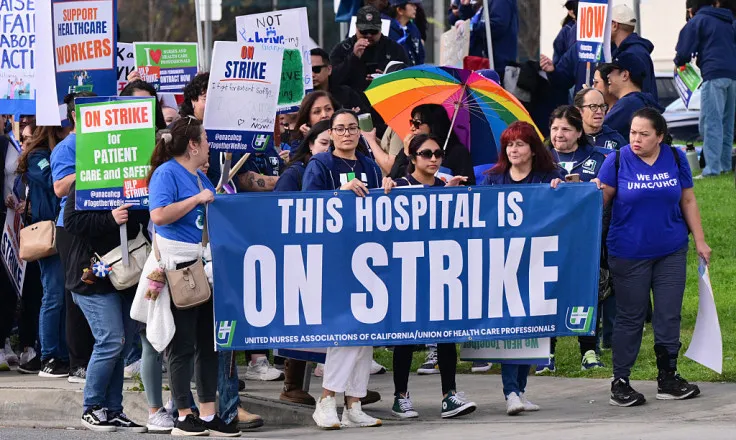
On Friday, nurses at Brigham & Women’s Hospital in Boston announced their plans to strike starting October 14. In contrast to the one-day walkout held on July 8 and the subsequent four-day lockout, the work stoppage by over 4,000 members of the Massachusetts Nurses Association (MNA) will be open-ended. Just one week after almost 3,000 MNA nurses voted in favor of authorizing an indefinite strike, the union announced that the strike will proceed if Mass General Brigham (MGB), the hospital’s parent company, fails to meet the workers’ demands for across-the-board wage increases and reduced health insurance costs. Beyond the impasse reached after 25 bargaining sessions, the nurses also accused MGB of committing several unfair labor practices during the negotiations. Should the strike proceed as scheduled, it will be the “largest open-ended nurse strike in Massachusetts history.”
Also this week, a federal judge ordered the restoration of union protections for the more than 30,000 workers of the Federal Bureau of Prisons. Judge Vernon Oliver of the District of Connecticut granted the National Council of Prison Locals’ motion for a preliminary injunction against the Bureau of Prisons after Director William Marshall terminated its employees’ CBA in September 2025. The Bureau of Prisons’ action followed President Trump’s March 2025 Executive Order restricting federal national security and intelligence offices from maintaining collective bargaining agreements with their employees. Judge Oliver explained that the Bureau of Prisons’ justifications for terminating the CBA were contradictory, meaning that the Bureau’s argument that it was simply complying with the Executive Order was impermissibly pretextual. While this decision will directly affect workers at the 122 Bureau of Prisons facilities across the country, it has already influenced the legal response of AFGE workers to the executive branch’s efforts to reduce public union protections in other areas of federal government work. Just days after Judge Oliver’s order, union employees at the EPA sued to block the termination of their own labor protections, citing the agency’s failure to provide an explanation as grounds to overturn the EPA’s decision.
Finally, Alamo Drafthouse movie theater workers in St. Louis voted to unionize this week, forming what employees say is “the first modern-era movie theater union in Missouri.” Inspired primarily by the introduction of an online ordering system, workers began their unionization campaign six months ago and won the vote 47 to 28. After the online ordering system dramatically reduced workers’ hours and tips, movie theater employees reached out to the UAW for support organizing a union. The bargaining unit encompasses a wide variety of movie theater staff, such as “cooks, dishwashers, food runners, ticket desk workers, bar staff and greeters.” In addition to their online ordering system concerns, workers hope to gain more transparency and a direct line to voice their opinions to management about the conditions at their workplace.


Daily News & Commentary
Start your day with our roundup of the latest labor developments. See all
October 5
Delaware bans captive audience meetings; EEOC settles remote work national origin discrimination claim; First Circuit stays enforcement order in VA's dispute with AFGE.
October 4
Boston nurses announce open-ended strike; federal judge restores federal prison workers' union protections; St. Louis workers form the first movie theater union in Missouri.
October 2
Gov. Newsom signs bill regulating AI in workplace; federal judge blocks Trump's $100,000 H-1B visa fee.
October 1
Senate confirms Keith Sonderling as Labor Secretary; Amazon warehouse workers launch an unfair labor practice strike.
September 30
Harvard grad union wins in First Circuit; AI data trainers initiate misclassification suits; Trader Joe’s found liable under ERISA.
September 29
Unions, AI companies, and private equity firms form a new coalition to shape data center policies; unions express support for the Paramount-Warner Bros. merger.