
Elias Decker is a student at Harvard Law School.
In today’s news and commentary, Starbucks prevails against claims it denied shifts to union workers and Center for State Labor Innovation aims to address labor law shortcomings.
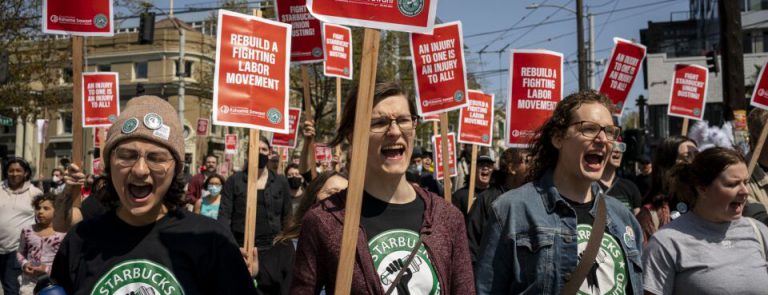
Also on Wednesday, August 5th, Starbucks — once again — prevailed at the Republican-controlled NLRB, this time over allegations that it had prevented unionized workers from picking up shifts at non-union stores. In 2023, an Administrative Law Judge and found that a Starbucks manager had been instructed by higher-ups that “unionized and nonunionized stores could not borrow from one another.” (Here, “borrowing” means a worker from one store picks up hours at another nearby store in order to increase their hours, since Starbucks rarely schedules workers for 40 hours a week.) The Administrative Law Judge held that this impermissibly limited and restrained workers’ right to organize. In overturning this lower decision, the NLRB relied heavily on the actual interaction that brought this case to the Board. In this interaction, a unionized worker reached out to a supervisor of a non-union store after hearing rumors about this limit on “borrowing.” The manager confirmed the rumors, but equivocated, saying “I said that’s what I heard/read at a union seminar but that doesn’t mean I truly know.” The manager also said “You are always welcome at [my store].” The NLRB’s sole Democratic member dissented, saying “I do not assign [the manager]’s lack of certainty and her assurances about borrowing at the Green Lake store the same weight that my colleagues do.”
On Wednesday, a group of labor leaders, academics, advocates, and practitioners announced the formation of the Center for State Labor Innovation (“CSLI”). The organization simultaneously launched its publication on Substack: Labor Innovation. The project identifies the ways that existing labor law has failed workers and seeks to remedy these failures by two main means: state-level innovation and sector-level worker power. It envisions state-led action via what it calls Workforce Standards Councils. These Councils would be “state-created and state-supervised public bodies that bring workers, employers, and regulators together to establish baseline standards for particular industries or occupations.” Their scope would extend to “give workers a consequential role in decisions about wages, benefits, scheduling, training, health and safety, and enforcement.” Labor Innovation‘s first article adds that Workforce Standards Councils are not a panacea but “just one policy idea” and that the group will “seek and welcome others,” publishing “deliberation, not polemics.”



Daily News & Commentary
Start your day with our roundup of the latest labor developments. See all
September 22
Judge blocks ICE raids in Alabama; Chicago hotel workers vote to strike; AutoZone workers look to create first union
September 21
In today’s News and Commentary, the Seventh Circuit raises the bar for the NLRB to obtain preliminary injunctions, the California Primary Care Association sues SEIU-UHW for racketeering, and the Seventh Circuit finds that an employer group and think tank do not have standing to challenge an Illinois law banning captive audience meetings. On Friday, the […]
September 20
Culinary Workers Union members protests union leadership; lawsuit against OpenAI and Microsoft reveal internal concerns about the threat of AI training to human labor.
September 17
Unions push to block Google from buying Spirit Airlines employment records; U.S. Department of Labor sues Oklahoma coffee chain over alleged wage violations.
September 16
Trump nominates Catherine Eschbach as EEOC general counsel; NLRB declines to resolve union work-assignment dispute; Allina Health physicians begin four-day strike.
September 15
Documents reveal the inner workings of Amazon's union avoidance program; Washington state public sector unions reach tentative deals amid a difficult bargaining cycle; hundreds of Nevada Culinary Union members protest their union's health care changes.