
Sophia is a student at Harvard Law School and a member of the Labor and Employment Lab.
In today’s news and commentary, HGSU wraps up its third week on strike and economists find that firms tend to target workers with “wage premiums” for AI replacement.
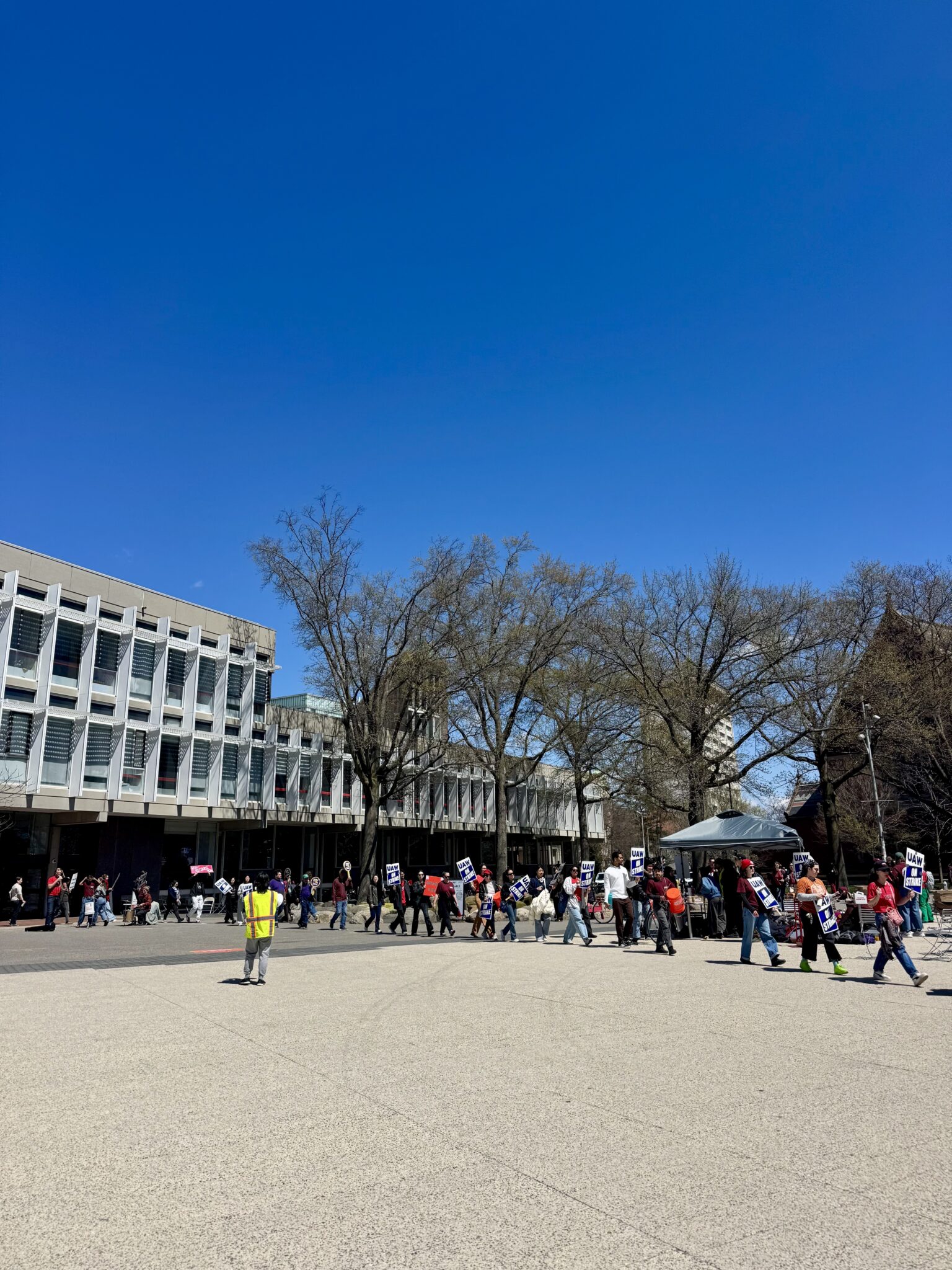
Today, the Harvard Graduate Students Union (HGSU) wraps up 18 days (and counting) of striking. In addition to high visibility pickets at Harvard’s Science Center Plaza and Longwood Campus, striking workers have engaged in numerous delivery pickets across campus, resulting in over 150 deliveries turned away. Additionally, HGSU is set to hold a Faculty Town Hall this Monday to address questions faculty may have surrounding the finals and grading period amidst the strike. The most recent bargaining session between HGSU and the University took place on April 28 and the next one is set for May 14, despite numerous requests by the union for earlier bargaining dates. Noting that “a strike through finals is now a real possibility,” HGSU has made several requests of faculty:
- Do not grade assignments or submit grades for classes that HGSU instructors and graders are usually responsible for.
- Do not conduct sections, labs, or office hours normally taught by striking workers, and do not hire replacements.
- Do not compile or share any lists of strikers.
- Urge administrators to come to the bargaining table more frequently.
- Be transparent with undergraduates about why grading is delayed.
In a paper published this month in The Quarterly Journal of Economics, MIT Professor Daron Acemoglu and Yale Professor Pascual Restrepo write that automation accounts for 52 percent of the growth in income inequality from 1980 to 2016. 10 of these percentage points arise directly from companies implementing automation to replace workers receiving a “wage premium,” which is defined as the higher compensation a worker earns compared to similarly situated workers in their industry. The study found that within groups of employees affected by automation, the largest effects were felt by workers in the 70th to 95th percentile of the salary range. This factor alone contributes to one-fifth of the total growth in income inequality.



Daily News & Commentary
Start your day with our roundup of the latest labor developments. See all
October 9
DHS proposes a $100k fee for the foreign grad employment program; Trump suspends tech company access to green card program; and private equity perpetuates poor working conditions for home care workers.
October 8
NLRB judge finds UPS unlawfully restricted union insignia; Harvard graduate workers authorize second strike; OSHA orders Union Pacific to pay $300,000 in damages in whistleblower case.
October 7
DOL scraps plan to remove decades-old wage-and-hour guidance from federal regulations; New York enacts personnel records access law; Starbucks loses bid to dismiss Workers United trademark suit.
October 6
Protect College Sports Act dampens athlete unionization outlook; Stanford RA union decides to withdraw petition
October 5
Delaware bans captive audience meetings; EEOC settles remote work national origin discrimination claim; First Circuit stays enforcement order in VA's dispute with AFGE.
October 4
Boston nurses announce open-ended strike; federal judge restores federal prison workers' union protections; St. Louis workers form the first movie theater union in Missouri.