
Swap Agrawal is a student at Harvard Law School.
In this weekend’s news and commentary, Amazon announced a new policy on building access that organizers say will hamper unionization drives; a labor contract covering 22,000 West Coast port workers expired; and Atlantic City’s largest casino workers’ union announced a tentative agreement with four casino resorts, averting a strike of over 4,500 employees.
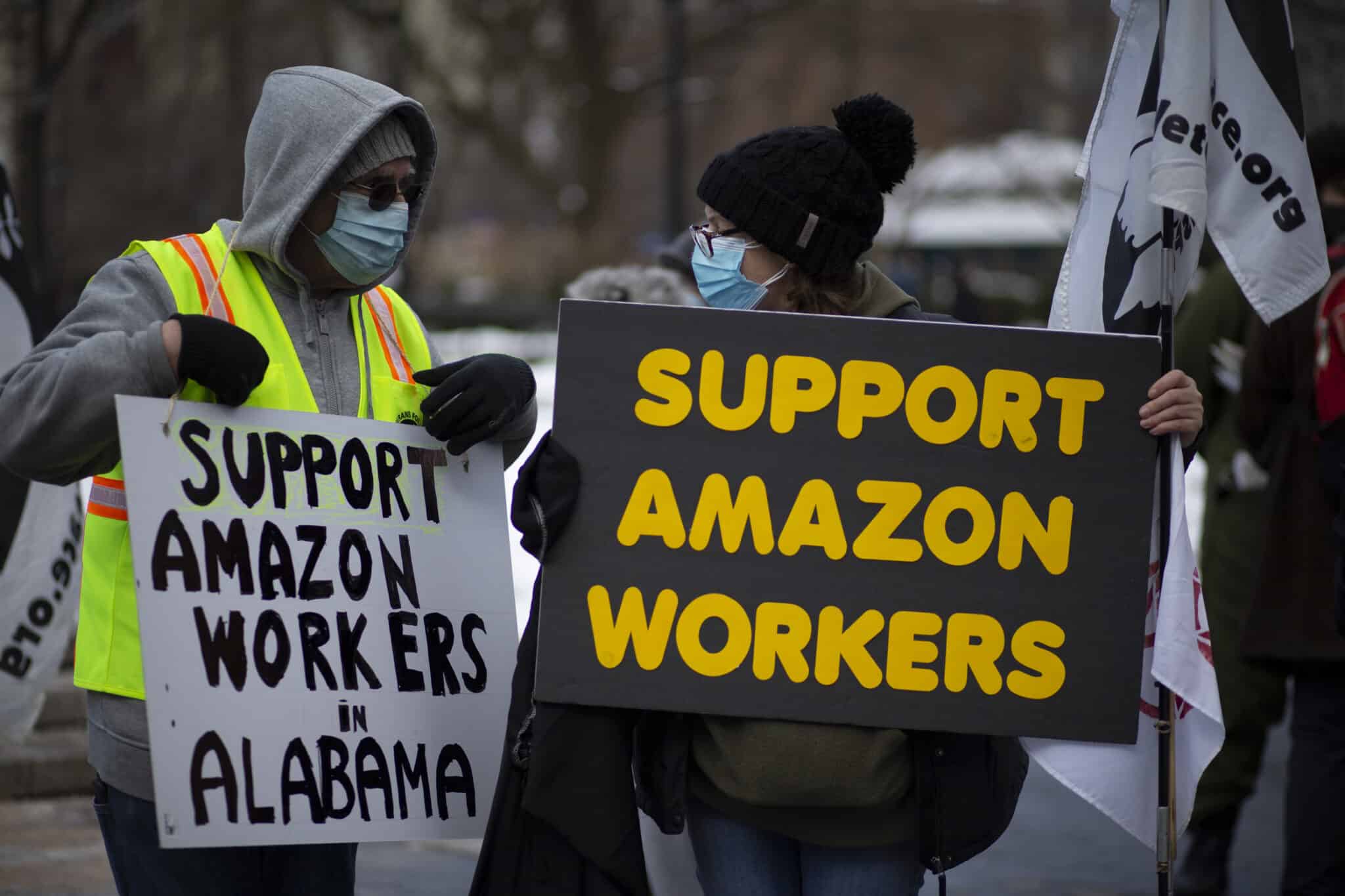
On June 30, Amazon announced a new policy preventing off-duty warehouse workers from accessing the company’s facilities. Specifically, workers can no longer access buildings or other working areas on their scheduled days off, before their shifts, or after their shifts. Organizers at Amazon say that the policy, which was shared with workers on Amazon’s internal app, is aimed at hampering unionization drives. “On our days off, we come to work and we engage our co-workers in the break rooms,” said Rev. Ryan Brown, an Amazon worker who is aiming to organize the company’s warehouse in Garner, North Carolina. “This was a direct response to that, to try to stop organizing by any means necessary,” Brown said. Angelika Maldonado, the chair of Amazon Labor Union’s Workers Committee, has also said that in order to organize the JFK8 warehouse, “[she] tried to be in the building as long as [she] could,” including “coming in on [her] days off.” Amazon spokesperson Kelly Nantel said that the new policy was motivated by safety concerns and stressed that it does not prevent off-duty employees from engaging their co-workers in “non-working areas” outside the company’s buildings.
On July 1, a labor agreement covering 22,000 port workers on the West Coast expired, adding pressure to high stake talks between employer group Pacific Maritime Association (PMA) and the International Longshore and Warehouse Union (ILWU). Last November, the ILWU declined an offer to extend the contract until July 2023. The current pact was originally set to end in 2019, but was lengthened after roughly two-thirds of union members voted to do so in exchange for higher wages and pensions. When the contract expired, so did its “no strike” clause, but PMA and ILWU said in a joint statement that normal operations will continue at the ports until an agreement can be reached. The union has significant bargaining leverage, as major ports in Los Angeles and Long Beach are still struggling with the supply chain impacts of the pandemic during busy summer months. Moreover, port disruptions would add to inflationary pressures that have hurt President Biden’s approval ratings ahead of critical midterm elections. The White House had been helping mediate talks, but if negotiations fail, Biden could rely on the Taft-Hartley Act to enforce an 80-day “cooling-off period.”
On June 30, UNITE HERE Local 54, Atlantic City’s largest casino workers’ union, announced that it reached a tentative agreement with four casino resorts covering 4,500 employees ahead of a July 1 strike deadline. Last month, UNITE HERE members had voted 96% yes on a proposal to authorize a strike at these casinos. “Over the years, casino workers have sacrificed wage increases for the health of the industry,” UNITE HERE said in a June 14 statement about the contract negotiations. “Workers have persevered through casino closures, Hurricane Sandy and a global pandemic. Now, they’re falling behind. As industry’s profits and gaming revenues surpass pre-pandemic levels, wages for Atlantic City’s casino workers have not kept pace.” The union also released a report earlier this year on the struggles casino workers are facing and the need for a raise. The union’s worker negotiating committees at MGM-owned Borgata, Caesars, Harrah’s, and Tropicana casinos approved the agreements and will soon set a date for a ratification vote from the entire membership. However, a July 3 strike deadline remains in effect for Hard Rock Casino.





Daily News & Commentary
Start your day with our roundup of the latest labor developments. See all
October 16
Department of Labor reduces wage-and-hour enforcement at unionized workplaces; Fain's victory poses question of federal monitor's extension.
October 15
New reporting examines the rollback of child labor protections; California tries to block a strike; NLRB charges Wisconsin mental health provider with firing workers during union drive.
October 14
Eleventh Circuit overturns ERISA exhaustion rule; DHS finalizes removal of automatic renewal for work permits; AFGE challenges SSA over flexible scheduling policy.
October 13
Chicago hotel workers remain on strike; a coalition of Democratic states sues the Labor Department over canceled unemployment insurance grants; the Federal Labor Relations Authority establishes a new mediation framework for federal worker disputes.
October 12
Workers at the Obama Foundation begin organizing; MLB submits its latest collective bargaining agreement proposal; Brigham & Women's nurses postpone strike.
October 11
UAW President Shawn Fain succeeds in his reelection bid, and Spanish unions call for a general strike.