

Alisha Jarwala is a student at Harvard Law School and a member of the Labor and Employment Lab.
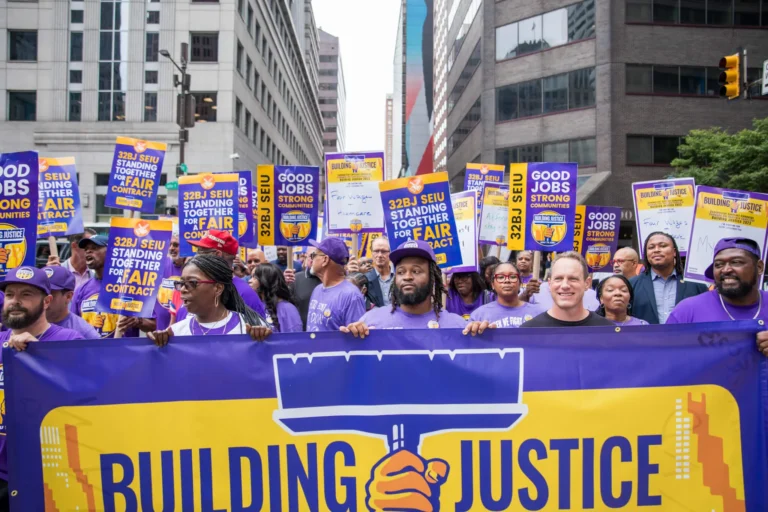
The Stop & Shop strike continues, with over 31,000 workers off the job to protest attempted cuts to their pay and benefits. Workers were visited yesterday by former Vice President Joe Biden, who offered support. “I know you’re used to hearing political speeches, and I’m a politician. I get it,” said Biden, according to NPR. “But this is way beyond that, guys. This is way beyond that. This is wrong. This is morally wrong, what’s going on around this country.” NPR notes that Biden’s message was very similar to Sen. Elizabeth Warren’s comments to workers last Friday, but Warren brought Dunkin’ Donuts. Also supporting the workers: a number of rabbis in Massachusetts, Connecticut, and Rhode Island, who have advised their congregations not to cross picket lines to buy food for Passover. “The food that you’re buying is the product of oppressed labor and that’s not kosher,” said Rabbi Barbara Penzner, of Temple Hillel B’nai Torah, a synagogue in Boston. (See additional OnLabor coverage of the Stop & Shop strike here.)
A new study from Georgetown University’s Kalmanovitz Initiative for Labor and the Working Poor found that Uber drivers in Washington, D.C. struggle to understand their actual pay. All of the drivers surveyed “experienced difficulties with, or barriers to, calculating their actual compensation.” In addition, 33 percent of drivers surveyed took on debt as a result of their work on the ride-hailing platform, and 30 percent reported physical assaults or safety concerns.
The faculty union at Rutgers University announced earlier this week that it reached a tentative agreement on a new contract, averting what would have been the first professor strike in the school’s nearly 253 -year history. According to a statement from Rutgers AAUP-AFT president Deepa Kumar, the union won “equal pay for equal work for female faculty, faculty of color and for faculty in the Newark and Camden campuses . . . [and] significant pay raises for [the union’s] lowest paid members, . . . graduate employees who will see their pay increase from $25,969 to $30,162 over the course of the contract.”
Colorado might be close to letting state employees collectively bargain. Colorado House Bill 19-1273 would solidify the right of state employees to form unions and outlines a process for negotiating contracts over wages, benefits and work conditions. If it passes, 26,500 workers would gain collective bargaining rights. Colorado Public Radio reports that the bill seems likely to make it through the Democrat-controlled legislature, but may face obstacles from the governor’s office, which has noted concerns about impact on the state budget.
Finally, The Atlantic reports that Instagram memers—the content creators that keep Instagram growing— have banded together to create an informal union. Here’s what Paul Praindo, a representative of the organizing committee, told The Atlantic: “People are doing a lot of work, doing it for free or little compensation . . . [a]ll these people are bringing revenue to Instagram, producing this major profit margin for this company, and they’re subject to really little job security.” The union’s demands include a “transparent appeals process for account bans; a direct line of support with Instagram, or a dedicated liaison to the meme community; and a better way to ensure that original content isn’t monetized by someone else.” Check out their Instagram, @unionizedmemes.


Daily News & Commentary
Start your day with our roundup of the latest labor developments. See all
September 8
In today’s News and Commentary, workers and unions across America celebrate Labor Day, California’s SEIU Local 1000 prepares for a strike authorization vote, and New York City creates the Office of Worker Power. On Monday, labor unions and workers gathered in cities across the United States in celebration of Labor Day. Parades and rallies took […]
September 7
Eighth Circuit finds DOL order violates Seventh Amendment; 1,300 workers at Encore Boston Harbor go on strike.
September 6
Encore casino workers strike; President Trump commutes sentence of former Philadelphia IBEW leader; Durham labor activist ends his hunger strike against Amazon.
September 4
NLRB advice memo narrows political protest protections; NLRB asks federal appeals court for deference.
September 3
Seond Circuit rejects a NLRB standard for union insignia in employer dress codes; House Republicans ramp up labor union investigations.
September 2
Trump’s US Steel agreement impacts labor talks; Mamdani clashes with teachers’ union; Boeing plans to resume bargaining talks.