
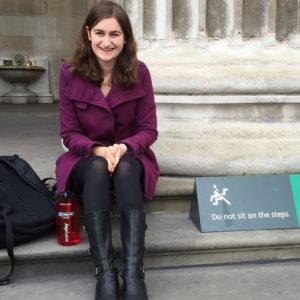
Rachel Sandalow-Ash is a student at Harvard Law School and a member of the Labor and Employment Lab.
For the fifth day, over 30,000 Stop & Shop workers at over 240 stores across New England stayed off the job and on the picket lines as negotiations continue. As previously reported in OnLabor, these workers — represented by five United Food and Commercial Workers (UFCW) locals — walked off the job on Thursday. Stop & Shop workers are protesting the company’s attempts to cut their pay and benefits; among other things, the company is trying to raise workers’ healthcare premiums, reduce workers’ healthcare benefits, and reduce sick days and holiday days for new employees. Last year, Stop & Shop’s parent company, Ahold Delhaize, “reported profits of more than $2 billion to its shareholders.” The Stop & Shop workers’ strike is the largest private-sector strike since 2016, when 40,000 Verizon workers walked off the job. Local and national politicians have joined workers on the picket lines; for instance, Massachusetts Senator Elizabeth Warren joined a Somerville, MA picket line on Friday and urged customers, “Do not cross the picket line.” On the picket lines, workers told reporters why they are on strike. For instance, Rachel Gonzalez, a Stop & Shop employee in Norwood, MA said, “We need to have a fair wage, we need to have affordable healthcare, most of us have families. We have bills just like everyone else.”
Last week, the New York State Nurses Association (NYSNA) reached a tentative agreement with three major New York hospital systems that will guarantee safe staffing, i.e. minimum ratios of nurses to patients. As previously reported in OnLabor, 97% of the 10,000 nurses who work in these hospital systems had threatened to go on strike to secure safe staffing. Now that the parties have reached this tentative agreement, the nurses will not walk off the job. As the New York Times reports, the nurses hope that the safe staffing agreements will serve as a model for contracts with other hospitals in the state. In addition to safe staffing guarantees, the tentative collective bargaining agreement includes 3% annual pay raises and a $100 million commitment from the hospitals to hire more nurses.
The Washington Post and the Boston Globe reported on the Harvard Graduate Students Union’s fight for protections against harassment and discrimination in its first union contract. As previously reported in OnLabor, the university administration is trying to carve out discrimination and harassment complaints from the contractual grievance procedure, while the union insists that student workers must be able to vindicate their civil rights. Madeleine Jennewein, a graduate student and research assistant in virology, told the Washington Post, “Thousands of survivors have suffered harassment and discrimination at Harvard. By refusing to change its broken system, Harvard is knowingly allowing that same abuse to happen again.”
Matt Bruenig writes in Jacobin that even though many people view the US as a low-tax country, “the average American worker has one of the highest compulsory payment rates in the developed world.” In determining the American worker’s compulsory payment rate, Bruenig combined income taxes, employee and employer-side payroll taxes, and employee and employer healthcare premiums (which are mandated under Obamacare’s employer and individual mandates). He found that only the Netherlands has a higher “labor tax burden” than the US. Bruenig argues that these data demonstrate that “American workers already pay more than enough money to provide good healthcare to everyone in the country . . . [but] they pay it into a private insurance system that wastes large portions of it on rents and administrative redundancy.”



Daily News & Commentary
Start your day with our roundup of the latest labor developments. See all
October 13
Chicago hotel workers remain on strike; a coalition of Democratic states sues the Labor Department over canceled unemployment insurance grants; the Federal Labor Relations Authority establishes a new mediation framework for federal worker disputes.
October 12
Workers at the Obama Foundation begin organizing; MLB submits its latest collective bargaining agreement proposal; Brigham & Women's nurses postpone strike.
October 11
UAW President Shawn Fain succeeds in his reelection bid, and Spanish unions call for a general strike.
October 9
DHS proposes a $100k fee for the foreign grad employment program; Trump suspends tech company access to green card program; and private equity perpetuates poor working conditions for home care workers.
October 8
NLRB judge finds UPS unlawfully restricted union insignia; Harvard graduate workers authorize second strike; OSHA orders Union Pacific to pay $300,000 in damages in whistleblower case.
October 7
DOL scraps plan to remove decades-old wage-and-hour guidance from federal regulations; New York enacts personnel records access law; Starbucks loses bid to dismiss Workers United trademark suit.