

Hannah Belitz is a student at Harvard Law School.
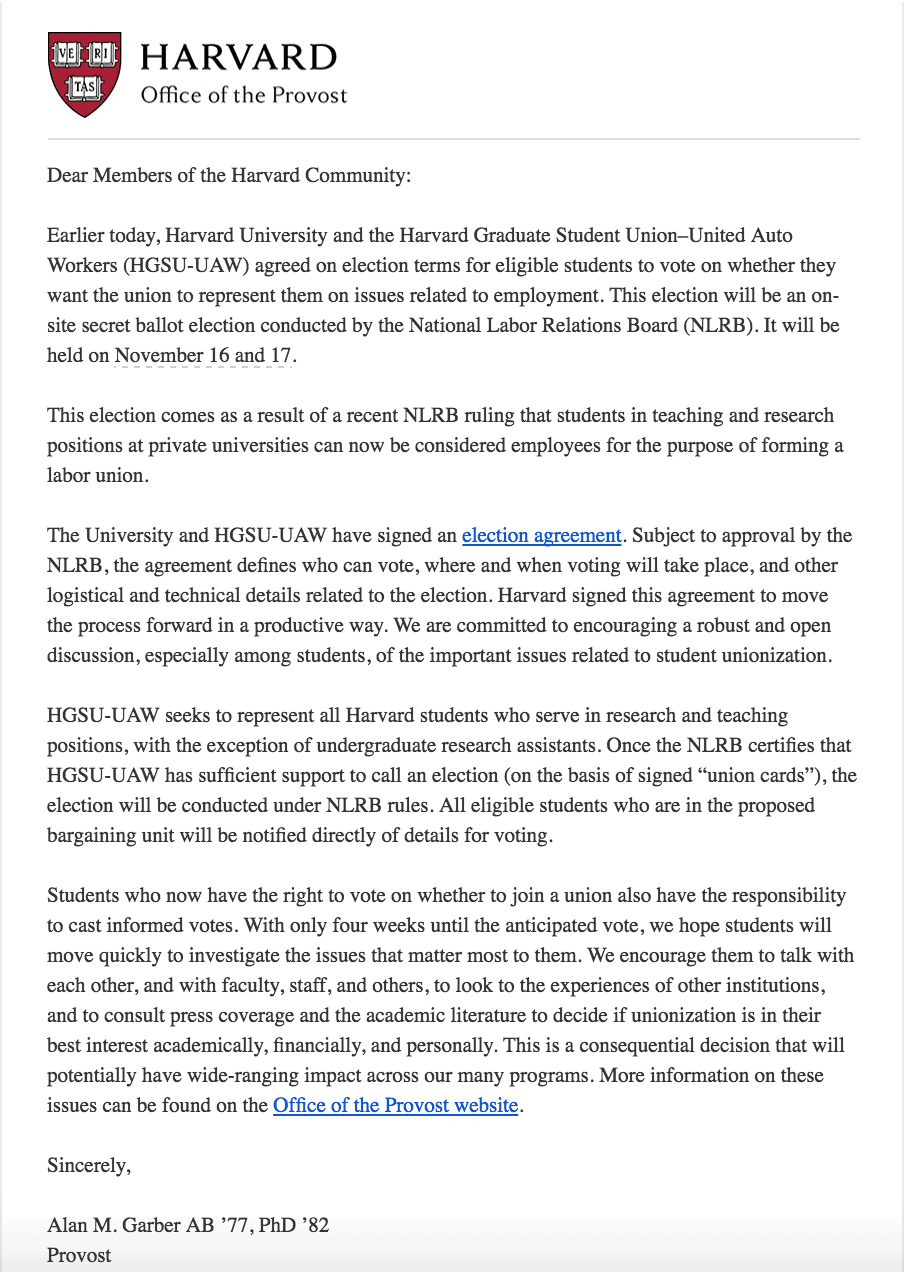
On Tuesday, Harvard University and the Harvard Graduate Student Union–United Auto Workers (HGSU-UAW) signed an agreement on election terms for eligible students to vote on unionization. An email sent to the student body about the election can be accessed here. HGSU-UAW seeks to represent all Harvard students who serve in research and teaching positions, with the exception of undergraduate research assistants. The NLRB will conduct an on-site secret ballot election on November 16 and 17. Both the Office of the Provost and the HGSU-UAW have created FAQ pages about unionization, and the HGSU-UAW has also created a “Response” to the Harvard FAQ page.
The Harvard University Dining Services (HUDS) workers’ strike has entered its third week, and students continue to rally to the cause. On Monday, hundreds of students staged a walk-out to support the workers. As The Crimson reports, the protests began at 10:30am, when Divinity students gathered at the Harvard Divinity School before marching to the Science Center Plaza to join striking HUDS workers for a rally. At 12:30pm, hundreds of undergraduates walked out of their afternoon classes and joined another rally, organized by the Student Labor Action Movement, at the John Harvard statute.
Ford has decided to stop making small cars in the United States, and plans to move production of its Focus compact cars from a factory in Wayne, Michigan to a new plant in Mexico. Donald Trump and other critics of NAFTA have attacked Ford for creating jobs in Mexico instead of the United States. However, as the New York Times points out, the move will not result in a cut to U.S. jobs: the Wayne factory will remain fully staffed to build more trucks and S.U.V.s. As the Times explains, Nafta has played a role in shifting American manufacturing jobs to Mexico. The story of Ford’s Wayne plant, however, demonstrates that many factors — including the state of the economy, the profitability of the vehicles being produced, the strength of the dollar, and how well or not each carmaker’s products are faring in the marketplace — determine the number of auto-making jobs in the United States.
At the end of September, Nissan CEO Carlos Ghosn threatened to abandon a major investment in the U.K. until the nation provided more clarity on its plans for post-Brexit trade relations with the E.U. According to the Wall Street Journal, Ghosn now appears to have shifted his tone. After a meeting on Friday with U.K. Prime Minister Theresa May, Ghosn said in a joint statement that he looked forward to “continued positive collaboration.” In the statement, Prime Minister May said that the U.K. government would continue to work with Nissan as it develops “the environment for competitiveness of the automotive industry here in the U.K. to ensure its success.”



Daily News & Commentary
Start your day with our roundup of the latest labor developments. See all
October 26
Harvard dining workers authorize strike; New York City bans horse carriages; Brooklyn nurses rally in support of colleague.
October 25
Dallas Cowboys Cheerleaders unionize; Bureau of Prisons again pushes for union contract cancellation; CSU faculty votes on strike authorization.
October 23
Employers increasingly shift health care costs onto workers and NYC proposes placing restrictions on fully automated customer service.
October 22
SCOTUS declines Wilcox appeal; Penn State research assistants win bargaining rights; SEIU sued over military leave firing.
October 21
DOL withdraws tipped-worker rule; Instacart settles hiring-bias claims; Phillips 66 locks out New Jersey refinery workers.
October 20
Korean unions oppose labor exemption bill; Portland city workers prepare for strike; UPenn grad student union looks to dismiss university filing