
Annie Hollister is an Honors Attorney at the U.S. Department of Labor and an alumna of Harvard Law School.
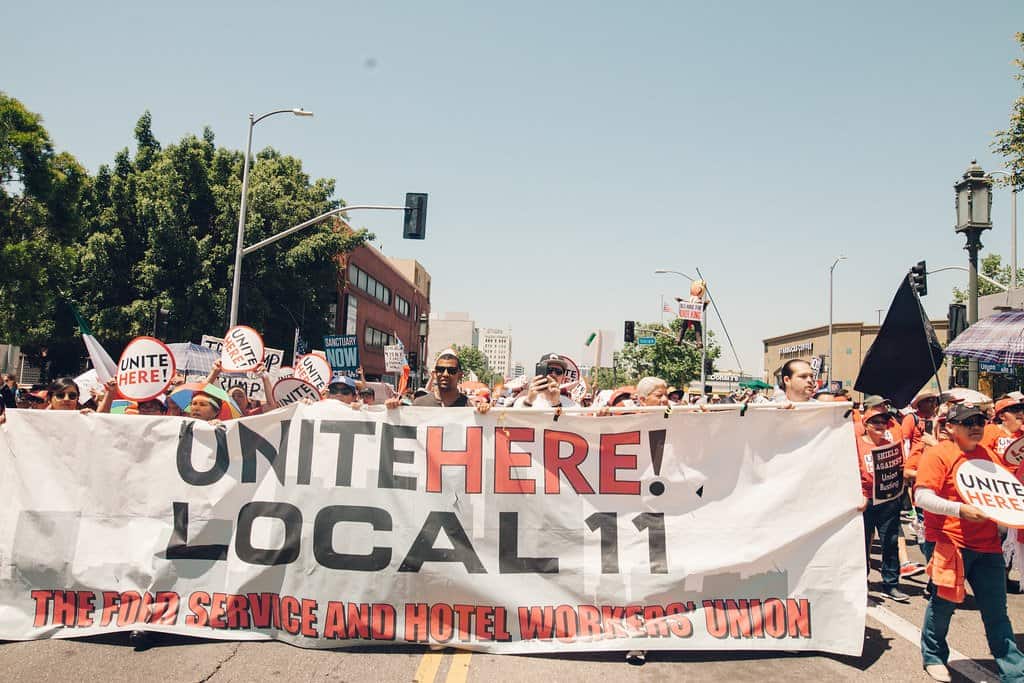
Presidential candidates are planning to boycott the upcoming Democratic debate if an ongoing labor dispute at Loyola Marymount University is not resolved. Food service workers at Loyola Marymount, which is scheduled to host the debate, have been in negotiations over a new union contract since last December. The workers are represented by Unite HERE Local 11 and are directly employed by Sodexo, a food service subcontractor. They have been picketing since November, when contract negotiations apparently reached and impasse. The next Democratic debate is scheduled to take place at Loyola Marymount next week. On Friday, Elizabeth Warren announced via Twitter that she would not cross the workers’ picket line, “even if it means missing the debate.” Bernie Sanders and Julián Castro quickly followed suit, with Castro (who has not qualified for the debate) urging that “No candidate for the Democratic nomination should cross a picket line.” By late afternoon, all qualifying candidates had announced that they will not participate in a debate at Loyola Marymount as long as the dispute remains ongoing. A spokesperson for the Democratic National Committee has said that the party is looking for an “acceptable resolution.” The December debate was initially slated to take place at UCLA, but was moved because of the University of California’s ongoing labor dispute with AFSCME Local 3299.
The campaign for a union at Hearst Magazines faces new complications. An organization called the Hearst International Employees Association has filed to intervene in the Writers Guild of America’s effort to organize workers across Hearst’s 24 publications. HIEA claims to already represent the workers seeking to organize with WGA. This is apparently the first time that many Hearst employees have heard of HIEA, which has not been mentioned in Hearst’s anti-union social media campaign or website. WGA organizers say that HIEA, which claims to have existed for nearly 75 years, may be a “company union” established to prevent workers from organizing independently. Public information about HIEA is scarce, but the union’s offices appear to be located within a Hearst office building. It also appears that the union’s tax exempt status has been revoked by the IRS. This is the latest development in an ongoing battle between the Writer’s Guild and Hearst. At an NLRB hearing last week, union and employer clashed over the size of the prospective bargaining unit. Hearst has proposed dividing the unit into six smaller units—a proposal the union has vigorously opposed on social media.
Behavioral health workers employed by Kaiser Permanente have called a five-day strike of more than 100 facilities across California. The roughly 4,000 striking psychologists and psychiatric nurses are represented by the National Union of Healthcare Workers. They are asking for a reduction in caseloads and caps on patient numbers per therapist. The strike was initially planned for mid-November, but was postponed after the sudden death of Kaiser CEO Bernard Tyson.
Earlier this year, the podcast Reveal investigated wage theft and worker mistreatment in senior care homes. In a follow up investigation, Reveal reports that dozens of the employers implicated in the initial investigation continue to receive federal Medicaid funds. Care facilities may be prohibited from receiving Medicaid funding if they are found guilty of fraud or patient neglect, but the federal government does not condition funding on compliance with labor laws. As a result, the federal government continues to fund dozens of facilities in California, Florida, Oregon, and Washington that have been found legally responsible for wage theft and other labor violations.





Daily News & Commentary
Start your day with our roundup of the latest labor developments. See all
October 16
Department of Labor reduces wage-and-hour enforcement at unionized workplaces; Fain's victory poses question of federal monitor's extension.
October 15
New reporting examines the rollback of child labor protections; California tries to block a strike; NLRB charges Wisconsin mental health provider with firing workers during union drive.
October 14
Eleventh Circuit overturns ERISA exhaustion rule; DHS finalizes removal of automatic renewal for work permits; AFGE challenges SSA over flexible scheduling policy.
October 13
Chicago hotel workers remain on strike; a coalition of Democratic states sues the Labor Department over canceled unemployment insurance grants; the Federal Labor Relations Authority establishes a new mediation framework for federal worker disputes.
October 12
Workers at the Obama Foundation begin organizing; MLB submits its latest collective bargaining agreement proposal; Brigham & Women's nurses postpone strike.
October 11
UAW President Shawn Fain succeeds in his reelection bid, and Spanish unions call for a general strike.