Zachary Boullt is a student at Harvard Law School.
Talks over a future potential COVID stimulus package have once again stalled after members of the House and Senate announced that there would not be much movement on a potential deal. The Senate has been focused on the Judge Amy Coney Barrett nomination hearings, prompting Senate Republicans to reject White House pushes to focus on making a stimulus package deal. Nancy Pelosi and Steven Mnuchin are expected to negotiate more this week to hammer out the $.4 trillion difference in their offers, but there is no set schedule for talks. Though talks initially stalled after Trump announced that he would not approve a deal before the election and then doubled back, talks are now stalling due to Senate Republicans’ resistance to any offers around or above the $2 trillion cost mark. However, some have criticized Pelosi for being unwilling to take the $1.8 trillion deal and for holding up negotiations, potentially to prevent the Trump administration from gaining credit from the stimulus. Any finalized stimulus package vote is not expected before the election.
Nurses at Backus Hospital in Norwich, Connecticut will begin a two-day strike today after negotiations failed on creating a new contract with the hospital. The hospital recently had nine employees test positive for COVID-19, and cases are rising in Norwich and nearby locales. The nurses’ chief demands are better wages and health insurance, as their wages are less than nearby hospitals, and better PPE, as they’ve been forced to reuse masks and equipment. Though representatives of the nurses are worried about patient care during the strike, they have pointed to the weeks of holdouts, negotiations, and delays they tried to avoid having to strike.
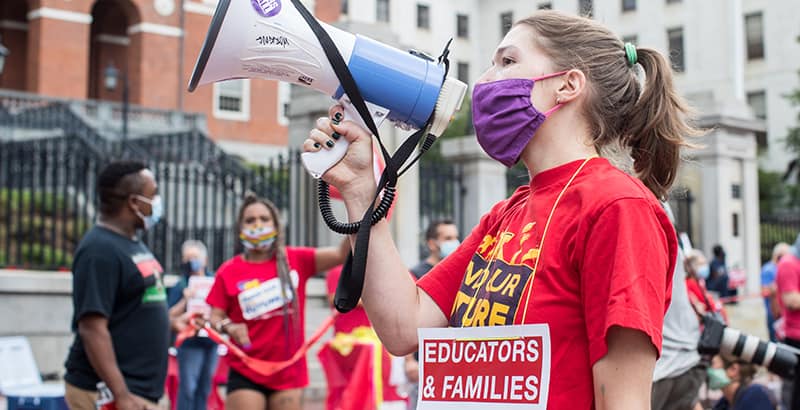
Tomorrow, October 14, a judge will hear the Boston Teachers Union’s (BTU’s) case seeking an injunction barring Boston Public Schools (BPS) from requiring in-person instruction. The lawsuit was filed last week after Boston’s COVID-19 infection rate rose to over 4%, which BTU claims was supposed to trigger school closings. BPS claims that it is allowed to keep schools open if the Boston Public Health Commission says the schools are safe, which it did after the 4.1% positive rate announcement. BTU says it has confirmed cases at four schools. Most of the students returning to BPS schools currently are “high-needs” students, including students experiencing homelessness, ESL learners, and special needs students. Teachers criticized the schools’ previous reopening for lack of teacher input and BPS’s failure to make the results of a ventilation study public.
The DOL has issued a new proposed rule regarding how pension investment firms working under ERISA requirements deal with proxy firms offering them investment or pension plan voting recommendations. According to Forbes, private pension plan managers generally use proxy advisory firms to offer voting recommendations for the plethora of companies under a firms’ control. Private firms generally do not review the recommendations of proxy firms, despite ERISA requirements. The proposed rule will not require investment firms to vote their proxies unless the vote can be directly tied to the best financial interests of investors, opening the door to doing away with proxy firms. Since proxy firms can make recommendations based on the social and environmental policy goals of their clients, the new rule will stymie the ability of investors to consider social and environmental goals when making decisions, instead making pension plan investors focus solely on maximizing investment returns and lowering administrative costs.

Daily News & Commentary
Start your day with our roundup of the latest labor developments. See all
April 8
The Writers Guild of America reaches a tentative deal with the Alliance of Motion Picture and Television Producers; the EEOC recovers almost $660 million in compensation for employment discrimination in 2025; and highly-skilled foreign workers consider leaving the United States in light of changes to the H-1B visa program.
April 7
WGA reaches deal with studios; meatpacking strike brings employer back to table; union leaders take on AI.
April 6
Trump to shrink but not eliminate CFPB, 9th Circuit nixes use of issue preclusion to invalidate arbitration agreements.
April 5
Trump proposes DOL budget cuts; NLRB rules in favor of cannabis employees; Florida warehouse workers unanimously authorize strike.
April 3
NLRB says Amazon failed to bargain with union; Harvard graduate workers authorize strike, and states move to preempt local employment law.
April 2
Sheridan, Colorado educators go on strike; Maryland graduate student workers are one step closer to collective bargaining rights.