
Elias Decker is a student at Harvard Law School.
In today’s News and Commentary, the NLRB says Amazon failed to bargain with Teamsters union, Harvard graduate workers authorize strike, and states move to preempt local employment law as a means of advancing President Trump’s agenda.
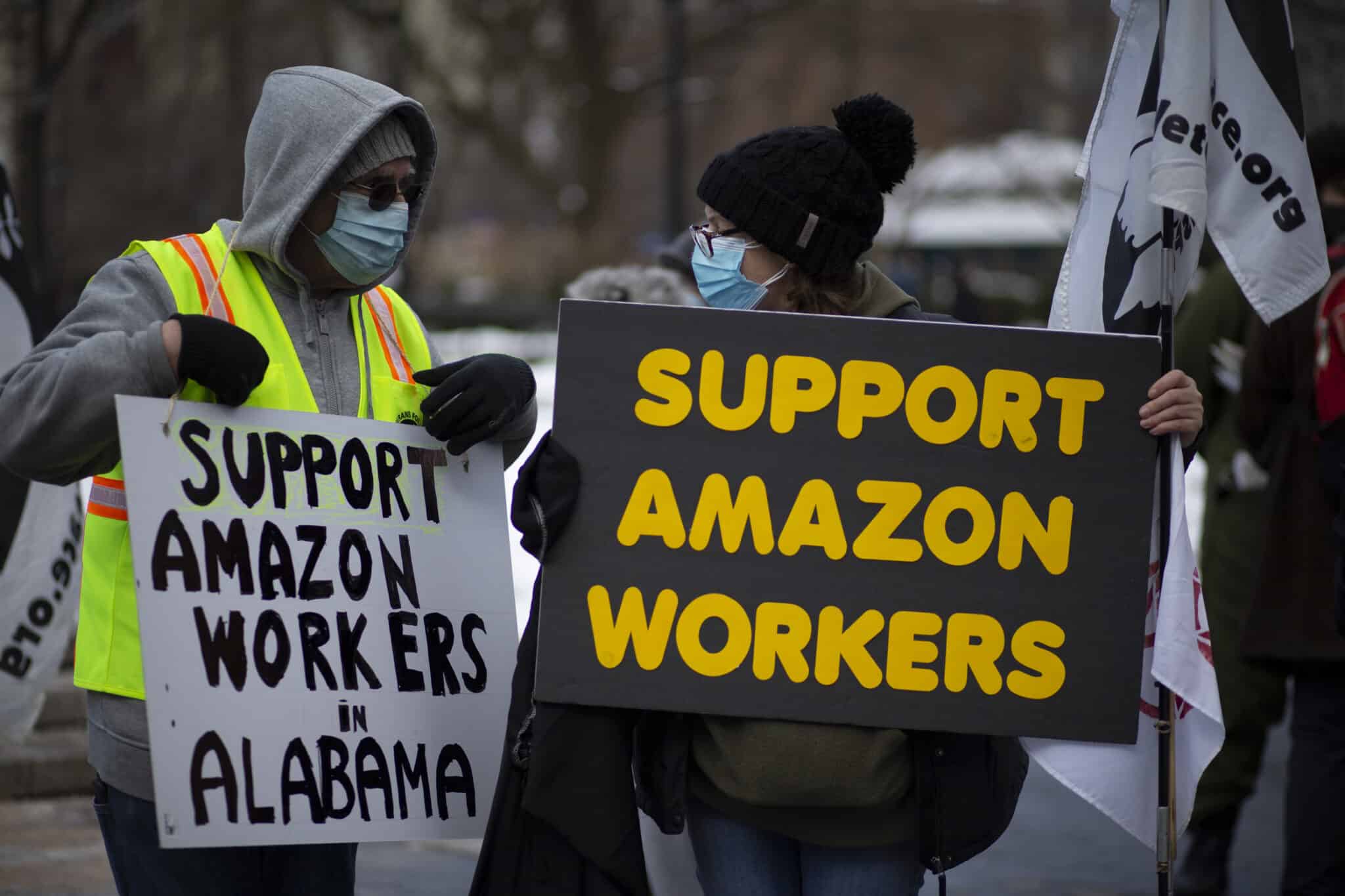
On Wednesday, the NLRB issued a decision finding that Amazon Services, Inc. failed in its duty to bargain in good faith with the Amazon Labor Union Local 1, an affiliate of the International Brother of Teamsters, at the JFK8 warehouse. This decision sets the stage for Amazon to challenge the ALU’s original 2022 victory in the courts. (The NLRA does not provide an avenue for direct judicial review of a union election, so when a party wishes to challenge a union’s certification, a common practice is to refuse to bargain and challenge the unfair labor practice in the court of appeals). Though Amazon has not filed this request for review, they have indicated their intention to do so: Amazon spokesperson Eileen Hands said “We’re confident an unbiased court will overturn the original certification, and we look forward to the opportunity for our team to fairly voice their opinions.”
With almost 96% ‘Yes’ votes and 79% voter turn-out, over three quarters of Harvard Graduate Students Union, UAW Local 5118, voted in favor of authorizing a strike, after a months-long bargaining process. This amounts to even greater support than the 92% of the bargaining unit that supported the last strike authorization vote in 2021, which preceded a three-day strike. It also follows what fourth-year doctoral student and union steward Lauren Chen called a “frustrating” bargaining process that has lasted well over a year. During the summer of 2025, the Harvard administration unilaterally carved out over 900 student workers from the bargaining unit, claiming that their “research doesn’t count as employment because it helps them work toward their degrees — and because they aren’t performing specific tasks in exchange for compensation,” a move criticized by Ben last year. This is not the only union activity at Harvard, as the Harvard Academic Workers, another UAW affiliate, opens its own strike authorization vote, nor the only activity in graduate workers unions, as the Student Workers of Columbia, UAW Local 2710, also recently authorized a strike.
Finally, states with Republic-dominated legislatures have been passing bills preempting local governments from advancing employment policy goals contrary to President Trump’s policy agenda. Florida’s SB 1134, currently awaiting Gov. Ron DeSantis’ signature, precludes localities’ funds from being used to advance DEI. Iowa has already passed SF 579, which prevents cities and counties from enforcing civil rights statutes — such as Title VII — that protect categories of workers not recognized by Iowa state law. Most broadly, Tennessee’s SB 674 prohibits all regulation of any private-sector employment relationship by cities and counties. RJ Gibson, government affairs director at the Tennessee Chamber of Commerce & Industry, praises bills like Tennessee’s as uniformity-advancing, arguing that uniformity makes it easier for employers to make investments and hires. Critics like Lisa Amsler, professor emerita at Indiana University’s Maurer School of Law, say that these bills are “undermining democracy at the local government level.”



Daily News & Commentary
Start your day with our roundup of the latest labor developments. See all
October 13
Chicago hotel workers remain on strike; a coalition of Democratic states sues the Labor Department over canceled unemployment insurance grants; the Federal Labor Relations Authority establishes a new mediation framework for federal worker disputes.
October 12
Workers at the Obama Foundation begin organizing; MLB submits its latest collective bargaining agreement proposal; Brigham & Women's nurses postpone strike.
October 11
UAW President Shawn Fain succeeds in his reelection bid, and Spanish unions call for a general strike.
October 9
DHS proposes a $100k fee for the foreign grad employment program; Trump suspends tech company access to green card program; and private equity perpetuates poor working conditions for home care workers.
October 8
NLRB judge finds UPS unlawfully restricted union insignia; Harvard graduate workers authorize second strike; OSHA orders Union Pacific to pay $300,000 in damages in whistleblower case.
October 7
DOL scraps plan to remove decades-old wage-and-hour guidance from federal regulations; New York enacts personnel records access law; Starbucks loses bid to dismiss Workers United trademark suit.