
Alexandra Butler is a student at Harvard Law School.
The number of new state unemployment claims increased by 9,000 last week, bringing the total number of weekly claims to 745,000. Many economists believe, however, that this increase is not indicative of what’s to come, with one noting that “[j]ob growth will accelerate, perhaps as soon as the second quarter, with decent gains in leisure and hospitality and travel.” Friday’s monthly jobs report somewhat confirms this predicted trend. According to the Department of Labor, nonfarm payroll employment saw an increase of 379,000, with roughly 94% of this increase stemming from the leisure and hospitality sector. Yet, even with this prediction, rebuilding the job market will not occur overnight, as the pandemic continues to have long-lasting effects on hiring patterns.
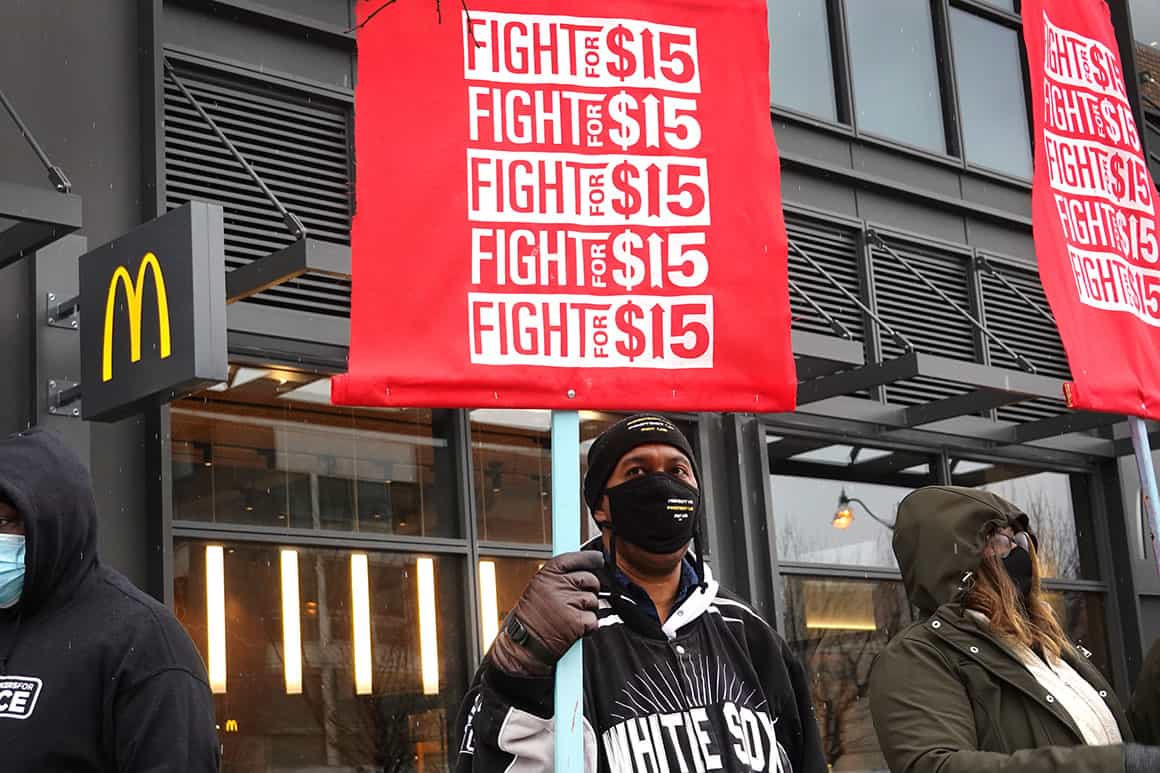
While the push for a national $15 minimum wage faces strong political opposition, a recent study suggests that the “Fight for $15” may have found unlikely support in companies such as Amazon, Walmart and Target. The study highlights that an increase in wages at one of these companies has a “ripple effect[]” on local wages, ultimately providing more workers within these companies’ operation venues with higher pay. Notably, the researchers also found that wage increases did not have a significant impact on the number of jobs available: as company wages increased by 10%, available local jobs decreased by only 1.7%. When it comes to improving worker livelihood, however, private action is only part of the answer. One economist highlights that “[t]here’s just no way to be sure to reach the tens of millions of hardworking but poorly paid workers without significantly raising the national minimum wage.”
Recent bipartisan support for the Pregnant Workers Fairness Act (PWFA) has left its strongest advocates hopeful for real reform. The Pregnancy Discrimination Act (PDA) creates a standard in which “women affected by pregnancy, childbirth, or related medical conditions shall be treated the same for all employment-related purposes . . . . as other persons not so affected but similar in their ability or inability to work.” Ultimately, under the PDA, the central question posed is whether employers must provide “accommodations” for pregnant women. When litigated, the answer to this question is often no, and the standard’s ambiguity has left many women without adequate support from their employers. As a result, women have faced job/income loss and harm as expecting mothers. Through mandatory employer-employee negotiations, the PWFA aims to change this system by moving away from the notion that “accommodations . . . [are] fringe benefit[s]”
In response to political opposition to worker-friendly legislation, the AFL-CIO has recently considered supporting the end of the filibuster as a means to advance its agenda. AFL-CIO President Richard Trumka recently underscored the necessity of passing the PRO Act, a piece of legislation that would ultimately protect workers’ rights to organize. Specifically, Trumka highlighted that “ending the filibuster” could help achieve this goal. The AFL-CIO executive board will make a decision next week.





Daily News & Commentary
Start your day with our roundup of the latest labor developments. See all
October 14
Eleventh Circuit overturns ERISA exhaustion rule; DHS finalizes removal of automatic renewal for work permits; AFGE challenges SSA over flexible scheduling policy.
October 13
Chicago hotel workers remain on strike; a coalition of Democratic states sues the Labor Department over canceled unemployment insurance grants; the Federal Labor Relations Authority establishes a new mediation framework for federal worker disputes.
October 12
Workers at the Obama Foundation begin organizing; MLB submits its latest collective bargaining agreement proposal; Brigham & Women's nurses postpone strike.
October 11
UAW President Shawn Fain succeeds in his reelection bid, and Spanish unions call for a general strike.
October 9
DHS proposes a $100k fee for the foreign grad employment program; Trump suspends tech company access to green card program; and private equity perpetuates poor working conditions for home care workers.
October 8
NLRB judge finds UPS unlawfully restricted union insignia; Harvard graduate workers authorize second strike; OSHA orders Union Pacific to pay $300,000 in damages in whistleblower case.