

Vail Kohnert-Yount is a student at Harvard Law School.
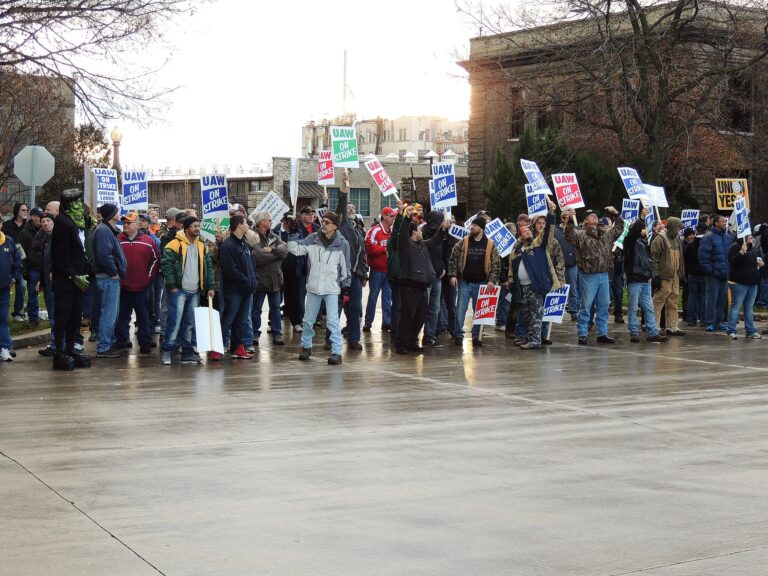
Harvard graduate student workers are going on strike today, after university administrators ended a bargaining session with the Harvard Graduate Student Union-UAW yesterday without reaching agreement on a contract. (Full disclosure: Many of OnLabor‘s contributors are HGSU-UAW members.) Bernie Sanders expressed his support for striking student workers, and OnLabor‘s own Annie Hollister published an op-ed in today’s Boston Globe about why she’s going on strike. Meanwhile, the university responded to two letters, one by all 11 Democratic members of the Massachusetts Congressional delegation and the other by Harvard Class of 1969 alumni, sent in support of the union.
After employees at Hearst Magazines announced their intent to unionize with the Writers Guild of America East last month, Hearst has published a website with the “information [everyone] need[s] to make a choice about the union,” as Hearst’s president Troy Young explained. However, Vice reported that the site is “glossy, misinformation-packed and very aggressive,” with false claims including that Hearst would be unable to hand out raises if its workforce unionized (and at least one typo). Several employees previously described Hearst’s strategy to New York magazine as a “classic union-busting” campaign.
The Los Angeles Times reported that Riot Games, a major video game developer, will pay a proposed settlement of at least $10 million collectively to the approximately 1,000 women it has employed at any time in the past five years. The settlement is one of the largest in California history for a gender discrimination suit, which was brought by two former employees who alleged that they were routinely subjected to sexual harassment and gender discrimination on the job. A 2018 investigation by Kotaku described rampant and systemic sexism at Riot, which sometimes encouraged sexual harassment, gender discrimination, and pay inequity.
Streetsblog Denver highlighted a recent survey from the Amalgamated Transit Union, in which 79% of drivers indicated that routes are not designed to allow enough time for bathroom breaks. 81% of operators reported “holding it in” while on the job, and 64% avoid drinking and eating anything while at work. Even worse, 25% of operators reported soiling themselves while driving a bus, and wearing diapers is a common practice. All of these coping mechanisms can lead to a litany of lifelong health problems – 30 percent of operators reported conditions like urinary tract infections, kidney infections, and constipation. In 2018, ATU launched a national campaign to win better bathroom access for its operators, which would likely help address operator shortages that transit agencies across the country are experiencing.
Report for America, a national program that places journalists in local newsrooms to report on under-covered communities, announced placements of journalists covering working-class issues in several cities around the country. The Wichita Eagle in Kansas will get a labor reporter, and local papers in South Carolina, Mississippi, Florida, New Mexico, Michigan, Missouri, New York, and Washington will get reporters covering beats focused on the poor and working-class ranging from citizen re-entry to housing to mental health.




Daily News & Commentary
Start your day with our roundup of the latest labor developments. See all
February 24
In today’s news and commentary, the NLRB uses the Obama-era Browning-Ferris standard, a fired National Park ranger sues the Department of Interior and the National Park Service, the NLRB closes out Amazon’s labor dispute on Staten Island, and OIRA signals changes to the Biden-era independent contractor rule. The NLRB ruled that Browning-Ferris Industries jointly employed […]
February 23
In today’s news and commentary, the Trump administration proposes a rule limiting employment authorization for asylum seekers and Matt Bruenig introduces a new LLM tool analyzing employer rules under Stericycle. Law360 reports that the Trump administration proposed a rule on Friday that would change the employment authorization process for asylum seekers. Under the proposed rule, […]
February 22
A petition for certiorari in Bivens v. Zep, New York nurses end their historic six-week-strike, and Professor Block argues for just cause protections in New York City.
February 20
An analysis of the Board's decisions since regaining a quorum; 5th Circuit dissent criticizes Wright Line, Thryv.
February 19
Union membership increases slightly; Washington farmworker bill fails to make it out of committee; and unions in Argentina are on strike protesting President Milei’s labor reform bill.
February 18
A ruling against forced labor in CO prisons; business coalition lacks standing to challenge captive audience ban; labor unions to participate in rent strike in MN