

Ajayan Williamson is a student at Harvard Law School.
In today’s news and commentary, Michigan legislators and unions seek to regulate AI in the workplace; the en banc D.C. Circuit hears oral argument in CFPB case; and white police officers sue Philadelphia over its DEI policies.
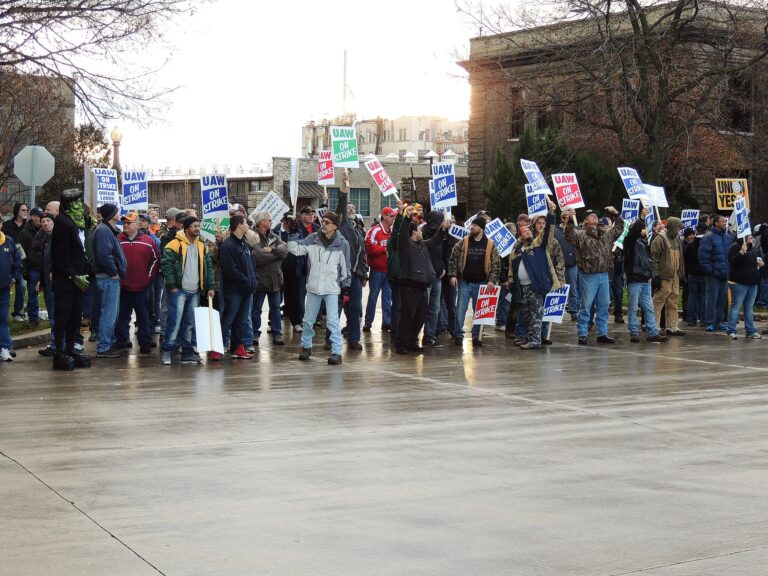
On Monday, Michigan lawmakers announced new legislation that would regulate AI in the workplace, and local unions came out in support of the bill. The “Responsible AI Security for Employees” (RAISE) Act would impose several restrictions: banning the use of AI to set wages and make certain employment decisions, requiring employee notice and consent for AI surveillance, and regulating or banning particular AI data collection and monitoring practices. The Michigan AFL-CIO issued a statement in support of the legislation, describing “unaccountable” AI as “one of the greatest threats the working class faces.” The Communication Workers of America and the Professional Employees Council of Sparrow Hospital also supported the bill. However, the legislation still needs to clear both a closely divided state legislature and increasing federal efforts to preempt state AI regulation.
Meanwhile, the en banc D.C. Circuit heard oral argument on Tuesday in NTEU v. Vought, the case challenging the Trump administration’s attempt to dismantle the Consumer Financial Protection Bureau (CFPB). When the administration purported to fire 90% of the agency’s staff last year, the National Treasury Employees Union filed suit against OMB Director Russ Vought, who had also been serving as Acting Director of the agency. An injunction issued by a district court last March was vacated by a panel of the D.C. Circuit in August, and the plaintiffs filed for en banc review. At oral argument, the administration conceded that it lacked the power to unilaterally decide to shutter the agency, but also argued that no such decision had been made, and that claims about terminations must be channeled through the Merit Systems Protection Board (MSPB) rather than the courts. However, these claims faced pushback, and several judges indicated that they were open to preserving a preliminary injunction while the merits are litigated.
Finally, a group of white police officers filed a lawsuit against the City of Philadelphia yesterday, alleging that the city’s DEI policies are racially discriminatory. The officers challenge the city’s “Rule of Five” policy, which the city council enacted in 2022 to allow selecting candidates for promotion from the five highest-ranked candidates, rather than the top two. As Bloomberg Law reports, the plaintiffs seek to represent a class of white male officers who were passed over for promotions in favor of individuals the complaint describes as “less qualified female and minority job applicants.” The claims are under Title VII, 42 U.S.C. § 1981, the Equal Protection Clause, and state anti-discrimination law. This suit also comes in the context of increasing federal pressure on DEI policies — the Fraternal Order of Police called on the Department of Justice to investigate the city’s policy late last year.



Daily News & Commentary
Start your day with our roundup of the latest labor developments. See all
March 18
Meatpacking workers go on strike; SCOTUS grants cert on TPS cases; updates on litigation over DOL in-house agency adjudication
March 17
West Virginia passes a bill for gig drivers, the Tenth Circuit rejects an engineer's claims of race and age bias, and a discussion on the spread of judicial curtailment of NLRB authority.
March 16
Starbucks' union negotiations are resurrected; jobs data is released.
March 15
A U.S. District Court issues a preliminary injunction against the Department of Veterans Affairs for terminating its collective bargaining agreement, and SEIU files a lawsuit against DHS for effectively terminating immigrant workers at Boston Logan International Airport.
March 13
Republican Senators urge changes on OSHA heat standard; OpenAI and building trades announce partnership on data center construction; forced labor investigations could lead to new tariffs
March 12
EPA terminates contract with second-largest union; Florida advances bill restricting public sector unions; Trump administration seeks Supreme Court assistance in TPS termination.