
Andrew Dunn is a student at Harvard Law School and a member of the Labor and Employment Lab.
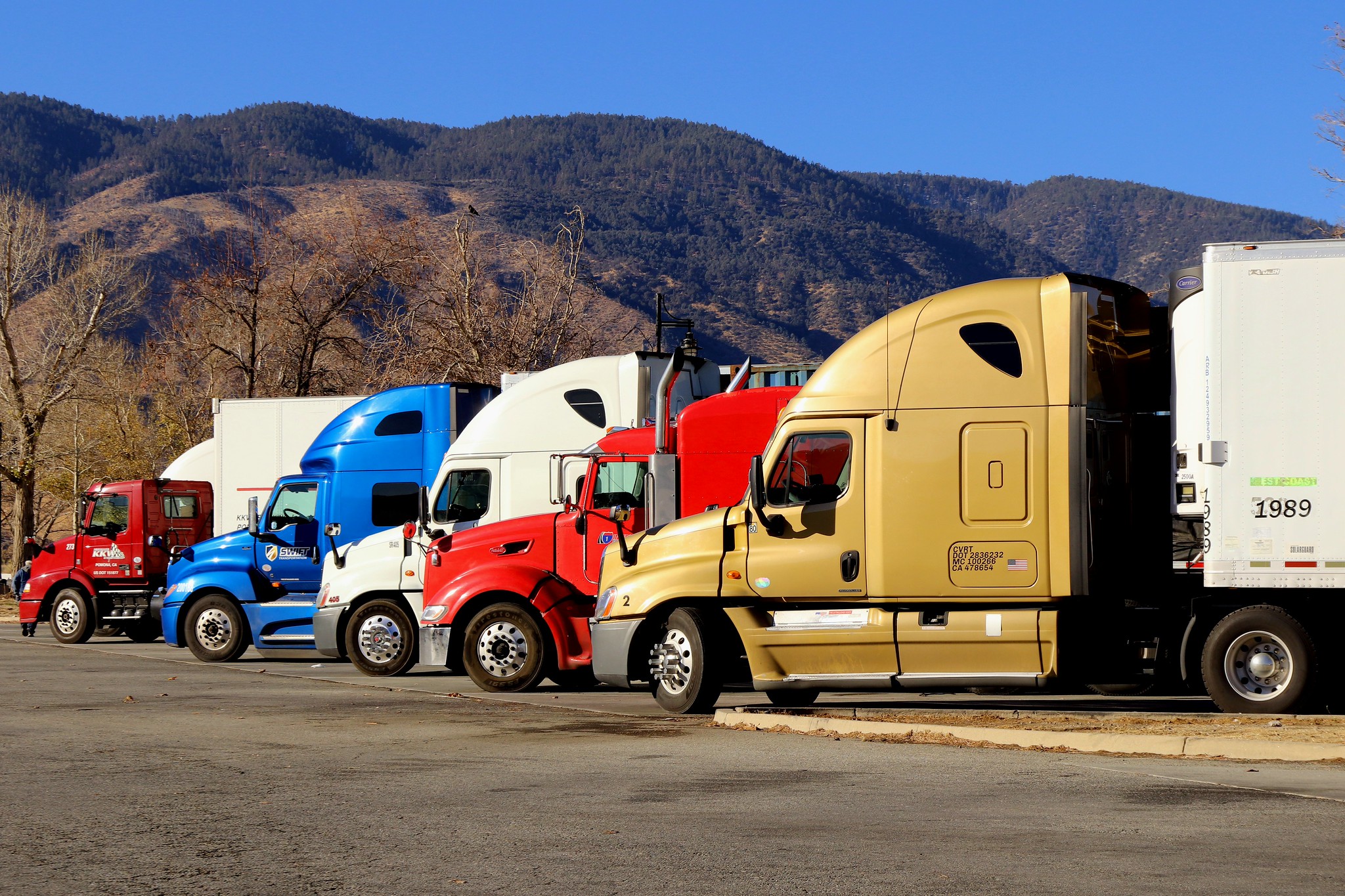
Jorge Rivera Lujan, a Dreamer protected under DACA, runs his own trucking business; Aleksei Semenovskii sought asylum from Russia and has been driving in the U.S. for more than five years. Both have complied with every requirement for commercial licenses, yet their livelihoods are under threat. Nearly 40 years after federal regulations first recognized the importance of noncitizen truckers, these workers are now fighting to keep their licenses and jobs.
The Trump Administration is targeting noncitizen commercial drivers, primarily truck drivers, as part of its coordinated actions against immigrant communities. In April, President Trump issued an Executive Order mandating enforcement of English language proficiency requirements for all commercial drivers. Language proficiency enforcement guidelines were made more aggressive in May, followed by an audit of state commercial licensing in June. In August, Secretary of State Rubio paused new visas for truck drivers.
Now, the Administration is trying to rewrite federal standards for Commercial Driver’s Licenses (CDLs) relied on by many noncitizen drivers. Falsely premised on safety and combatting fraud, this sudden rulemaking revokes licenses from nearly 200,000 drivers solely based on immigration status.
In Jorge Lujan v. Federal Motor Carrier Safety Administration (FMCSA), workers are challenging this attack on their livelihoods. This post explains the shift in CDL standards, how the rule circumvents procedural safeguards, and the legal battle to stop the rule.
Non-Domiciled CDLs
In 1986, Congress enacted the Commercial Motor Vehicle Safety Act (CMVSA), authorizing DOT to set minimum standards for CDLs. Drivers of commercial vehicles, such as buses, garbage trucks and semi-trucks, must hold a CDL. As part of the CMVSA, state agencies must issue licenses only to drivers domiciled in that state, with limited exceptions. In 1988, DOT finalized the Nonresident CDL exception, allowing states to confer CDLs on immigrants and nonresidents who meet the relevant licensing requirements. A 2011 rule changed the name of the “Nonresident CDL” to the “Non-Domiciled CDL,” reflecting how the CMVSA structures standards while maintaining nonresident eligibility. Currently, 43 states issue non-domiciled CDLs.
What’s Changed?
For most states, a domiciled CDL requires proof of citizenship or lawful permanent residency. Prior to the September rule, this made non-domiciled CDLs the only option for many noncitizen drivers as people with a valid Employment Authorization Document (EAD) were eligible for non-domiciled commercial licensing. EADs are available to people with a broad range of immigration statuses, including asylees, refugees, Dreamers, and individuals with Temporary Protected Status or Deferred Enforced Departure. Under the new rule, however, eligibility is restricted to recipients of specific non-immigrant visas: H-2A (temporary agricultural workers), H-2B (temporary non-agricultural workers), and E-2 (treaty investors). Most noncitizens currently driving without one of these visas will lose their CDL or commercial learner’s permit.
Unjustified Rule
Typically, this kind of significant change would go through the notice-and-comment process as required by the Administrative Procedure Act (APA). On average, this process takes 18 months. Instead of following standard protocols, however, the Trump Administration is attempting to force through the CDL change as an Interim Final Rule (IFR). IFRs go into effect immediately while the agency collects comments before publishing a final rule. To issue an IFR, the agency must justify skipping APA requirements by showing good cause. Here, the Administration is attempting to justify the departure from standard APA requirements by pointing to the twin goals of promoting safety and preventing fraud. But the Administration does not offer any meaningful statistics about fraudulently obtained CDLs or vehicular accidents. Instead, FMCSA emphasizes there have been “at least five fatal crashes involving non-domiciled CDL holders” in the first 8 months of 2025. The agency claims two of the incidents involve improperly issued CDLs.
This limited anecdotal evidence is entirely unconvincing. According to DOT data on CDL drivers of large trucks (accessible under People Table 25), 3,756 drivers with valid CDLs were involved in fatal crashes in 2019. In 2020, this number decreased to 3,470. And in 2021 there were 4,094 fatal crashes. The five accidents from January through August would be a miniscule percentage of fatal truck accidents in a typical year. If noncitizen truckers are 16% of drivers but only an infinitesimal number of fatal accidents, could the new rule really be about safety?
How Bad is this Change?
The rule estimates that “there are approximately 200,000 non-domiciled CDL holders, and approximately 20,000 non-domiciled [learner’s permit] holders.” 97% of these CDL holders, 194,000 people, are expected to just “exit the freight market” because of this punitive shift. This is short-sighted policymaking since trucking already faces frequent turnover and persistent retention issues from limited wage growth and poor working conditions.
This rule attacks noncitizen drivers who prop-up the trucking industry and thereby our economy. In 2023, FMCSA estimated foreign-born drivers represent 16% of truckers. Long-haul trucking also routinely faces shortages of qualified workers—the American Trucking Association estimated there would be a shortfall of 160,000 workers by 2028 before this change. In 2023, trucking of freight contributed $611.5 billion to U.S. GDP and trucks move about 70% of goods shipped annually in the United States. This rule now further degrades supply chain stability and affordability, exacerbating two crises driven by President Trump’s trade and immigration policies.
Jorge Lujan v. FMCSA
Considering the questionable bases for the new rule and significant harms likely to flow from it, drivers and unions are challenging this abrupt revocation of non-domiciled CDLs. After DOT published the rule, Jorge Rivera Lujan, Aleksei Semenovskii AFSCME, AFT, and Public Citizen filed an emergency petition for review in the D.C. Circuit Court of Appeals. The CMVSA directs challenges to CDL standards to the court of appeals for the circuit where the driver adversely affected resides. On November 13th, the D.C. Circuit granted an emergency stay pending review that temporarily halts enforcement of the rule.
In granting the stay, the D.C. Circuit determined the plaintiffs were likely to prevail on three primary claims. First, that the rule likely violates the CMVSA since it was issued without consulting state agencies. Second, that DOT’s action is unlikely to qualify for the good cause exception because evidence in the record fails to show a benefit to public safety, highlighting that DOT’s own data shows “non-domiciled CDL holders account for approximately 5 percent of all CDL holders but only about 0.2 percent of fatal crashes.” Third, that the rule is likely arbitrary and capricious in violation of the APA, failing to articulate a satisfactory explanation and inadequately considering reliance interests of and irreparable harm to drivers. The court also emphasized the rule potentially degrades public safety because non-domiciled CDL holders may be replaced by less safe drivers.
Even though the D.C. Circuit has tipped its hand and appears inclined to invalidate the rule, review is ongoing and Congress could codify this callous change. But these workers deserve stability and dignity, not scapegoating. Indeed, evidence shows that deregulation has a far greater impact on roadway safety than do noncitizen truckers. If the Administration wants to tackle trucking safety, it should look to the profound effect that deregulation has had, rather than continue its baseless attack on noncitizen drivers


Daily News & Commentary
Start your day with our roundup of the latest labor developments. See all
April 9
California labor backs state antitrust reform; USMCA Panel finds labor rights violations in Mexican Mine, and UPS agrees to cap driver buyout offers in settlement with Teamsters.
April 8
The Writers Guild of America reaches a tentative deal with the Alliance of Motion Picture and Television Producers; the EEOC recovers almost $660 million in compensation for employment discrimination in 2025; and highly-skilled foreign workers consider leaving the United States in light of changes to the H-1B visa program.
April 7
WGA reaches deal with studios; meatpacking strike brings employer back to table; union leaders take on AI.
April 6
Trump to shrink but not eliminate CFPB, 9th Circuit nixes use of issue preclusion to invalidate arbitration agreements.
April 5
Trump proposes DOL budget cuts; NLRB rules in favor of cannabis employees; Florida warehouse workers unanimously authorize strike.
April 3
NLRB says Amazon failed to bargain with union; Harvard graduate workers authorize strike, and states move to preempt local employment law.