

In today’s news and commentary, the International Alliance of Theatrical Stage Employees enters the final stages of negotiations for its basic agreement and the Supreme Court appears likely to side with Starbucks in 10(j) injunctions case.
The International Alliance of Theatrical Stage Employees (IATSE), which represents film and TV crew members, enters the final stages of its months-long bargaining process with the Alliance of Motion Picture and Television Producers (AMPTP). In comparison to the contentious negotiating between the AMPTP and other entertainment unions last year, IATSE’s negotiations have been fairly smooth. So far, negotiations have addressed specific concerns of the individual crafts – makeup artists, hair stylists, costume designers, set decorators. Today, the union will begin broader negotiations for the basic agreement covering all entertainment craftspeople. IATSE is seeking significant wage increases, increased penalties for rest-period violations, improved sick leave, and expanded streaming residuals. Matthew Loeb, IATSE’s international president, has indicated a desire to reach agreement as soon as possible. IATSE has never staged a nationwide strike, and many crew members were unable to work during the writers’ and actors’ strikes last year. Still, the union has not ruled out a strike should it be necessary.
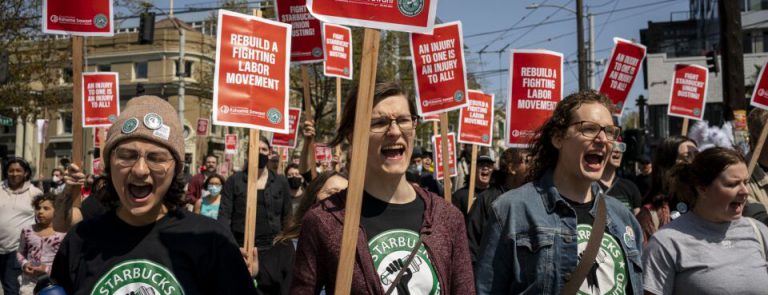
Last week, the Supreme Court heard oral argument in the Starbucks 10(j) injunction case. As John reported, the case was brought by Starbucks after the NLRB obtained a 10(j) injunction temporarily halting the firing of union organizers dubbed the Memphis 7. The case before the Court was not about the firing of the organizers, but rather about what standard courts apply when considering an NLRB request for injunction. Starbucks argued for imposing a more rigorous, four-factor test which includes an assessment of whether the side seeking relief would suffer irreparable harm without the injunction. The Court’s ruling is expected by the end of June, but, based on questioning during oral argument, it appears the Court will come down on the side of the company. The legal implications of their ruling is unlikely to be substantial. However, it signals to unions and to courts that protecting workers’ rights is difficult.



Daily News & Commentary
Start your day with our roundup of the latest labor developments. See all
September 28
The Protect College Sports Act nears passage in the Senate; San Francisco municipal workers agree to contract extensions.
September 27
The Trump Administration reaches a settlement with federal unions on reduction in force actions; the United Auto Workers file an en banc petition seeking review of a Second Circuit decision regarding labor arbitrations.
September 25
Healthcare workers rally to restore legal status for TPS holders; nurses at a Maine hospital overwhelmingly vote to form their union despite alleged aggressive union busting tactics.
September 24
NLRB abandons rule for offensive conduct during protected activity; New York home care workers seek a union election; maritime deck officers endure long fight for first contracts.
September 23
DoorDash settles delivery-worker pay claims; Philadelphia school workers win new contract; stock gains spur retirements.
September 22
Judge blocks ICE raids in Alabama; Chicago hotel workers vote to strike; AutoZone workers look to create first union