

Jason Vazquez is a staff attorney at the International Brotherhood of Teamsters. He graduated from Harvard Law School in 2023. His writing on this blog reflects his personal views and should not be attributed to the Teamsters.
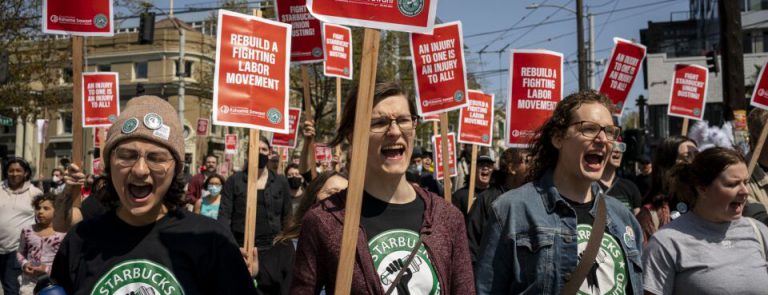
After months of bargaining, nearly 1,500 Kellogg employees — responsible for the production of Cheez-Its, Pringles, Pop-Tarts, Frosted Flakes, Froot Loops, Rice Krispies, Corn Flakes, Eggo, and other snacks and breakfast items — launched a strike on Tuesday, shuttering production at the company’s handful of U.S. factories. The president of the union, BCTGM, has explained that the company has tried to use offshoring threats to coerce employees into accepting “outrageous proposals” that would strip them of protections they have enjoyed “for decades.” The Kellogg action comes in the wake of the union’s successful strike against Nabisco last month, perhaps signaling that labor militancy will continue to intensify as the pandemic retreats. Should the trend persist, it could reshape the balance of power in the U.S. economy.
A report released Tuesday by AFSCME Cultural Workers United reveals that while accepting billions of dollars in pandemic aid under a federal program designed to preserve payrolls several of the country’s leading cultural institutions collectively laid off or discharged thousands of employees. To highlight one egregious example, the prestigious Philadelphia Museum of Art received more than five million dollars in payroll assistance yet laid off nearly a hundred employees — and, perversely, hired a unionbusting law firm to orchestrate its unsuccessful campaign to suppress organizing activities. More encouragingly, the report finds that the sector’s unionized employees experienced far fewer job losses than their nonunion counterparts, showcasing the degree to which unions protected their members during the pandemic, as I explored earlier this year.
On Tuesday nearly a dozen staffers at the Appeal, a digital media outlet dedicated to criminal justice reform, announced they had secured control of the publication’s IP and transitioned to a worker-led nonprofit. The development appears to conclude a dramatic saga that started in May, when the staff’s public disclosure that they had formed a union prompted immediate terminations. The staffers subsequently ousted the management team after it tried to entirely shutter the outlet, then expressed a commitment to restructuring as a “worker-led nonprofit.” Click here to read an interesting piece featured in the Appeal last year which examines the threads linking economic exploitation and criminality and encourages the labor movement to expel police unions.
In litigation news, a Ninth Circuit panel is set to hear oral arguments today in Hooks v. Nexstar Broadcasting, Inc., a § 10(j) proceeding involving the company’s efforts to withdraw support from the union representing thousands of its employees. The district court granted injunctive relief upon finding that Nexstar, the largest owner of local television stations in the country, had likely violated the Act by withdrawing recognition absent objective evidence the union had lost majority support. The injunction rests on an interpretation of § 8(a)(5) effectively dictated by Ninth Circuit precedent, under which an inference of likelihood of irreparable harm automatically follows from a finding of likely success on the merits. The Ninth Circuit will squarely review this interpretation on appeal.
The case is significant in that it offers a preview of whether the federal courts will prove receptive to GC Abruzzo’s signature policy of “aggressively seek[ing]” relief under § 10(j), which she has described as “one of the most important tools available to effectively enforce the Act.” This injunction was one of a handful she cited in the August memo in which she committed to aggressively pursuing § 10(j), writing that the initiative has “led to extremely positive results.” If the injunction is sustained, it might portend an era of more effective enforcement of the nation’s labor laws.
In other legal news, the Supreme Court denied a cert petition seeking to overturn a state court’s ruling that California’s “AB5” law is not preempted under the FAA. The statute codifies the worker-friendly “ABC test,” articulated by the California Supreme Court in Dynamex Operations West, Inc. v. Superior Court, under which workers are considered “employees” — and entitled to the concomitant benefits and protections — if they are under the company’s direct control, engaged in its usual course of business, or do not operate their own independent business. The Ninth Circuit recently dismissed a similar preclusion challenge to the law, which a major trucking association in the state has also appealed to the Justices.



Daily News & Commentary
Start your day with our roundup of the latest labor developments. See all
September 25
Healthcare workers rally to restore legal status for TPS holders; nurses at a Maine hospital overwhelmingly vote to form their union despite alleged aggressive union busting tactics.
September 24
NLRB abandons rule for offensive conduct during protected activity; New York home care workers seek a union election; maritime deck officers endure long fight for first contracts.
September 23
DoorDash settles delivery-worker pay claims; Philadelphia school workers win new contract; stock gains spur retirements.
September 22
Judge blocks ICE raids in Alabama; Chicago hotel workers vote to strike; AutoZone workers look to create first union
September 21
In today’s News and Commentary, the Seventh Circuit raises the bar for the NLRB to obtain preliminary injunctions, the California Primary Care Association sues SEIU-UHW for racketeering, and the Seventh Circuit finds that an employer group and think tank do not have standing to challenge an Illinois law banning captive audience meetings. On Friday, the […]
September 20
Culinary Workers Union members protests union leadership; lawsuit against OpenAI and Microsoft reveal internal concerns about the threat of AI training to human labor.