
Nikita Rumsey is a student at Harvard Law School.
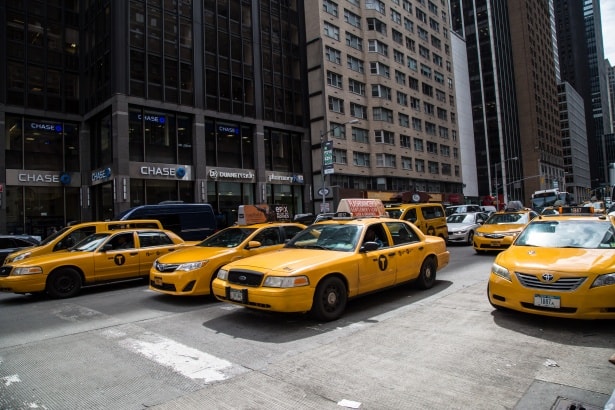
New York City cab drivers announced a hunger strike this week, after having occupied a sidewalk outside City Hall operating a 24-hour picket line for over a month, calling on the de Blasio administration to provide a more robust response to the industry’s slow-moving yet staggering crisis of medallion debt. As New York Magazine put it, the cab drivers’ latest announcement represents “a desperate cry for help from city policies that have left thousands of drivers facing financial ruin, including bankruptcy, foreclosure, eviction, and homelessness.” By way of background, for years the city kept the number of medallions in circulation limited, which steadily drove up their value and led to the growth of a financial bubble as drivers borrowed increasingly large sums to compete for medallions at city-run auctions, peaking at over $1 million per medallion in 2013 and raising hundreds of millions in city revenue. Yet after 2011 when Uber and Lyft arrived, the city failed to contain or control the sudden entrance of what would amount to over 100,000 additional cars flooding the market, which undercut the metered taxi industry and caused the value of medallions to plummet and drivers unable to compete.
As a result of what the taxi drivers see as the city’s complicity in failing to regulate the entry of e-commerce ride-share competitors like Lyft and Uber, yellow-taxi drivers have been left with crushing debt that they simply cannot pay back given the current state of the market. Indeed, according to the New York Taxi Workers Alliance as relayed by New York Magazine, the average debt for each of the 6,000 medallion owners hovers around $550,000, while the value of the medallion itself has dropped to around $100,000 and the average driver can only clear $200 per day after expenses. Such crushing debt has had tragic results, including the suicides of at least nine drivers. In response, the city has proposed a debt-relief plan that could reduce the debts of each medallion owner by $200,000. However, the cab drivers at City Hall say this isn’t enough. As one driver put it, “TLC has said it’s going to be on average $200,000 relief. Which doesn’t mean much when you’re left with $300,000 to pay off…. [This] does not solve this crisis, it’s a bridge to bankruptcy and utter financial ruin … for an entire workforce whose crisis the city itself is responsible for.”
Meanwhile, Bloomberg reported that UNITE HERE Local 11 filed suit against the City of Los Angeles in state court this Friday, alleging that the city should be required to disclose its proposed plans for the 2028 Olympic and Paralympic Games before signing an agreement with the organization responsible for the event. In seeking that the court issue a writ of mandate requiring the city to comply with the state’s public records act and publicly release the so-called “Games Agreement” before it is executed, the union argues that the public deserves to know about the city’s plans for security, housing, labor, transportation and related issues, given the large impact that the event will likely have on the city for years to come. Apparently, the union has been seeking to obtain a draft of the city’s proposed agreement and relevant correspondence since earlier this summer, but to no avail.
Additionally, more news has emerged out of the massive John Deere UAW strike, where approximately 10,000 workers across 14 locals in the Midwest walked off their jobs last week after rejecting a proposed contract that gave “sub-inflation raises and eliminating pensions for all new hires.” Most recently, Deere & Co. successfully petitioned for a temporary restraining order enjoining thousands of union members from picketing at its Davenport Works facility in Iowa. According to Iowa state court judge Marlita A. Greve, the union has used “mass picketing” tactics to impede or prevent non-striking workers, customers and others from safely accessing the plant’s entrances, exits and parking lots, blocked the free-flow of traffic and used megaphones and audio-enhancing devices to conduct “acts of verbal and physical harassment [and] intimidation.” Notably, the court’s injunction prohibits union members from congregating outside the facility in groups larger than four, as well as proscribes the use of burn barrels and even chairs. Moreover, any union member found in violation of the injunction could be held in contempt, which could result in up to six months of jail time and/or a $500 fine. According to the Quad-City Times, various labor law experts have opined that the injunction is unusually strict, especially in the absence of evidence that things like burn barrels and chairs have played a role in limiting the ingress/egress at the facility.





Daily News & Commentary
Start your day with our roundup of the latest labor developments. See all
October 15
New reporting examines the rollback of child labor protections; California tries to block a strike; NLRB charges Wisconsin mental health provider with firing workers during union drive.
October 14
Eleventh Circuit overturns ERISA exhaustion rule; DHS finalizes removal of automatic renewal for work permits; AFGE challenges SSA over flexible scheduling policy.
October 13
Chicago hotel workers remain on strike; a coalition of Democratic states sues the Labor Department over canceled unemployment insurance grants; the Federal Labor Relations Authority establishes a new mediation framework for federal worker disputes.
October 12
Workers at the Obama Foundation begin organizing; MLB submits its latest collective bargaining agreement proposal; Brigham & Women's nurses postpone strike.
October 11
UAW President Shawn Fain succeeds in his reelection bid, and Spanish unions call for a general strike.
October 9
DHS proposes a $100k fee for the foreign grad employment program; Trump suspends tech company access to green card program; and private equity perpetuates poor working conditions for home care workers.