

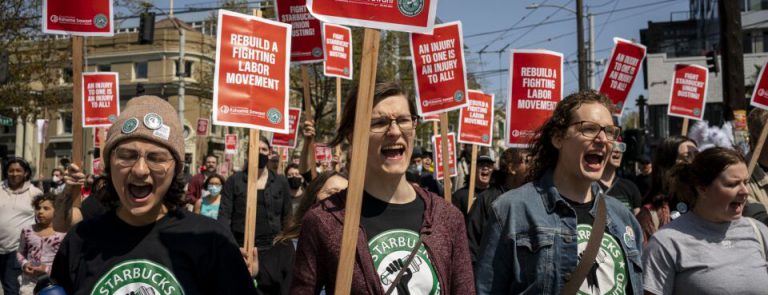
Wayfair employees are walking out today to protest the furniture company’s contacts with the contractors running child internment camps on the border. Wayfair workers learned that the company placed a $200,000 furniture order with BCFS, a federal contractor that runs immigrant detention camps, for a facility housing 3,000 migrant children legally seeking asylum in the United States. Last week, investigators revealed horrifying conditions at the border patrol facilities holding migrant children. After employees raised concerns, Wayfair management announced that it would sell to any paying customer “acting within the laws” (the letter does not appear to mention lawsuits challenging prolonged detention of migrant children and conditions in the internment camps under federal law and the landmark Flores Agreement). Wayfair workers aren’t the only ones protesting their companies’ ties to immigration enforcement: Microsoft, Salesforce, and Google employees protested their companies’ ties to ICE, CBP, and DHS last summer.
Today, Congressional Democrats will introduce legislation to guarantee government employees the right to unionize. America’s nearly 21 million federal, state, and local government employees are excluded from the collective bargaining rights codified by the federal National Labor Relations Act. States can extend collective bargaining rights to public-sector employees, but many do not. According to Vox, bill sponsors Senator Mazie Hirono (D-HI) and Rep. Matt Cartwright (D-PA) consider the bill a direct response to Janus v. AFSCME, last year’s Supreme Court decision banning mandatory fair-share fees in public sector union contracts. (Read OnLabor’s coverage of Janus here). The legislation also comes on the heels of resurgent organizing by public-sector employees, including the wildcat teachers’ strikes which swept red states last summer and federal workers’ threatened walk-outs which brought the country’s longest government shutdown to an end this January.
Last night, public defender Tiffany Cabán declared victory in a stunning, long-shot campaign to become the new District Attorney of Queens, New York—a borough of 2.3 million people. Cabán’s insurgent campaign against the powerful Queens political machine gained widespread attention for her commitment to becoming a “decarceral prosecutor” in the mold of Philadelphia D.A. Larry Krasner and Boston D.A. Rachel Rollins. Cabán’s central campaign promises included decriminalizing sex work and ending cash bail; she will be the first District Attorney nationwide to decriminalize sex work. Cabán’s win is another victory for the increasingly mainstream decriminalization movement, which is also fighting for legislation to decriminalize sex work statewide.
Google sent an internal memo to employees warning that it will consider any employee who protests the company while representing Google in the Pride Parade to be in violation of its code of conduct. The memo was sent after employees marching with Google made plans to protest by carrying signs or shirts protesting Google’s policies for content moderation, which came under fire this month for facilitating anti-LGBTQ and racist harassment. Employees would be allowed to protest Google at Pride—but not if they marched with the corporate contingent. Experts told Bloomberg that the decision may violate federal labor law’s protecting workplace organizing and a California law protecting employee’s political activities.
In a new piece in the Prospect, Sanjukta Paula writes that anti-trust law, originally meant to constrain corporate power, has become its friend—enabling corporate consolidation while restricting worker organizing for better wages and condition.



Daily News & Commentary
Start your day with our roundup of the latest labor developments. See all
September 25
Healthcare workers rally to restore legal status for TPS holders; nurses at a Maine hospital overwhelmingly vote to form their union despite alleged aggressive union busting tactics.
September 24
NLRB abandons rule for offensive conduct during protected activity; New York home care workers seek a union election; maritime deck officers endure long fight for first contracts.
September 23
DoorDash settles delivery-worker pay claims; Philadelphia school workers win new contract; stock gains spur retirements.
September 22
Judge blocks ICE raids in Alabama; Chicago hotel workers vote to strike; AutoZone workers look to create first union
September 21
In today’s News and Commentary, the Seventh Circuit raises the bar for the NLRB to obtain preliminary injunctions, the California Primary Care Association sues SEIU-UHW for racketeering, and the Seventh Circuit finds that an employer group and think tank do not have standing to challenge an Illinois law banning captive audience meetings. On Friday, the […]
September 20
Culinary Workers Union members protests union leadership; lawsuit against OpenAI and Microsoft reveal internal concerns about the threat of AI training to human labor.