

Adi Kamdar is a student at Harvard Law School.
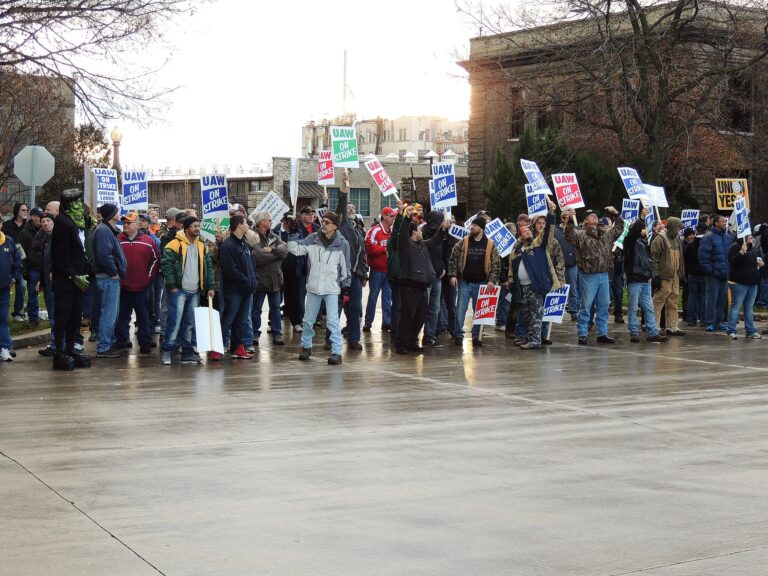
Today is the first day of the Democratic National Convention in Philadelphia, and labor is heavily represented. Monday’s speaker’s list includes AFL-CIO president Richard Trumka, AFT president Randi Weingarten, AFSCME president Lee Saunders, Building Trades president Sean McGarvey, SEIU president Mary Kay Henry, and NEA president Lily Eskelsen Garcia. Winning over labor is crucial, especially after newly tapped VP pick Tim Kaine expressed agreement with provisions of the Trans-Pacific Partnership before renouncing his support for the deal soon after.
Meanwhile, those staying tuned to their mobile devices or taxi cab televisions in Philadelphia will see a flurry of ads regarding minimum wage waivers for union workers, according to the Wall Street Journal. The ads are sponsored by the Worforce Fairness Institute, “which has for years fought union-backed legislation in Washington.”
Roughly $66,000. That’s how much it’ll cost per employee for banks to move their British staff abroad post-Brexit, a consulting firm estimated, according to Bloomberg. This price includes the “cost of relocating staff, hiring and firing other employees and setting up new offices in cities that could include Amsterdam, Dublin, Paris or Frankfurt.” Many banks have threatened—or are planning—to move out of the U.K. in order to maintain free access to the rest of the European market.
A Bloomberg video talks about how the labor force participation rate is at its lowest rate in 30 years, and the U.S. birth rate is at its lowest in a hundred. The commentator notes that, because of factors like the low birth rate, there will be a continued threat to labor participation unless we look to immigration to fill some much-needed gaps.



Daily News & Commentary
Start your day with our roundup of the latest labor developments. See all
March 19
WNBA and WNBPA reach verbal tentative agreement, United Teachers Los Angeles announce April 14 strike date, and the California Gig Workers Union file complaint against Waymo.
March 18
Meatpacking workers go on strike; SCOTUS grants cert on TPS cases; updates on litigation over DOL in-house agency adjudication
March 17
West Virginia passes a bill for gig drivers, the Tenth Circuit rejects an engineer's claims of race and age bias, and a discussion on the spread of judicial curtailment of NLRB authority.
March 16
Starbucks' union negotiations are resurrected; jobs data is released.
March 15
A U.S. District Court issues a preliminary injunction against the Department of Veterans Affairs for terminating its collective bargaining agreement, and SEIU files a lawsuit against DHS for effectively terminating immigrant workers at Boston Logan International Airport.
March 13
Republican Senators urge changes on OSHA heat standard; OpenAI and building trades announce partnership on data center construction; forced labor investigations could lead to new tariffs