
Otto Barenberg is a student at Harvard Law School and the former Digital Director of OnLabor.
In today’s news and commentary, unions fight unlawful purges of federal workers and a union drive at a North Carolina Amazon facility falls short.
Last week, the Trump Administration’s plans to gut the federal workforce — without Congressional authorization, and contrary to separation-of-powers principles — became concrete. The Department of Housing and Urban Development is firing 50% of its 9,600 employees, cutting jobs from the Agency’s civil rights enforcement division, disaster rebuilding team, and data collection units, among others. The U.S. Forest Service announced plans to fire 3,400 employees. New leadership at the Consumer Financial Protection Bureau has terminated hundreds of staffers, with plans to shutter the watchdog entirely. Mass firings have also affected — or are expected imminently at — the Centers for Disease Control and Prevention; the Department of Homeland Security; the National Nuclear Security Administration, which maintains America’s nuclear weapons; the Department of Veterans Affairs; the Environmental Protection Agency; the Department of Education; the Department of Energy; and others.
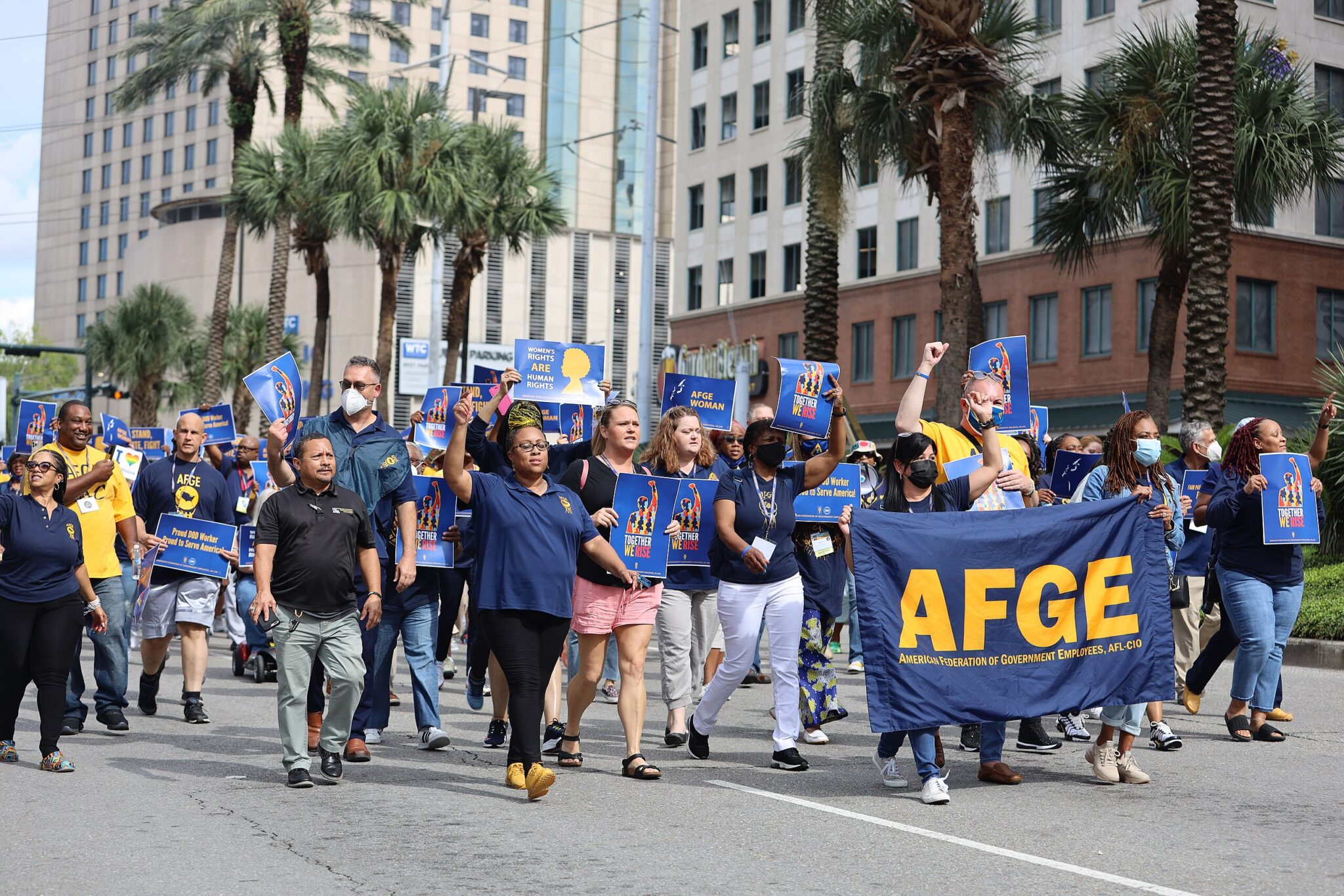
The purges, which Trump and his right-hand-billionaire Elon Musk have said will cover 10% of the federal government’s 2.4 million civilian employees, have thrust federal workers’ unions onto the frontlines of legal and political resistance. Last week, a coalition of unions sued the Trump Administration to block the mass firings, arguing the President exceeded his authority under Article II of the Constitution and usurped Congress’s sole power to appropriate funds. As Holden reported, unions have also brought suit to bar the Musk team from accessing highly sensitive data on the federal workforce. And unions have brought lawsuits at individual agencies — including a legal challenge to the Trump Administration’s plans to gut the CFPB. As John reported last week, the threats to federal workers have led to record-high membership in the American Federation of Government Employees, the largest federal workers union. The AFGE’s annual legislative conference last week featured its biggest-ever rally and dozens of high-profile Democratic lawmakers.
Amazon workers at a Garner, North Carolina fulfillment center voted down a union drive by a 2,447 to 829 margin. The union, Carolina Amazonians United for Solidarity and Empowerment (CAUSE), had advocated starting wages of $30 per hour, up from the current starting wage of $18, as well as more vacation time and longer lunch breaks. Deploying the catchphrase “I am not a robot,” CAUSE had hoped to spearhead the second successful unionization push at an Amazon facility, following a Staten Island warehouse’s successful bid in 2022. Leaders of CAUSE have alleged “relentless and illegal efforts to intimidate us” by the online retail giant, but have not yet indicated whether they will bring legal challenges against the election’s outcome.



Daily News & Commentary
Start your day with our roundup of the latest labor developments. See all
October 8
NLRB judge finds UPS unlawfully restricted union insignia; Harvard graduate workers authorize second strike; OSHA orders Union Pacific to pay $300,000 in damages in whistleblower case.
October 7
DOL scraps plan to remove decades-old wage-and-hour guidance from federal regulations; New York enacts personnel records access law; Starbucks loses bid to dismiss Workers United trademark suit.
October 6
Protect College Sports Act dampens athlete unionization outlook; Stanford RA union decides to withdraw petition
October 5
Delaware bans captive audience meetings; EEOC settles remote work national origin discrimination claim; First Circuit stays enforcement order in VA's dispute with AFGE.
October 4
Boston nurses announce open-ended strike; federal judge restores federal prison workers' union protections; St. Louis workers form the first movie theater union in Missouri.
October 2
Gov. Newsom signs bill regulating AI in workplace; federal judge blocks Trump's $100,000 H-1B visa fee.