
Hannah Finnie is a writer in Washington, D.C. interested in the intersections of work and culture. She is a graduate of Harvard Law School.
Yesterday the U.S. Senate voted down President Biden’s nominee to lead the Department of Labor’s Wage and Hour Division, on a mostly party-line vote that got three Democrats to vote no alongside every Republican senator. The nominee was David Weil, who previously held the role under President Obama. He has written extensively about how modern corporations have found ways to engineer large profits at the expense of workers’ pay, benefits, and conditions (he’s the author of the book “The Fissured Workplace,” which explains this phenomenon). The three Democrats to vote no were Senator Manchin (D-W.Va.), and Sens. Kyrsten Sinema and Mark Kelly, both of Arizona. Business interests largely opposed Weil’s nomination.
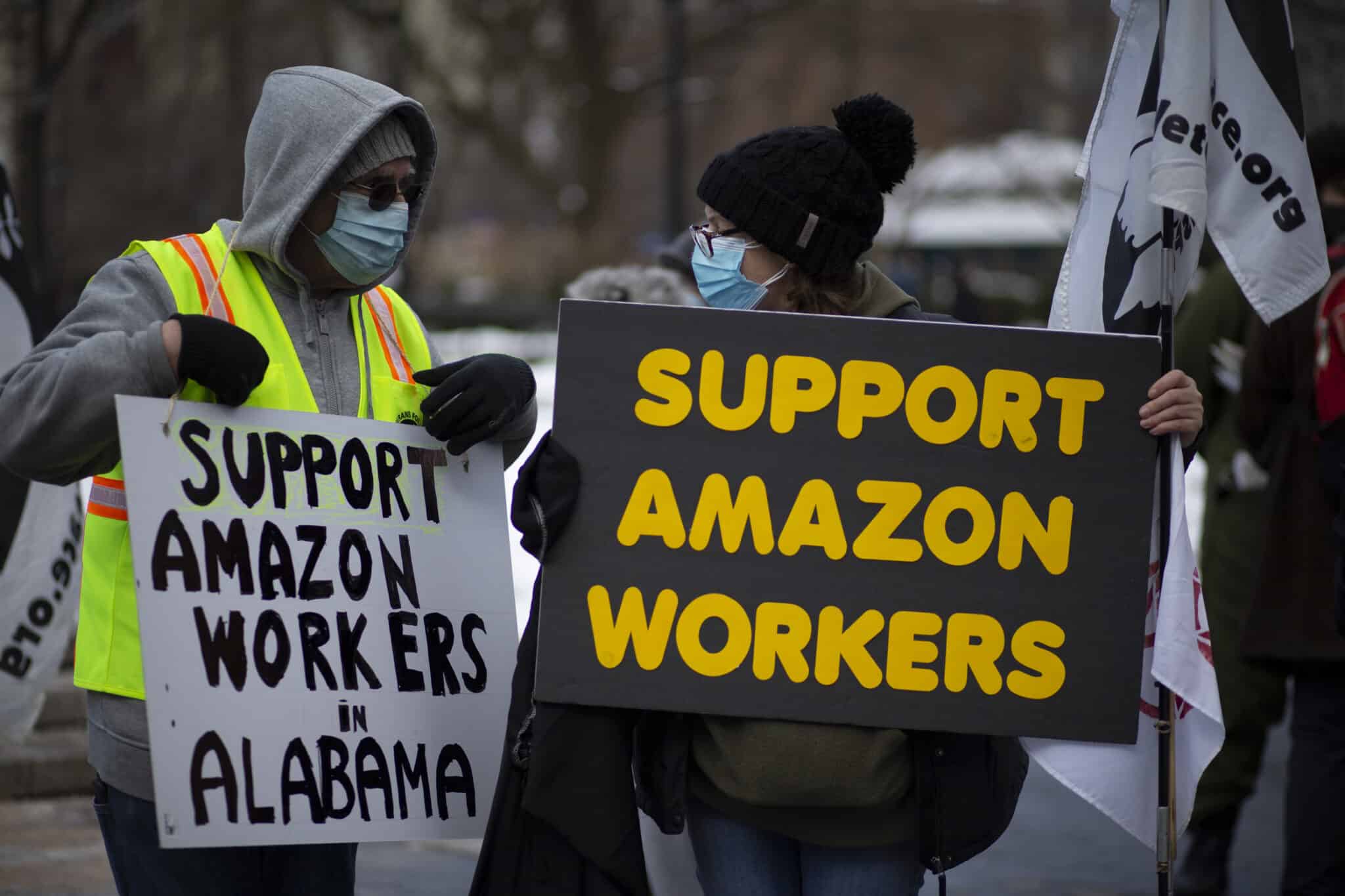
As Anita noted yesterday, the second Bessemer, Alabama Amazon warehouse unionization vote is currently underway. The first vote was riddled with claims by the RWDSU (Retail, Wholesale, and Department Workers Union), the union representing the warehouse workers, that Amazon had improperly interfered with the vote. The NLRB subsequently ruled for the union and agreed that Amazon had improperly interfered with the previous union vote, leading to this second effort. As of Thursday night, the vote was too close to call, with enough votes being challenged to swing the outcome of the election.
However, there’s also a second Amazon unionization vote underway. A Staten Island, New York Amazon facility is also currently counting votes (again as of Thursday night). The group representing the workers, the Amazon Labor Union, says that the pro-union votes have the lead as of the latest count.
Notably, Amazon hired the consulting polling firm Global Strategy Group (GSG), which is closely aligned with Democratic politicians and issue-based campaigns, to help roll out its anti-union strategy. On its website, GSG labels itself as “top Democratic pollsters” whose work “was pivotal in helping Democrats secure today’s majorities in the US House of Representatives and Senate.”

Daily News & Commentary
Start your day with our roundup of the latest labor developments. See all
April 6
Trump to shrink but not eliminate CFPB, 9th Circuit nixes use of issue preclusion to invalidate arbitration agreements.
April 5
Trump proposes DOL budget cuts; NLRB rules in favor of cannabis employees; Florida warehouse workers unanimously authorize strike.
April 3
NLRB says Amazon failed to bargain with union; Harvard graduate workers authorize strike, and states move to preempt local employment law.
April 2
Sheridan, Colorado educators go on strike; Maryland graduate student workers are one step closer to collective bargaining rights.
April 1
DOL proposes 401(k) rule; Starbucks investors reelect controversial board members; Washington passes workplace immigration warning requirement.
March 31
In today’s news and commentary, the Supreme Court hears a case about Federal Court jurisdiction over arbitration, a UPS heat inspection lawsuit against OSHA is dismissed, and federal worker unions and NGOs call on the EPA to cease laying off its environmental justice staffers. A majority of Supreme Court justices signaled support for allowing federal […]