
Sophia is a student at Harvard Law School and a member of the Labor and Employment Lab.
In today’s news and commentary, Amazon Labor Union intervenes in NYS PERB lawsuit; the British Columbia General Employees’ Union engages in shareholder activism; and Meta lays off hundreds of risk auditing workers.
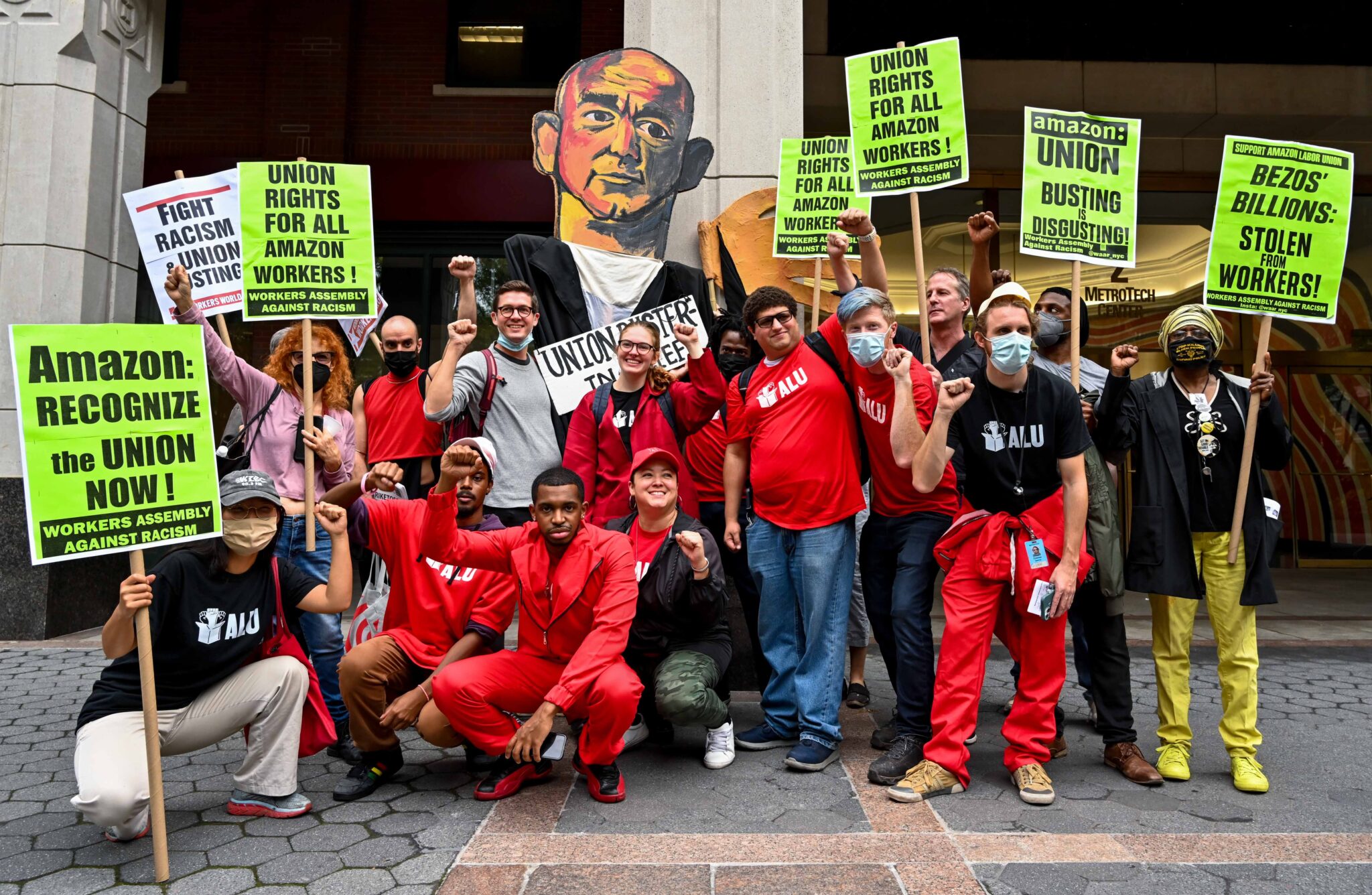
As Gurtaran previously reported, last month Amazon.com Services sued to block enforcement of Senate Bill 8034A, which authorizes the New York State Public Employment Relations Board (NYS PERB) to assert jurisdiction over private sector labor disputes when the National Labor Relations Board is unable to assert jurisdiction (e.g. due to a lack of quorum). Shortly after Governor Kathy Hochul signed the bill into law, Amazon Labor Union No. 1, International Brotherhood of Teamsters (ALU-IBT Local 1) filed an unfair labor practice charge against Amazon with NYS PERB. On Wednesday, U.S. District Judge Eric R. Komitee of the Eastern District of New York granted ALU-IBT Local 1’s motion to intervene in the suit between Amazon.com and NYS PERB. The Union argued that “the outcome of this action will directly impact ALU-IBT Local 1’s ability to vindicate the rights of the employees it represents under New York law” and that “the Union’s experience will significantly contribute to full consideration of the factual and legal issues here at issue.”
As a long-term investor in Thomson Reuters, the British Columbia General Employees’ Union (BCGEU)—a Canadian union representing more than 95,000 members in both public and private sectors—has called on the company to reassess the ties its artificial intelligence (AI) product has with the Trump Administration. Specifically, the Union has criticized how the company’s Consolidated Lead Evaluation and Reporting (CLEAR) investigative software has facilitated the surveillance and tracking of migrants and asylum seekers by the U.S. Immigration and Customs Enforcement. Before a Thomson Reuters general meeting this past June, BCGEU submitted a shareholder proposal asking the company “to strengthen its AI governance framework by aligning it with the UN Guiding Principles on Business and Human Rights.” This effort is just one example of how unions are leveraging the trillions of dollars held by collectively bargained pension plans to engage in shareholder activism for social good.
Earlier this week, Meta announced that 600 workers from its AI division would be laid off, while the company quietly moved to cut more than 100 employees tasked with reviewing privacy and integrity risks. These discharges come just six years after the Federal Trade Commission fined Meta—then known as Facebook—$5 billion for deceiving users about its data privacy abilities and required the company to create new roles and corporate practices to improve transparency and accountability in handling user data. Meta’s chief privacy officer noted that the majority of its manual reviews—content moderation processes historically conducted by human reviewers—would now be executed by automated systems.





Daily News & Commentary
Start your day with our roundup of the latest labor developments. See all
October 12
Workers at the Obama Foundation begin organizing; MLB submits its latest collective bargaining agreement proposal; Brigham & Women's nurses postpone strike.
October 11
UAW President Shawn Fain succeeds in his reelection bid, and Spanish unions call for a general strike.
October 9
DHS proposes a $100k fee for the foreign grad employment program; Trump suspends tech company access to green card program; and private equity perpetuates poor working conditions for home care workers.
October 8
NLRB judge finds UPS unlawfully restricted union insignia; Harvard graduate workers authorize second strike; OSHA orders Union Pacific to pay $300,000 in damages in whistleblower case.
October 7
DOL scraps plan to remove decades-old wage-and-hour guidance from federal regulations; New York enacts personnel records access law; Starbucks loses bid to dismiss Workers United trademark suit.
October 6
Protect College Sports Act dampens athlete unionization outlook; Stanford RA union decides to withdraw petition