
Kevin Vazquez is a staff attorney at the International Brotherhood of Teamsters. He graduated from Harvard Law School in 2023. The opinions he expresses on this blog are his own and should not be attributed to the IBT.
On Friday, an analysis published by the Center of Public Integrity demonstrates that the recent spike in labor organizing—which has seen thousands of workers across the country, many working in sectors that have traditionally proven virtually impervious to union organizing, petition for representation elections with the NLRB—is indeed unusual. Analyzing data published by the National Labor Relations Board (NLRB), Public Integrity’s report determined that workers have filed more than 2,000 election petitions with the NLRB since the start of the fiscal year (which began last October), which is a jump of more than 60% from FY2021—the highest increase in at least a decade.
Though the recent surge in organizing and the renewed cultural salience of unions have undoubtedly been among the most positive developments for organized labor in decades, the response has not been sympathetic in all quarters. Corporate executives, in particular, are beginning to feel the pinch: according to Public Integrity’s review of disclosures filed with the Department of Labor (DOL), numerous well-known and highly visible corporations—such as Amazon, Starbucks, Dollar General, Walgreens, Chipotle, and even Hershey’s—have been spending thousands of dollars daily to scuddle organizing efforts. In December and January, for example, Dollar General alone paid the Labor Relations Institute—a consulting firm that assists companies in becoming “union free” by teaching workers about “the disadvantages of unions”—nearly $85,000 to enlist its services in order to prevent six workers from unionizing in one of its Connecticut stores (a story that was poignantly documented in-depth by the Washington Post late last year). Amazon, unsurprisingly, emerged as the undisputed leader in anti-union spending, disbursing more than $4.2 million to four anti-union labor law firms in FY2021, according to disclosures filed with the DOL, which described the expended funds as “responses to large scale union organizing efforts.”
Moreover, the NLRB itself has been struggling to manage its growing workload. In a press release issued earlier this year, which highlighted the increase in election petitions that it had received, the agency said that it was “handling unsustainable caseloads” and “processing the most cases it [had] seen in years with the lowest staffing levels in the past six decades.” It called on Congress to increase its funding and “help [it] restore the capacity that [it has] lost after years of underfunding.” This response is understandable, considering the number of full-time NLRB employees has contracted by more than 30 percent in the last 15 years, while the number of private-sector workers failing under the NLRB’s jurisdiction has risen by 50 percent.
On that note, workers at GEICO, the insurance behemoth, have accused the company of unlawfully attempting to disrupt their ongoing organizing efforts. The organizing drive, undertaken by Geico United, an independent and unaffiliated labor union, has been occurring in a GEICO office near Buffalo, New York with about 2,500 employees. Last month, GEICO United filed an unfair labor practice charge against the company, and New York state lawmakers also sent a letter to the company, urging it to permit its workers to organize without employer coercion. Despite this, however, GEICO workers allege that the company’s efforts to undermine the union have not only persisted but grown increasingly aggressive as the drive continues, and they now include frequent anti-union emails sent to the workers, anti-union posters in the workplace, and regular captive audience meetings with management.
In central and southeast Ohio, the contract negotiations between Kroger workers, represented by UFCW, and the company continued this weekend. The union sent the latest contract proposal to its workers on Friday, which includes a $1.00 hourly wage increase and adjustments to the proposed wage progression structure as workers move up the ranks. The union announced on Wednesday that it had reached an agreement with the company after two consecutive days of bargaining—the first time the two parties had met since 55 percent of UFCW members in the unit rejected what Kroger called its “last, best, and final offer” in September, the third tentative contract agreement offered by the company. The workers will vote on the latest proposal, which covers 82 stores and more than 12,000 workers, from Tuesday to Thursday. If they decide to once again vote it down, a strike will doubtlessly begin to loom on the horizon.
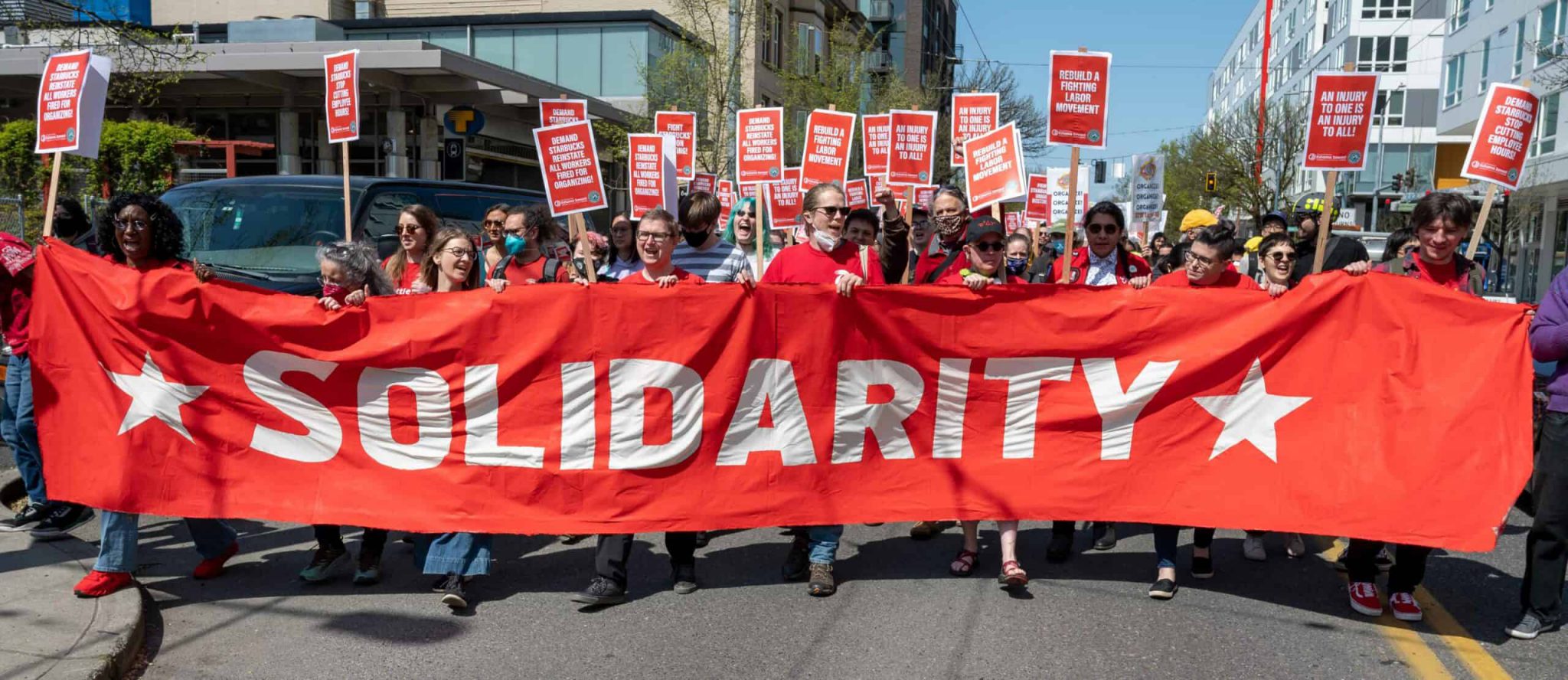
A lengthy NPR piece published earlier today chronicles the plight of many Starbucks workers—who “fear retaliation”—as the company’s “union-avoidance” measures have gradually intensified into a blistering scorched-earth campaign. Thus far, more than 300 Starbucks stores have held union elections, but that number has been outpaced by the more than 325 unfair labor practice charges that have been lodged against the company. More alarmingly, the number of stores petitioning for elections has dipped precipitously in recent months, from a high of 71 filed in March to a low of eight in August. This, Starbucks organizers say, is evidence that the company’s unlawful anti-union tactics—inundating workers with captive audience meetings and anti-union propaganda, granting raises and benefit increases for only non-union stores, firing dozens of union leaders, and so on—are bearing rotten fruit. For a longer treatment of this saga, including interviews with individual Starbucks workers who have experienced retaliation, take a look at the full NPR article.
Finally, a Vox report from Friday describes how two midterm ballot measures—in states approximately 500 miles apart—“offer two visions of labor rights in America.” On the one hand is a referendum in Illinois, which seeks to join New York, Hawaii, and Missouri by codifying collective bargaining rights in the state constitution. Unlike those states, however, it seeks to do so through a ballot measure—for the first time in the nation’s history. If the measure is successful, Illinois would also be the first state in the nation that bans “right-to-work” laws in the state constitution. On the other hand is Tennessee, where union strength is far weaker, and voters are being asked to decide the opposite question: whether to codify right-to-work in their state constitution. Tennessee, of course, is one of 27 states with an already existing right-to-work law, but it would be only the tenth to enshrine that “right” in its state constitution—following Alabama in 2016. For more in-depth coverage of the two ballot measures, the contexts in which they have arisen, and the interests at stake, check out the full piece in Vox.


Daily News & Commentary
Start your day with our roundup of the latest labor developments. See all
July 29
NYC public defender strikes spread to the Bronx; NLRB drops challenge to New York labor law after Amazon wins its case; new data shows appointments of women and minorities to S&P 500 boards at lowest level in a decade.
July 28
DOJ drops charges against SEIU California president; Massachusetts nurses file ULP against hospital; Democratic lawmakers look to remove damage caps in employment discrimination cases
July 27
NY Port Authority proceeds to trial on PUMP Act case; First Circuit denies stay in order vacating H-1B visa fee; DC Circuit panel denies First Amendment claim over disclosure of confidential emails in allegation of prison's COVID-19 mismanagement.
July 24
EEOC drops request for UPenn's Jewish staff; Starbucks defeats mail-in ballots; and Mamdani appoints Lina Khan.
July 23
Ninth Circuit affirms ban of transphobic books in school; leading demographer warns of impending labor shortage.
July 22
EDNY strikes down state labor board law; D.C. Circuit applies Loper Bright to NLRB; Joint employer bill reaches the House floor.