
Sophia is a student at Harvard Law School and a member of the Labor and Employment Lab.
In today’s news and commentary, the “Big Three” record labels make a deal with an AI music streaming startup; 30 stores join the now week-old Starbucks Workers United strike; and the Mine Safety and Health Administration draws scrutiny over a recent worker death.
This week, Universal Music Group, Sony Music, and Warner Music Group—the world’s three major record labels—announced that they had struck a deal with an artificial intelligence music startup called Klay. The startup licensed the rights to thousands of songs from the three labels in order to train its large language model (LLM) and eventually allow users to remake songs in different styles through its technology. The United Musicians and Allied Workers (UMAW) criticized the deal, arguing that it will primarily benefit major label executives and AI startups, while the everyday musician gets squeezed. UMAW has vocally supported the Living Wage for Musicians Act, which would create a new streaming royalty system to more fairly compensate artists for the music they create. Currently, Spotify—the world’s largest streaming platform—pays on average about $0.003 per stream, which would require an artist to receive over 800,000 monthly streams to earn the equivalent of a $15 per hour full-time job.
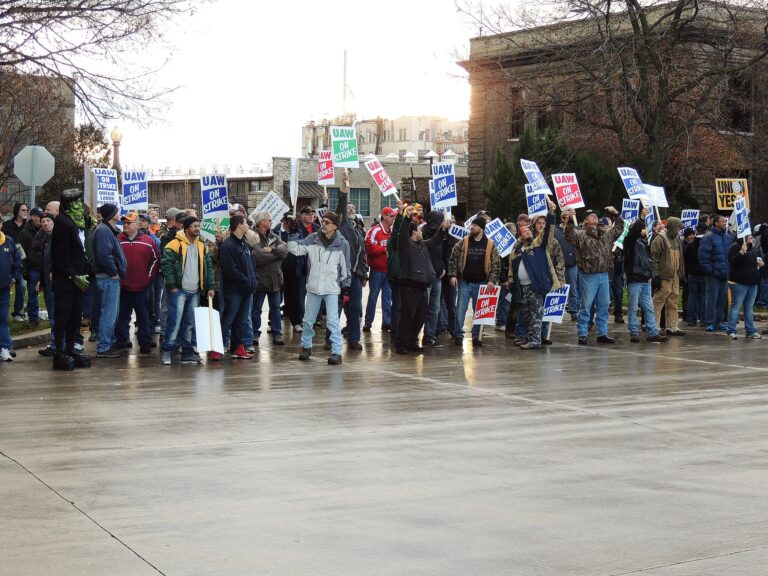
As Liana reported earlier this week, Starbucks Workers United (SWU) launched a strike at 65 stores nationwide. Yesterday, 30 additional stores in 25 U.S. cities decided to join the now week-long strike, bringing the total number of striking stores to 95 in 65 cities. This latest SWU strike started last Thursday on Red Cup Day, which is usually one of Starbucks’ most busy days of the year. Despite the strike, Starbucks reported that this year’s Red Cup Day generated the most sales and store traffic since the company began the annual promotional event. Just over 3% of U.S. Starbucks locations are unionized, begging the question: How many stores will need to organize for the company to finally sign a fair contract? The Starbucks barista unionization effort is an example of the steep challenges involved in organizing a massive multinational corporation, and the true grit workers have in standing up to power and demanding a better workplace.
On November 13, Steve Lipscomb—a miner in West Virginia—was found dead in a flooded mine called Rolling Thunder. Five days prior, a crew employed by Alpha Metallurgical Resource—the owner of the mine—struck a pocket of water, causing the mine to flood. While the 17 other miners working at the time of the accident survived, Lipscomb’s fatality and the five-days it took to locate him provoked increased scrutiny of the Department of Labor’s Mine Safety and Health Administration (MSHA). Typically, when a mining accident occurs a seismograph is deployed to help locate miners trapped underground. But for some unknown reason(s), no such equipment was used in the search for Lipscomb—an omission that has triggered calls for an investigation into the agency’s emergency response unit. Thus far in 2025, Rolling Thunder has received 60 MSHA citations, 10 of which the agency has classified as “significant and substantial”, meaning that serious injury is reasonably likely to occur if the discrete safety hazard is not addressed.


Daily News & Commentary
Start your day with our roundup of the latest labor developments. See all
February 24
In today’s news and commentary, the NLRB uses the Obama-era Browning-Ferris standard, a fired National Park ranger sues the Department of Interior and the National Park Service, the NLRB closes out Amazon’s labor dispute on Staten Island, and OIRA signals changes to the Biden-era independent contractor rule. The NLRB ruled that Browning-Ferris Industries jointly employed […]
February 23
In today’s news and commentary, the Trump administration proposes a rule limiting employment authorization for asylum seekers and Matt Bruenig introduces a new LLM tool analyzing employer rules under Stericycle. Law360 reports that the Trump administration proposed a rule on Friday that would change the employment authorization process for asylum seekers. Under the proposed rule, […]
February 22
A petition for certiorari in Bivens v. Zep, New York nurses end their historic six-week-strike, and Professor Block argues for just cause protections in New York City.
February 20
An analysis of the Board's decisions since regaining a quorum; 5th Circuit dissent criticizes Wright Line, Thryv.
February 19
Union membership increases slightly; Washington farmworker bill fails to make it out of committee; and unions in Argentina are on strike protesting President Milei’s labor reform bill.
February 18
A ruling against forced labor in CO prisons; business coalition lacks standing to challenge captive audience ban; labor unions to participate in rent strike in MN