

Jon Weinberg is a student at Harvard Law School.
The recent settlement announced between Uber and drivers in California and Massachusetts in suits over driver classification (analyzed here) continues to receive extensive coverage. While questions about the “drivers’ association” have been highlighted in recent commentary, controversy has also arisen over the settlement amounts and how the settlement treats the tipping of drivers.
Settlement Amounts
MarketWatch has analyzed payments under the proposed settlement in the following tables. Notably, “the listed settlement amount would be doubled for drivers who had opted out of 2013 and 2014 Uber arbitration clauses,” and the nine named plaintiffs will receive an additional enhancement estimated at $7,500 each.
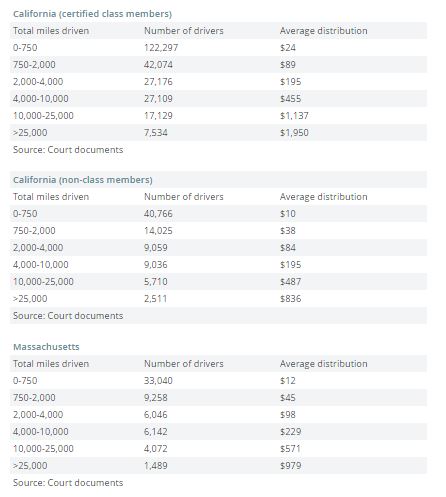
Tables by MarketWatch
As these tables reflect, nearly 80% of the 243,319 California class members will receive less than $200 on average. California class members who drove up to 10,000 miles for Uber will get no more than $455 on average, while those who drove more than 10,000 miles and up to 25,000 receive $1,137 on average. Massachusetts drivers who logged the most miles, however, won’t even be this well-compensated: those who drove in excess of 25,000 miles will receive $979 on average.
Driver Tipping
Money focuses on the tipping provisions of the settlement. Drivers will be able to solicit tips and place signs in their vehicles noting tips are not included, but passengers will not be able to tip via the app and its cashless, automated payment system. (Uber’s chief competitor, Lyft, allows tipping through its app.) On the one hand, Money theorizes that drivers will now be incentivized to provide lower passenger ratings for those who do not tip. On the other hand, Uber passengers have become accustomed to not tipping and not needing to have cash on hand. The actual impact of the tipping settlement will depend on which dynamic proves more important.



Daily News & Commentary
Start your day with our roundup of the latest labor developments. See all
October 12
Workers at the Obama Foundation begin organizing; MLB submits its latest collective bargaining agreement proposal; Brigham & Women's nurses postpone strike.
October 11
UAW President Shawn Fain succeeds in his reelection bid, and Spanish unions call for a general strike.
October 9
DHS proposes a $100k fee for the foreign grad employment program; Trump suspends tech company access to green card program; and private equity perpetuates poor working conditions for home care workers.
October 8
NLRB judge finds UPS unlawfully restricted union insignia; Harvard graduate workers authorize second strike; OSHA orders Union Pacific to pay $300,000 in damages in whistleblower case.
October 7
DOL scraps plan to remove decades-old wage-and-hour guidance from federal regulations; New York enacts personnel records access law; Starbucks loses bid to dismiss Workers United trademark suit.
October 6
Protect College Sports Act dampens athlete unionization outlook; Stanford RA union decides to withdraw petition