
Tascha Shahriari-Parsa is a government lawyer enforcing workers’ rights laws. He clerked on the Supreme Court of California after graduating from Harvard Law School in 2024. His writing on this blog reflects his personal views only.
In today’s news & commentary: Teamsters reaches a historic settlement with Universal Intermodal; the Sixth Circuit stays an NLRB injunction ordering reinstatement of the Starbucks “Memphis Seven”; and California considers a bill that would require large employers to submit pay data reports based on sex, ethnicity, and race.
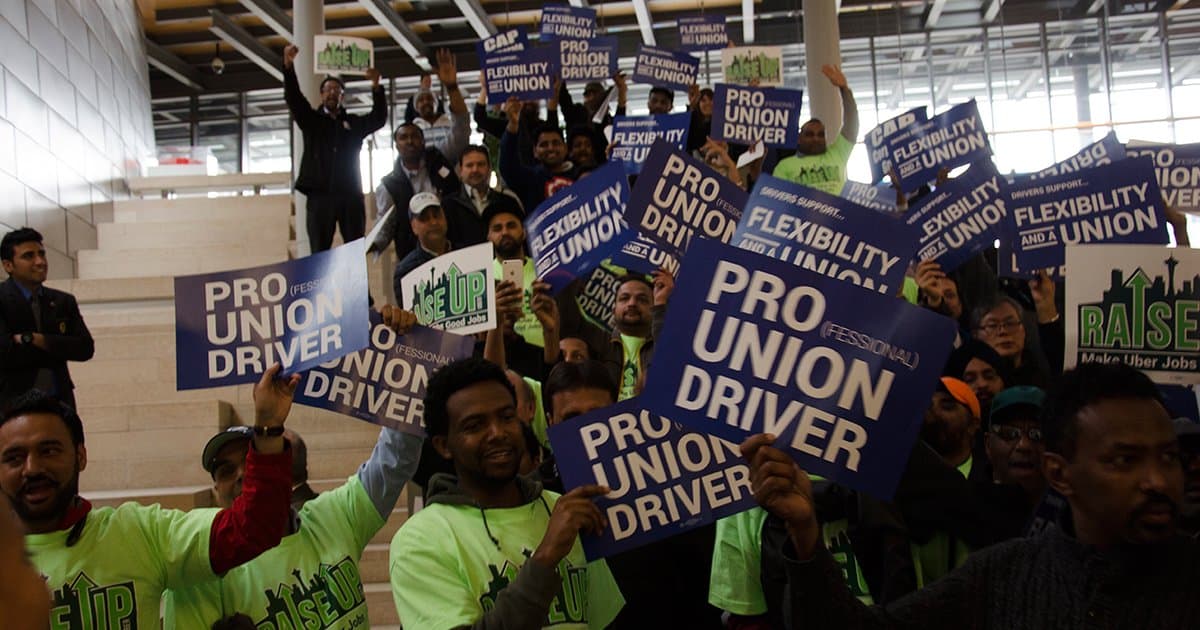
Shipping company Universal Intermodal reached a historic settlement with the Teamsters: the company will reclassify its Southern California drayage drivers as employees; will re-open a closed facility in Compton; and will reinstate, with backpay, around 66 workers who were terminated during a unionization effort with the Teamsters. The August 5 settlement, described in an NLRB press release on Wednesday, follows two Teamsters suites against Universal Intermodal before the Board. In the first, Teamsters accused the company of illegally firing workers for organizing ahead of a union vote. An NLRB administrative law judge found that the company closed its Compton facility as a form of retaliation against the union effort, rather than for business reasons. A second suite by the Teamsters accused Universal Intermodal of violating and misclassifying drivers as independent contractors. The settlement agreement also requires the company to recognize the union, to bargain with the union over their first collective bargaining agreement, and to provide options for other drivers to transfer to full-time employee status in the union-represented bargaining unit. Following the settlement, Julie Gutman Dickinson of Bush Gottlieb, representing the Teamsters, called Universal Intermodal “the role model of a high-road employer.”
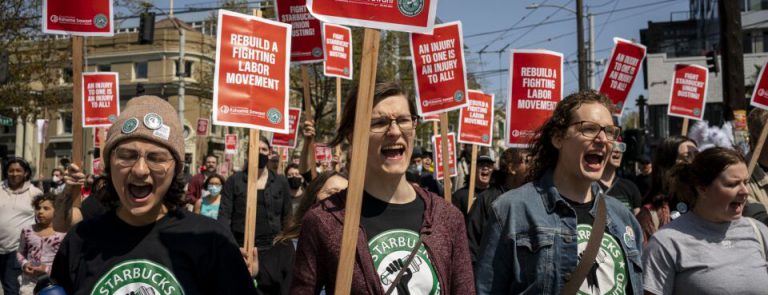
An NLRB injunction ordering Starbucks to reinstate seven terminated union supporters in Memphis was halted by the Sixth Circuit on Tuesday. The termination of the “Memphis Seven” in February received national attention, and led to an NLRB petition to the federal courts seeking reinstatement of the workers. According to a May NLRB press release, “Starbucks directed a wide variety of coercive measures at its employees, including disciplining the employee responsible for starting the campaign; more closely supervising its employees; closing the area of the store on days organizers had previously invited the public and customers to come to show support for the campaign; and removing all pro-union materials from the community bulletin board inside the store, including notes authored by customers expressing support for the employees and their campaign. Then, following increased media coverage and public support for the campaign, Starbucks terminated seven Union activists all on the same day, including five of the six members of the union organizing committee.” The workers voted 11-3 to unionize in June, joining over 300 other Starbucks stores that have unionized over the past year.
The NLRB sued Starbucks in federal court under NLRA Section 10(j), which allows the Board to seek an interim injunction for temporary relief when unfair labor practices have occurred. U.S. District Judge Sheryl H. Lipman ruled for the NLRB, writing that the Board showed “reasonable cause” that Starbucks violated the NLRA. Starbucks appealed the decision in an emergency stay motion, and a three-judge panel decided this week that the motion “raises issues . . . that deserve full pleading and reasoned consideration.” The internal NLRB trial is scheduled to commence on September 12th.
California could soon pass a pay reporting bill that would help combat pay disparities for women and people of color. The bill, S.B. 1162, would mandate employers in California with at least 15 workers to post salaries or wages on their job listings, and require companies with 100 or more workers to send details on mean and median pays for workers based on race, ethnicity, and sex within every job classification, as well as pay data reports for employees hired through labor contractors, to the California Civil Rights Department. The bill was passed by the California Senate in late May, and has since been undergoing consideration by the state Assembly. In the process, the bill has been amended to exclude mandating public reports on how much companies pay workers based on race, ethnicity, and sex; had such measures been included in the final bill, it would have been the first legislation of its kind in the country.




Daily News & Commentary
Start your day with our roundup of the latest labor developments. See all
October 7
DOL scraps plan to remove decades-old wage-and-hour guidance from federal regulations; New York enacts personnel records access law; Starbucks loses bid to dismiss Workers United trademark suit.
October 6
Protect College Sports Act dampens athlete unionization outlook; Stanford RA union decides to withdraw petition
October 5
Delaware bans captive audience meetings; EEOC settles remote work national origin discrimination claim; First Circuit stays enforcement order in VA's dispute with AFGE.
October 4
Boston nurses announce open-ended strike; federal judge restores federal prison workers' union protections; St. Louis workers form the first movie theater union in Missouri.
October 2
Gov. Newsom signs bill regulating AI in workplace; federal judge blocks Trump's $100,000 H-1B visa fee.
October 1
Senate confirms Keith Sonderling as Labor Secretary; Amazon warehouse workers launch an unfair labor practice strike.