
Fran Swanson is a student at Harvard Law School.
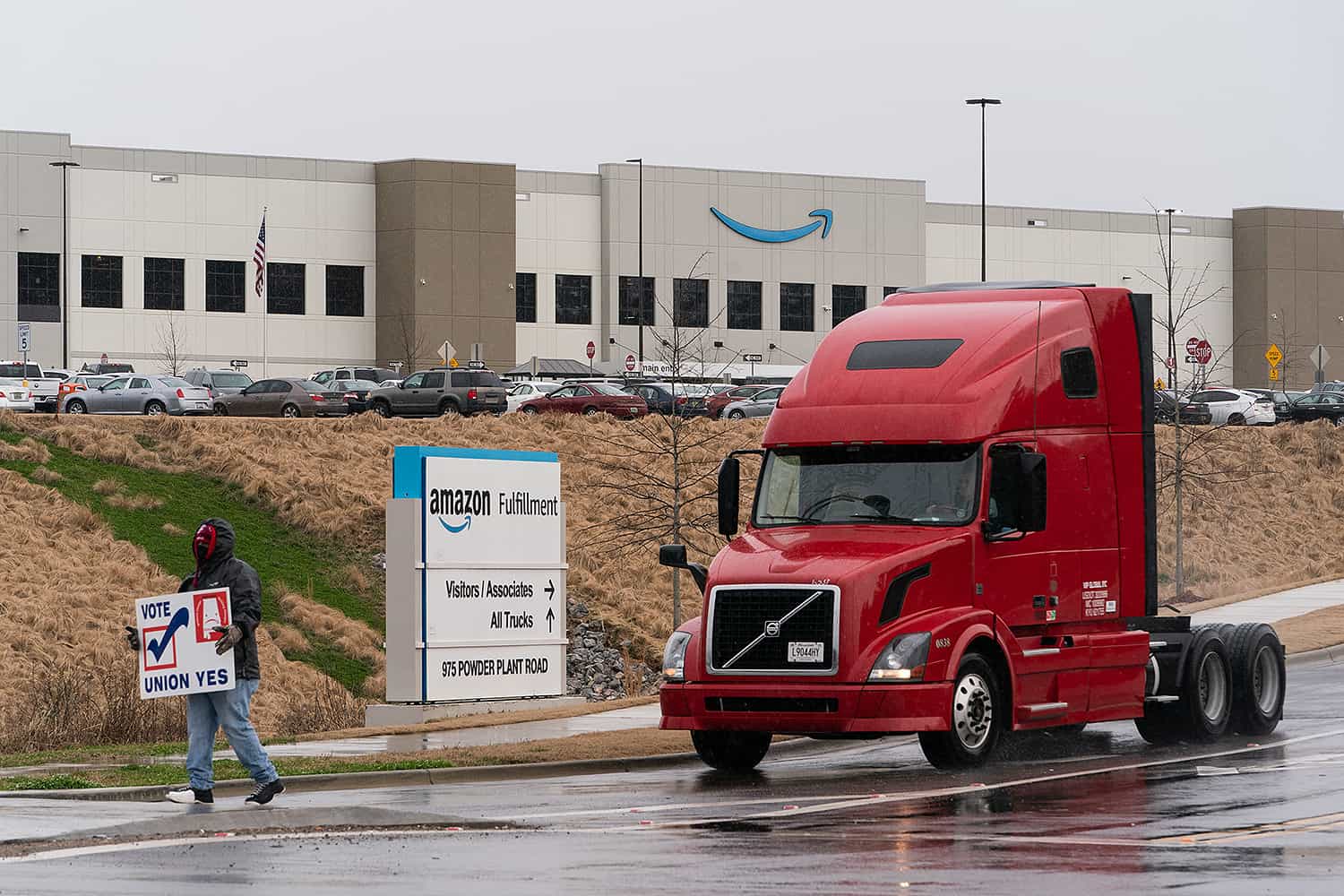
Pro-union workers are optimistic about the new election underway at the Amazon warehouse in Bessemer, but they still face significant obstacles, the Guardian reports. Over 6,100 workers are eligible to vote and, because of the facility’s high turnover rate, nearly half of those workers were not there during the first election. Amazon employs over 1 million people across the US, and two of its Staten Island warehouses have filed petitions for elections with the NLRB. Amazon is continuing to aggressively undermine unionization efforts at Bessemer this time around, too: it continues to hold captive audience meetings and one worker has filed a ULP alleging that management warned him about speaking with other workers about the union. And, the mailbox that was installed at the front of the warehouse during the first election was only moved to a different on-site location, which RWDSU has challenged. (The NLRB ruled it would resolve this after the election.) Darryl Richardson, who has worked at the warehouse for two years, explained that Amazon is “still using the same scare tactics they used last time, but due to the first election, you have employees who understand and know that Amazon isn’t telling them the truth.” Peter Connelly, who also works at the warehouse, said that he believed many workers who did not support the union in the first election now support it because the union is able to organize more effectively than earlier in the pandemic and because Amazon didn’t deliver on its election promises. Ballots are due on March 25th and counting will begin March 28th.
NLRB General Counsel Jennifer Abruzzo believes Congress must do more to combat forced arbitration, Bloomberg Law reports. At a Georgetown panel on Tuesday, Abruzzo said that “[t]he Supreme Court is allowing employers to use private contracts to evade their federal statutory obligations and pretty much has eviscerated public rights that Congress put in the NLRA.” She said that the vast majority of forced arbitration agreements will not be affected by the Ending Forced Arbitration of Sexual Assault and Sexual Harassment Act, which passed both houses of Congress last week (and which Tascha explained here). She criticized the Supreme Court’s 2018 Epic Systems ruling and called on Congress to pass the PRO Act.
Politicians who argue that the child tax credit is unnecessary because of the existence of Temporary Assistance for Needy Families (TANF) ignore TANF’s failures, a series of ProPublica investigations reveals. In Arizona, only 6% of families below the poverty line can receive assistance because the state uses TANF money to fund child welfare investigations (and subsequent removal of children from their families), which disproportionately target Black families. In New Mexico, single mothers applying for TANF are forced, on penalty of perjury, to identify the father of their child and recall the exact date when they became pregnant so that the state can seek child support and then pocket money meant for children. And yet, $5.2 billion in TANF funding sits entirely unused in states’ accounts despite surging need. TANF, advocate Ruby Duncan explained, “is not a caring program.”



Daily News & Commentary
Start your day with our roundup of the latest labor developments. See all
September 7
Eighth Circuit finds DOL order violates Seventh Amendment; 1,300 workers at Encore Boston Harbor go on strike.
September 6
Encore casino workers strike; President Trump commutes sentence of former Philadelphia IBEW leader; Durham labor activist ends his hunger strike against Amazon.
September 4
NLRB advice memo narrows political protest protections; NLRB asks federal appeals court for deference.
September 3
Seond Circuit rejects a NLRB standard for union insignia in employer dress codes; House Republicans ramp up labor union investigations.
September 2
Trump’s US Steel agreement impacts labor talks; Mamdani clashes with teachers’ union; Boeing plans to resume bargaining talks.
September 1
California legislature passes a bill banning AI workplace surveillance of workers' emotional states; Labor Department repeals decades-old farmworker protection rules; Sixth Circuit upholds a $1.4 million verdict for farmworkers.