

Jon Weinberg is a student at Harvard Law School.
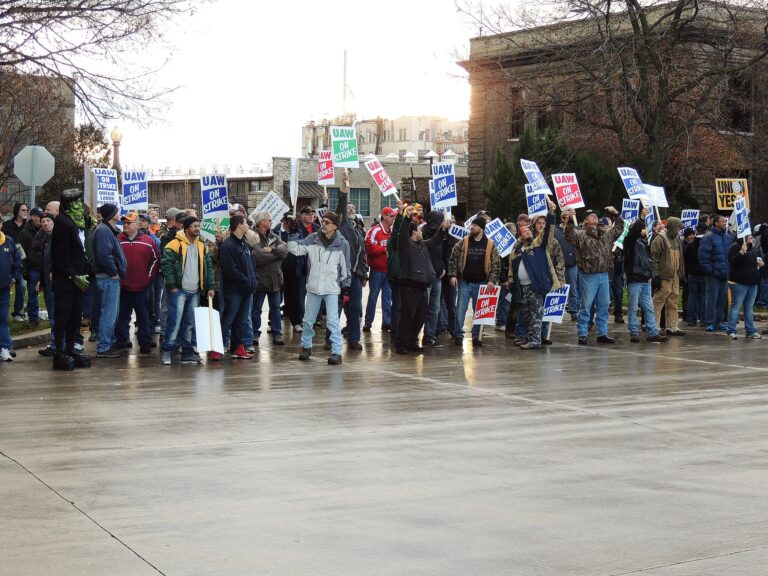
The New York Times has more on the recently-announced tentative agreement between the United Auto Workers and General Motors. Union leaders from plants across the country will meet Wednesday to hear details about the plan and decide whether to approve and submit it to members for a vote. As with the initial announcement, details of the agreement remain undisclosed. The International Business Times reported further about the United Auto Workers negotiations with automakers and the implications of pattern bargaining for manufacturing sectors.
According to Engadget, Democratic presidential candidate Bernie Sanders spoke at a picket line with Verizon workers in New York. 40,000 Verizon employees nationwide have been without a union contract for months.
As New York moves toward adopting a $15 an hour wage for fast food workers, restaurateurs and the public remain at odds. The Journal News reports that the National Restaurant Association “filed a challenge late last week with the state Industrial Board of Appeals, asking the panel to throw out a September order from the state Department of Labor implementing a higher minimum wage at fast-food chains like McDonald’s and Burger King.” The appeal is a precursor to any future court battle. Meanwhile, according to WBNG News, a Siena Poll released Monday found that 62% of New York voters support the wage increase.
Writing for The Washington Post, Lydia DePillis examines a new study that found age discrimination in hiring is worse for women than men. The National Bureau of Economic Research concluded that “the résumés of older women get far fewer callbacks than those of older men and of younger applicants of either sex.” The researchers speculated that the disparity could be due to difficulties in bringing suits under both age and sex discrimination laws, and the importance of physical appearance. DePillis notes that the disparity could have implications for retirement security and the social safety net, as women have longer life expectancies.
In an interview with Yahoo, economist and former Labor Secretary Robert Reich called debates over the minimum wage indicative of the shift in the center of American politics such that systems work for wealthy Americans at the expense of others. Reich noted that ““There’s ample evidence that you can raise the minimum wage and not cause job losses…You put more money in more people’s pockets and they turn around, most of them, and they spend it – middle class, lower middle class and the working class – they spend the extra money they get and it creates more jobs.”
The Atlantic published a story on modern American manufacturing and how companies moving jobs back to the United States do so without the same benefits and security similar jobs once guaranteed. Notably, “many of the companies are locating their new plants in right-to-work states where it’s less likely their workers will join a union, and the prevailing wages are far lower.” The article further notes data from the National Employment Law Project on low manufacturing salaries and that “the return of manufacturing doesn’t necessarily mean that the middle class is on its way back, too. It may be that most new manufacturing employees in the U.S. will just be added to the ranks of low-paid, overworked Americans trying to get by.”




Daily News & Commentary
Start your day with our roundup of the latest labor developments. See all
March 20
Appeal to 9th Cir. over law allowing suit for impersonating union reps; Mass. judge denies motion to arbitrate drivers' claims; furloughed workers return to factory building MBTA trains.
March 19
WNBA and WNBPA reach verbal tentative agreement, United Teachers Los Angeles announce April 14 strike date, and the California Gig Workers Union file complaint against Waymo.
March 18
Meatpacking workers go on strike; SCOTUS grants cert on TPS cases; updates on litigation over DOL in-house agency adjudication
March 17
West Virginia passes a bill for gig drivers, the Tenth Circuit rejects an engineer's claims of race and age bias, and a discussion on the spread of judicial curtailment of NLRB authority.
March 16
Starbucks' union negotiations are resurrected; jobs data is released.
March 15
A U.S. District Court issues a preliminary injunction against the Department of Veterans Affairs for terminating its collective bargaining agreement, and SEIU files a lawsuit against DHS for effectively terminating immigrant workers at Boston Logan International Airport.