
Rund Khayyat is a student at Harvard Law School.
As the burden of COVID-19 has disproportionately fallen on newly recognized essential workers, unions continue organizing to protect their members working on the frontline. The United Food and Commercial Workers union has partnered with Albertsons Companies, which owns grocery chains like Acme Markets and Safeway, in a push to temporarily designate grocery store workers as either “extended first responders” or “emergency personnel.” The new designation would grant grocery workers priority access to Covid-19 testing and to personal protective equipment. The union and Albertsons this week bought an advertisement in the New York Times to push for the change.
In Massachusetts and across New England, carpenters and painters have refused to continue work on construction sites, citing concerns that employers are not taking the precautions to adequately protect them from the virus. The North Atlantic States Regional Council of Carpenters and the Painters and Allied Trades Union directed thousands of members to stop reporting to work until the sites are safer, and called on Governor Charlie Baker to order a statewide shutdown of construction projects. Though Baker said his administration issued strong guidance for social-distancing protocols on construction sites, union leaders counter that enforcement is not happening and workers are being put at risk. The president of the Massachusetts Building Trades Council, which represents over 75,000 members working in the Massachusetts construction industry, stated that workers aren’t given enough protective gear or the opportunity to practice distancing. Though a few cities including Boston and Somerville have banned non-emergency construction projects, construction on inadequately protected sites continues across most of the state.
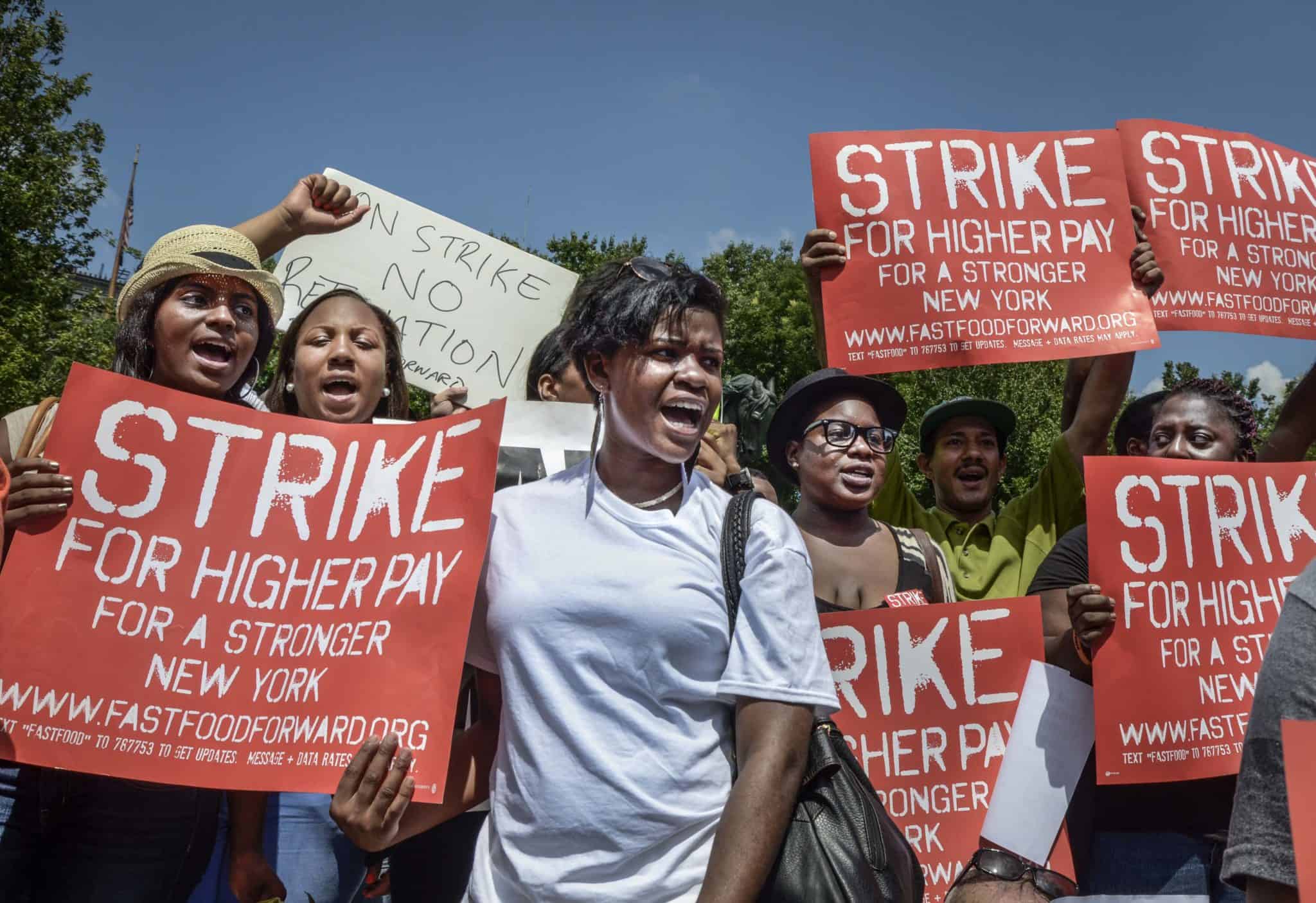
As part of the growing wave of strikes led by frontline workers across the country, hundreds of non-union cashiers and cooks at 50 fast food restaurants across California went on strike on Thursday to demand more protection. Workers from national chains like Burger King, Taco Bell, Domino’s and Pizza Hut participated in the strike. They demanded personal protective equipment (masks, gloves and soap), $3-an-hour hazard pay, and two weeks of paid sick leave to employees exposed to the coronavirus. The walkout was inspired by recent strikes at McDonald’s stores in San Jose and Los Angeles. Employees at the LA location, where two workers recently tested positive for COVID-19, stated that they had to work through the crisis without masks or hand sanitizer. The lackluster coronavirus safety precautions do not seem peculiar to the LA location – a survey of 800 McDonald’s workers conducted by the Service Employees International Union revealed that nearly a quarter of employees have worked while sick during the pandemic. The survey also found that McDonald’s banned or discouraged roughly half of the workers from wearing face masks or gloves.
Thursday’s strike was a massive labor organizing effort that would normally take months to plan. The Fight For $15 campaign, which helped coordinate the walk out, reported that the effort was the first spontaneous worker walkout in the 8 years of the campaign.
In recognition of the threats to essential workers, Congressional democrats are trying to add a hazard pay program to the next coronavirus relief package. The proposal would grant a $25,000 (almost $13-per-hour) hazard pay increase for frontline health care workers, and a $15,000 incentive for people who join the medical workforce surge during the pandemic. But, there are no Republican cosponsors of the proposal, which signals that it is unlikely to garner significant bipartisan support in the GOP controlled Senate.
Finally, the Labor Department on Thursday reported that another 6.6 million people filed for unemployment benefits last week, bringing the number of Americans who have lost their jobs over the past three weeks to 16 million. To contextualize the numbers, COVID-19 has caused more job losses over three weeks than the 2008 recession caused over two years. Economists project that 20 million people will have lost their jobs by the end of the month, pushing the unemployment rate to 15%. In February, the number stood at 3.5% after 113 months of job growth.
It is too early to evaluate how these numbers will translate to rent loss, but tenants nationwide are already struggling to pay their essential bills. According to data compiled by multiple apartment owner trade groups, 31% of tenants have so far failed to pay rent, compared with 18% in March and April of 2019. The number of Americans who cannot afford to pay rent will likely rise in May as the pandemic continues. As of now, tenants can stitch together April payments by collecting deferrals, applying their security deposits, paying with credit cards, or relying on the grace period before their rent is considered late.

Daily News & Commentary
Start your day with our roundup of the latest labor developments. See all
September 22
Judge blocks ICE raids in Alabama; Chicago hotel workers vote to strike; AutoZone workers look to create first union
September 21
In today’s News and Commentary, the Seventh Circuit raises the bar for the NLRB to obtain preliminary injunctions, the California Primary Care Association sues SEIU-UHW for racketeering, and the Seventh Circuit finds that an employer group and think tank do not have standing to challenge an Illinois law banning captive audience meetings. On Friday, the […]
September 20
Culinary Workers Union members protests union leadership; lawsuit against OpenAI and Microsoft reveal internal concerns about the threat of AI training to human labor.
September 17
Unions push to block Google from buying Spirit Airlines employment records; U.S. Department of Labor sues Oklahoma coffee chain over alleged wage violations.
September 16
Trump nominates Catherine Eschbach as EEOC general counsel; NLRB declines to resolve union work-assignment dispute; Allina Health physicians begin four-day strike.
September 15
Documents reveal the inner workings of Amazon's union avoidance program; Washington state public sector unions reach tentative deals amid a difficult bargaining cycle; hundreds of Nevada Culinary Union members protest their union's health care changes.