
Hugh O'Neil is a student at Harvard Law School and a member of the Labor and Employment Lab.
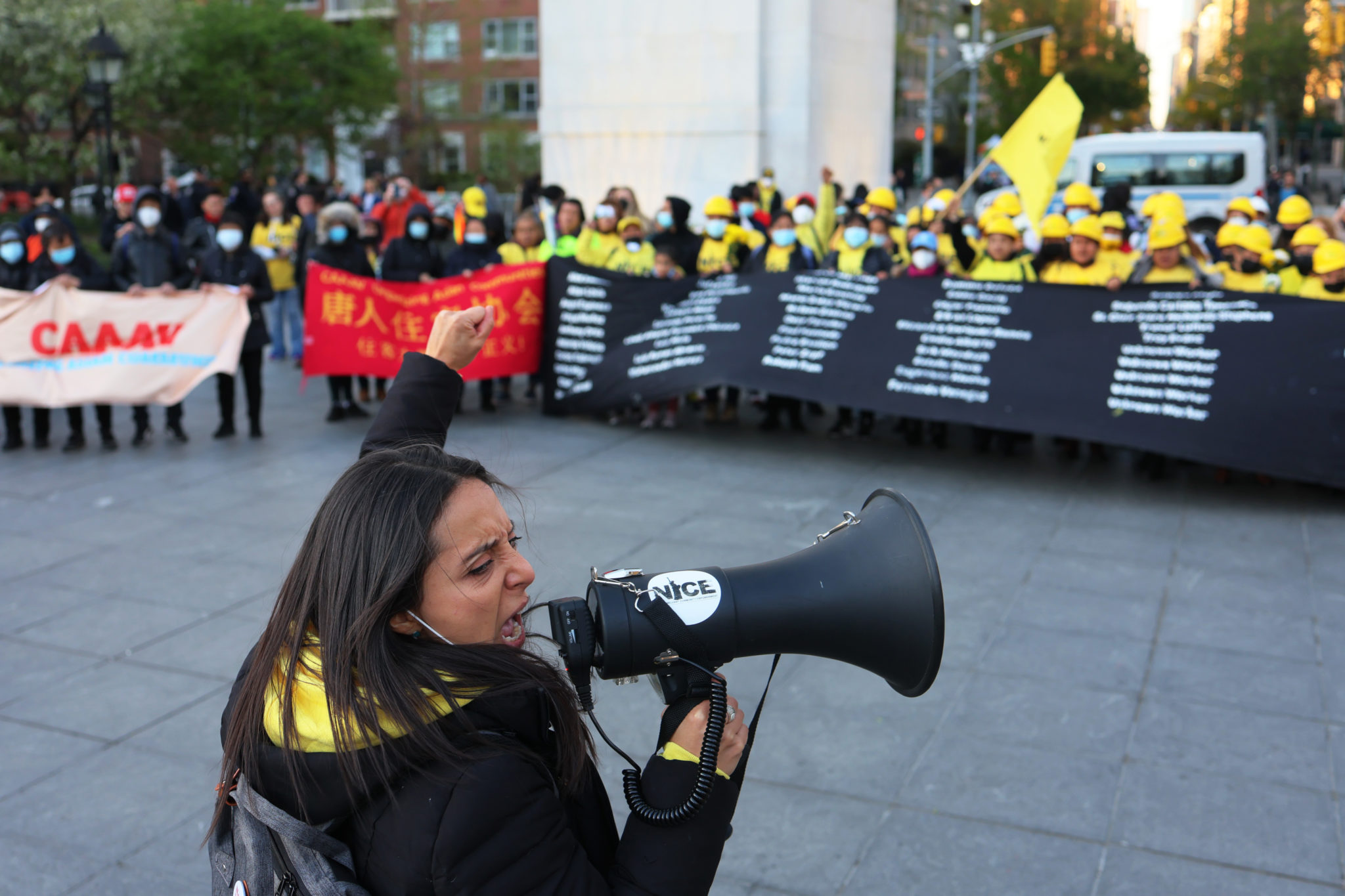
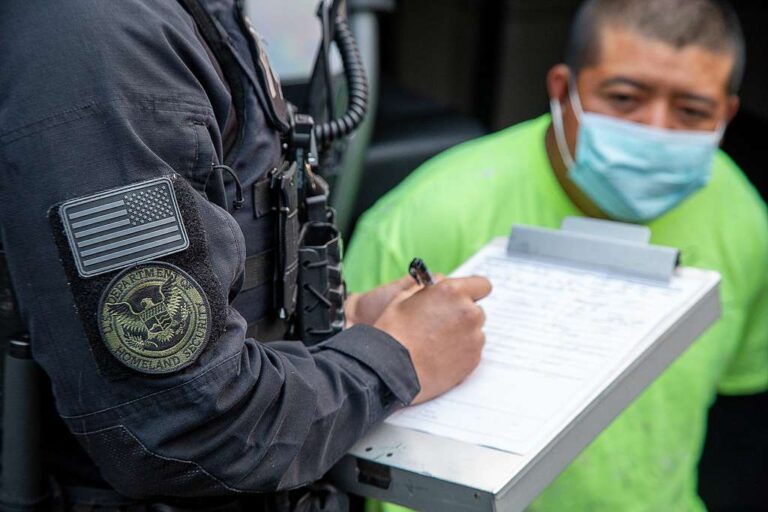
In the past year, Immigration and Customs Enforcement (ICE) agents have mounted a callous and unprecedented immigration crackdown. ICE’s tactics have violated the constitutional rights of undocumented and documented immigrants, as well as U.S. citizens. While ICE has deployed a range of enforcement strategies, raids on private businesses like hospitals, car washes, and agricultural facilities have become a mainstay. ICE’s actions have raised important questions sounding in morality, constitutionality, and politics.
What may not be top of mind to most observers is how recent events have affected workers’ rights under Section 7 of the NLRA. In this post, I argue that Trump’s immigration policy has revealed the extent of employer control over immigration-related issues, bolstering arguments that employees have a protected right to strike over federal immigration enforcement policy.
“Mutual Aid and Protection” Doctrine
Section 7 of the NLRA guarantees to workers the right to join a labor organization and bargain collectively. It also grants workers the power “to engage in other concerted activities for the purpose of collective bargaining or other mutual aid or protection.” Section 7 doctrine is expansive. Among other applications, courts have read §7 to grant employees the power to take certain collective political actions related to their status as employees.
In Eastex, Inc. v. NLRB, the Supreme Court held that employee §7 rights to engage in political activity depends, in part, on the extent to which the employer controls the issue that is the target of the employees’ activity. In particular, footnote 18 of Eastex explained that when the employer controls the target of employee concerted action, the employees’ use of economic weapons, like the strike, is likely protected. Thus, to take a classic example, because an employer has control over the temperature in the workplace, a work stoppage in opposition to a broken heating system is protected by § 7 (Washington Aluminum). On the other hand, Eastex also clarifies that where the employer lacks control, employee use of economic weaponry may be unprotected.
So, what if workers strike in pursuit of immigration policy goals? In interpreting Eastex footnote 18, two different NLRB General Counsels have arrived at opposite answers to this question. Both considered whether “A Day Without Immigrants” work stoppages were protected Section 7 activity. The advice memoranda diverged with respect to whether employers had sufficient control over the immigration policy targeted by employees to justify the walkout. The 2006 Board rejected the argument that the walkouts were protected, while the 2017 Board advised the opposite.
In the 2017 EZ Industrial Solutions memo, the General Counsel reasoned that although employers do not have direct control over immigration enforcement policy, there are sufficient actions they can take that evince enough control to justify a strike. For example, the GC posited, employers could pledge not to call or cooperate with ICE, requiring warrants and subpoenas for any searches or information requests. They could actively serve as “conduits” between their workers and “immigrant or legal aid groups.” Further, employers could publicly denounce ICE and self-designate as a “sanctuary” employer. Finally, employers can lobby legislators to change legislation or regulation.
How Current Events Effect the Doctrine
Given Trump’s focus on immigration enforcement and executive power, it is unlikely a Trump Board would reach the same outcome if EZ Industrial came up again. But in light of the breadth and depth of Trump’s immigration tactics, it is worth considering what recent events may have done to Section 7 doctrine as it relates to the use of the strike in pursuit of immigration enforcement policy.
On one view, the nearly unconstrained power of Trump’s immigration policy has weakened the argument that immigration advocacy and lobbying can fall within Section 7’s “mutual aid and protection” clause. The logic is as follows:
The Trump Administration’s immigration enforcement has included dozens, if not hundreds, of ICE raids. Even local law enforcement has been helpless in the face of this federal power; private employers are even more powerless. Even when raids have raised legal questions, workers and employers have unable to raise such challenges before it is too late. Any semblance of employer control over immigration policy is a mirage.
But this view takes a mile-high perspective and fails to reckon with how employers have responded to immigration crackdowns on the ground. Thus, instead of framing employers as completely powerless to the executive branch’s whims, a second view of the current situation highlights the various practical mechanisms employers have used to control the ways ICE interacts with the their workplaces. Indeed, this view more accurately accounts for what has happened over the last ten months.
It will always be true that an employer cannot unilaterally change federal immigration policy. But that is not what Eastex footnote 18 asks. Eastex asks not whether the employer has complete or unilateral control over the target of the employee political activity, but instead whether the employer “lack[s] . . . control.” The past year has shown that employers do not, in fact, lack control.
In the face of Trump’s ICE explosion, employers have devised protocols and procedures for how they and their employees should interact with ICE. The employee policies explain important guidelines like the warrant requirement and the the distinction between public areas of the workplace (where ICE may enter) and private areas (where ICE may not). At times, employers have refused comply with ICE except upon the issuance of a warrant or subpoena. For example, in a recent public showdown, the Los Angeles Dodgers blocked ICE’s entry to the Dodger Stadium parking lot. And when these policies failed to curb the potency of ICE raids, employers have vocalized dissent to the Trump administration. During the summer, ICE targeted factories and farms. Employers publicly denounced these efforts because the deportation of workers hurt their bottom line. They pleaded with Trump to stop. And as a result, Trump at least temporarily pulled back its focus on these sectors.
Recent events have also uncovered the extent to which employers are willing to cooperate with federal immigration enforcement. Home Depot and Lowe’s provide ICE access to security cameras. Many large corporations also maintain contracts with ICE. Although a different flavor, cooperation with ICE is still indicative of employer influence over immigration enforcement.
Conclusion
It remains to be seen which view of the last ten months will prevail. Of course, the odds are not in favor of an immigration advocate that files an EZ Industrial-type case during the next four years. Indeed, protests like “A Day Without Immigrants” are unlikely to be prevalent during the Trump administration because of the risks posed to the people that participate in them. Regardless, while the Trump administration’s actions have made many Americans feel powerless, employers can choose to take (or not take) a wide range of actions that impact the actual enforcement of immigration policy. The fact that those tools are available to employers means that the strike may also remain available to employees.





Daily News & Commentary
Start your day with our roundup of the latest labor developments. See all
March 16
Starbucks' union negotiations are resurrected; jobs data is released.
March 15
A U.S. District Court issues a preliminary injunction against the Department of Veterans Affairs for terminating its collective bargaining agreement, and SEIU files a lawsuit against DHS for effectively terminating immigrant workers at Boston Logan International Airport.
March 13
Republican Senators urge changes on OSHA heat standard; OpenAI and building trades announce partnership on data center construction; forced labor investigations could lead to new tariffs
March 12
EPA terminates contract with second-largest union; Florida advances bill restricting public sector unions; Trump administration seeks Supreme Court assistance in TPS termination.
March 11
The partial government shutdown results in TSA agents losing their first full paycheck; the Fifth Circuit upholds the certification of a class of former United Airline workers who were placed on unpaid leave for declining to receive the COVID-19 vaccine for religious reasons during the pandemic; and an academic group files a lawsuit against the State Department over a policy that revokes and denies visas to noncitizens for their work in fact-checking and content moderation.
March 10
Court rules Kari Lake unlawfully led USAGM, voiding mass layoffs; Florida Senate passes bill tightening union recertification rules; Fifth Circuit revives whistleblower suit against Lockheed Martin.