
Sophia is a student at Harvard Law School and a member of the Labor and Employment Lab.
Imagine receiving your paycheck, months after you were supposed to get paid, only to find 70% of your earnings deducted for unexplained “expenses.” On top of that, you signed a contract with an exclusivity provision stipulating that you may not work any other job in the same industry without giving your boss 20% of those earnings. To make matters worse, you learn that you’ve been paying the company you work for five times the market rate to live in a roach-infested apartment with bunk beds you share with other employees. This is the life of a typical fashion model in the United States.
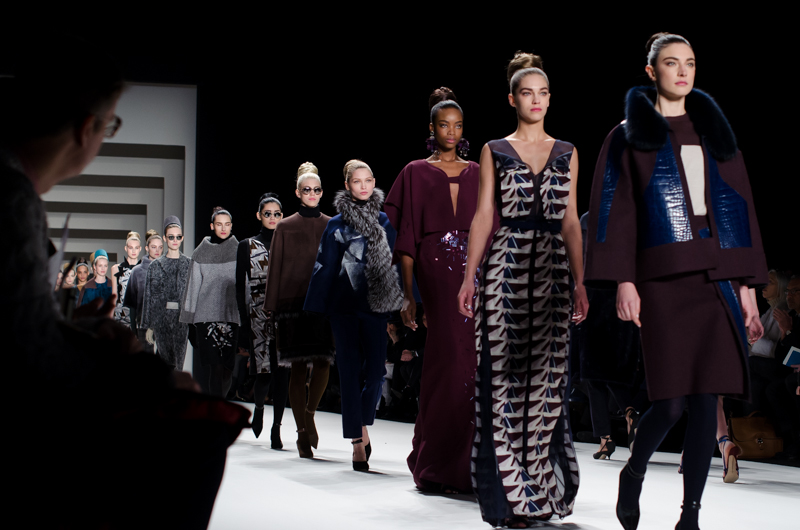
As Sara Ziff previously argued, the fashion industry — a culture rampant with eating disorders, the normalization of performing sexual favors to get work, and financial exploitation—is badly in need of a makeover. Nine years after California failed to extend employee status and other labor protections to models working within the state, the New York State Senate delivered models their first legislative victory with the Fashion Workers Act (FWA) (eff. June 19, 2025). This post discusses key provisions in the FWA and offers areas future legislation should address to further improve labor conditions for models.
Strengths of the Fashion Workers Act
The FWA should be applauded for establishing sector-wide minimum labor standards for models in New York, specifically through the following four provisions.
Registration Requirements for Model Management Companies — Within one year of the Act’s effective date, every model management company operating in New York must register with the state’s Department of Labor and deposit a $50,000 surety bond. Requiring agencies to deposit a bond with the department will incentivize agencies to follow the law or risk thousands of dollars if they fail to comply.
Plain Language Summary of Agreement — The Act requires agencies to provide a “deal memo” to the model — a written summary of the key terms and conditions of the modeling project in “plain language” that “the model sufficiently understands,” and “includ[es] but [is] not limited to the scope of work, rate of pay, payment term, usages, incurred expenses, and expectations of the model.” Translating dense legalese into accessible language is an essential first step in helping models regain agency over their careers in an industry dominated by unequal power dynamics. Before FWA was enacted, agreements often required models to delegate “power of attorney” to their modeling agency, which essentially granted the company unfettered control over a model’s finances and contractual obligations.
Preventing Surprise Charges — Modeling agencies must provide “an itemized recitation” of “all items initially paid for” by the company “but [that] will ultimately be deducted from the compensation due to the model.” Companies are required to supply reasoned documentation to models on a quarterly basis so that the “validity of each charge” is verifiable. This provision aims to end the predatory cycle in which agencies charge models exorbitant and unauthorized fees that result in models working in debt to their agencies.
Proscribing Certain Mandatory Conditions of Employment — The law prohibits agencies from requiring as a condition of representation that models sign a contract that lasts more than three years, automatically renews without the model’s affirmative written consent, or imposes a commission fee greater than 20% of the model’s compensation.
Areas of Improvement
Two provisions of the FWA have laudable aims but lack in ways that could hinder their efficacy and enforceability.
Whistleblower Protection — The FWA grants aggrieved models whistleblower protection for filing a complaint with the state’s labor department or for bringing a private right of action. Additionally, a management company found to have breached the Act is subject to a civil penalty of up to $3,000 for the first violation, and up to $5,000 for any subsequent violation. As David Weil argued, however, a perennial challenge for laws dependent on enforcement by individual employees is that the cost of exercising one’s individual rights (e.g. the time and effort to learn one’s rights, and the risk of employer retaliation) can be higher than the benefit the individual worker receives. Although the FWA’s whistleblower protection attempts to lower this individual cost, the reality that statutes left to individual enforcement will consistently be under-enforced could render this provision toothless in practice.
Safeguarding Digital Replicas — Both management companies and clients must obtain a model’s “clear written consent for the creation or use of [her] digital replica.” Although an agency must obtain the model’s consent “separately from the representation agreement,” the same obligation is not required of clients. While model management companies may not condition their representation of a model upon her agreeing to the creation of a digital replica, clients retain the power to do just that. The possibility of clients only hiring models who agree to the creation of their digital replica prior to signing a work agreement risks undermining the effect of the informed consent provision of the Act—what good is “clear and conspicuous” informed consent when withholding consent costs one the job?
Paths Forward
Future legislation on model rights should consider four areas that the FWA does not address.
First, state legislators should address the employment classification question for the purposes of giving models enhanced employment protections under their respective state laws. An ongoing class action lawsuit, Shanklin v. Wilhelmina Models, Inc., filed in 2013 in New York state court alleging that two major management companies misclassified models as independent contractors rather than employees, could resolve the question for New York models. But state legislators would be well advised to act first given the unknown and lengthy timeline of litigation.
Second, New York should consider joining the growing ranks of states that have implemented sectoral bargaining boards, including for caregivers in Nevada, nursing homes aides in Minnesota, and fast food workers in California. Building off the minimum labor standards implemented by the FWA, future legislation could establish a tripartite worker board where models, modeling agencies, and the state government negotiate wages and other terms and conditions of modeling work. This bargaining framework, where the state serves as an intermediary, is especially fitting for the modeling industry where the vast majority of the workforce is geographically concentrated in two states: California and New York.
Third, agencies should be required to give models a know your rights presentation as part of a new hire orientation. Given that the modeling industry is composed of an overwhelmingly young and female workforce that historically signed away any semblance of bargaining power by granting power of attorney to their agencies, states should take extra care to ensure that models know their rights. For example, New York could require agencies, as a condition of satisfying their registration requirement, to affirmatively inform all models they represent of their rights under the FWA and future legislation through a verbal presentation and written materials.
Lastly, the growing use of “AI twins” and digital avatars threatens to erase the FWA’s very purpose. One model even wrote, “I Am a Model and I Know That Artificial Intelligence Will Eventually Take My Job.” Legislation safeguarding models from sweeping technological displacement should urgently be considered—taking action now could mean the difference between accepting a technophilic future as inevitable or saving what’s left of the humanity in modeling that the FWA was designed to protect.



Daily News & Commentary
Start your day with our roundup of the latest labor developments. See all
March 25
UPS rescinded its driver buyout program; California court dismissed a whistleblower retaliation suit against Meta; EEOC announced $15 million settlement to resolve vaccine-related religious discrimination case.
March 24
The WNBPA unanimously votes to ratify the league’s new CBA; NYU professors begin striking; and a district court judge denies the government’s motion to dismiss a case challenging the Trump administration’s mass revocation of international student visas.
March 23
MSPB finds immigration judges removal protections unconstitutional, ICE deployed to airports.
March 22
Resurgence in salting among young activists; Michigan nurses strike; states experiment with policies supporting workers experiencing menopause.
March 20
Appeal to 9th Cir. over law allowing suit for impersonating union reps; Mass. judge denies motion to arbitrate drivers' claims; furloughed workers return to factory building MBTA trains.
March 19
WNBA and WNBPA reach verbal tentative agreement, United Teachers Los Angeles announce April 14 strike date, and the California Gig Workers Union file complaint against Waymo.