

In today’s News and Commentary, President Biden nominates Suzanne Summerlin for permanent general counsel at the Federal Labor Relations Authority, hundreds of journalists across the country walked off the job yesterday to demand leadership change at newspaper chain giant Gannett, and a pro-union resolution in Pennsylvania sparked debate over which political party better supports the working class.
In his third attempt to fill a years-long vacancy of a permanent general counsel at the Federal Labor Relations Authority (FLRA), President Biden nominated Suzanne Elizabeth Summerlin. The FLRA governs relations between the federal government and its employees. The agency issues unfair labor practice complaints and investigates and prosecutes labor charges on behalf of the 1.2 million civil servants in bargaining units. The Senate has not confirmed a nominee to the role since 2019. If confirmed, Summerlin will replace Acting General Counsel Charlotte Dye, who has been serving in the role since March 2021. In February of this year, the U.S. Government Accountability Office reported that Dye’s service was in violation of the Vacancies Act, as it had extended well beyond the 300-day allowance for acting service for a presidentially appointed, Senate-confirmed position.
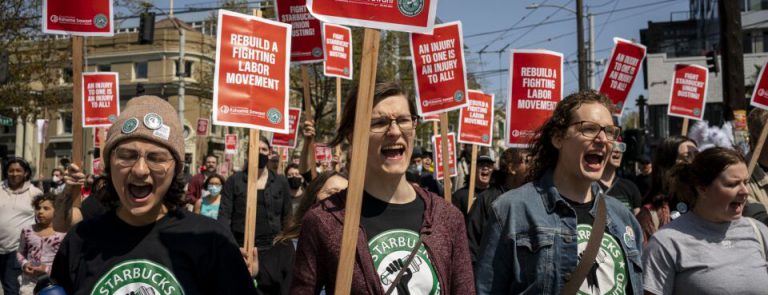
Unionized journalists at two dozen local newspapers owned by Gannet, the nation’s largest newspaper chain, struck on Monday. Journalists from California, Arizona, Texas, Indiana, New York, New Jersey, Georgia, and Florida demanded an end to extreme budget cuts and leadership changes at headquarters. The strikes coincided with Gannett’s annual shareholder meeting, where CEO and chairman of the board, Mike Reed, was reelected. During Reed’s tenure, Gannett shares have dropped more than 60%, several newsrooms have closed, 401-K contributions have been suspended, and many employees have experienced forced furloughs. The company’s workforce has shrunk by approximately 47%. In the last five years, 18 Gannett newsrooms have unionized, and two additional Georgian newspapers voted to unionize on Monday. The union is calling for an annual base salary of $60,000 and a lowering of the CEO-to-employee compensation ratio, from 66:1 to 20:1.
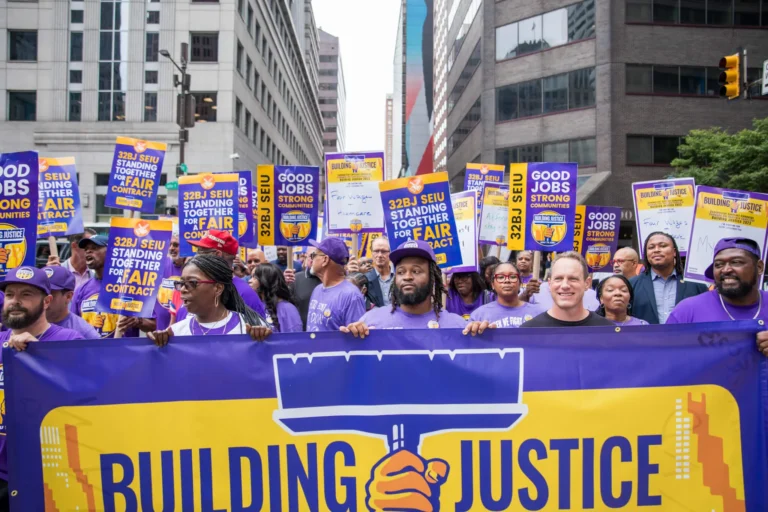
Pennsylvania’s House of Representatives passed a resolution designating June 5-9 “Union Organizing Week.” The resolution honors workers who have fought for their right to organize and bargain collectively. Though largely symbolic, H.R. 60 is sparking much debate in the Pennsylvania legislature around which party better supports the working class and labor unions. Republicans argue that the state’s slow-moving steel-mill-permitting process and Regional Greenhouse Gas Initiative are costing the state thousands of jobs. Democrats counter saying that support for oil and gas companies should not be equated with support of the union and union jobs. State Democrats have introduced proposals for raising Pennsylvania’s minimum wage from $7.25 to $15 hourly. The Republican-controlled state Senate has indicated its opposition to such a measure.


Daily News & Commentary
Start your day with our roundup of the latest labor developments. See all
October 2
Gov. Newsom signs bill regulating AI in workplace; federal judge blocks Trump's $100,000 H-1B visa fee.
October 1
Senate confirms Keith Sonderling as Labor Secretary; Amazon warehouse workers launch an unfair labor practice strike.
September 30
Harvard grad union wins in First Circuit; AI data trainers initiate misclassification suits; Trader Joe’s found liable under ERISA.
September 29
Unions, AI companies, and private equity firms form a new coalition to shape data center policies; unions express support for the Paramount-Warner Bros. merger.
September 28
The Protect College Sports Act nears passage in the Senate; San Francisco municipal workers agree to contract extensions.
September 27
The Trump Administration reaches a settlement with federal unions on reduction in force actions; the United Auto Workers file an en banc petition seeking review of a Second Circuit decision regarding labor arbitrations.