
Otto Barenberg is a student at Harvard Law School and the former Digital Director of OnLabor.
In today’s news and commentary, a teachers’ union staff strike prompts Biden to cancel a major speech; the D.C. Circuit reaffirms deference to the NLRB; and a Wisconsin judge strikes down parts of Act 10.
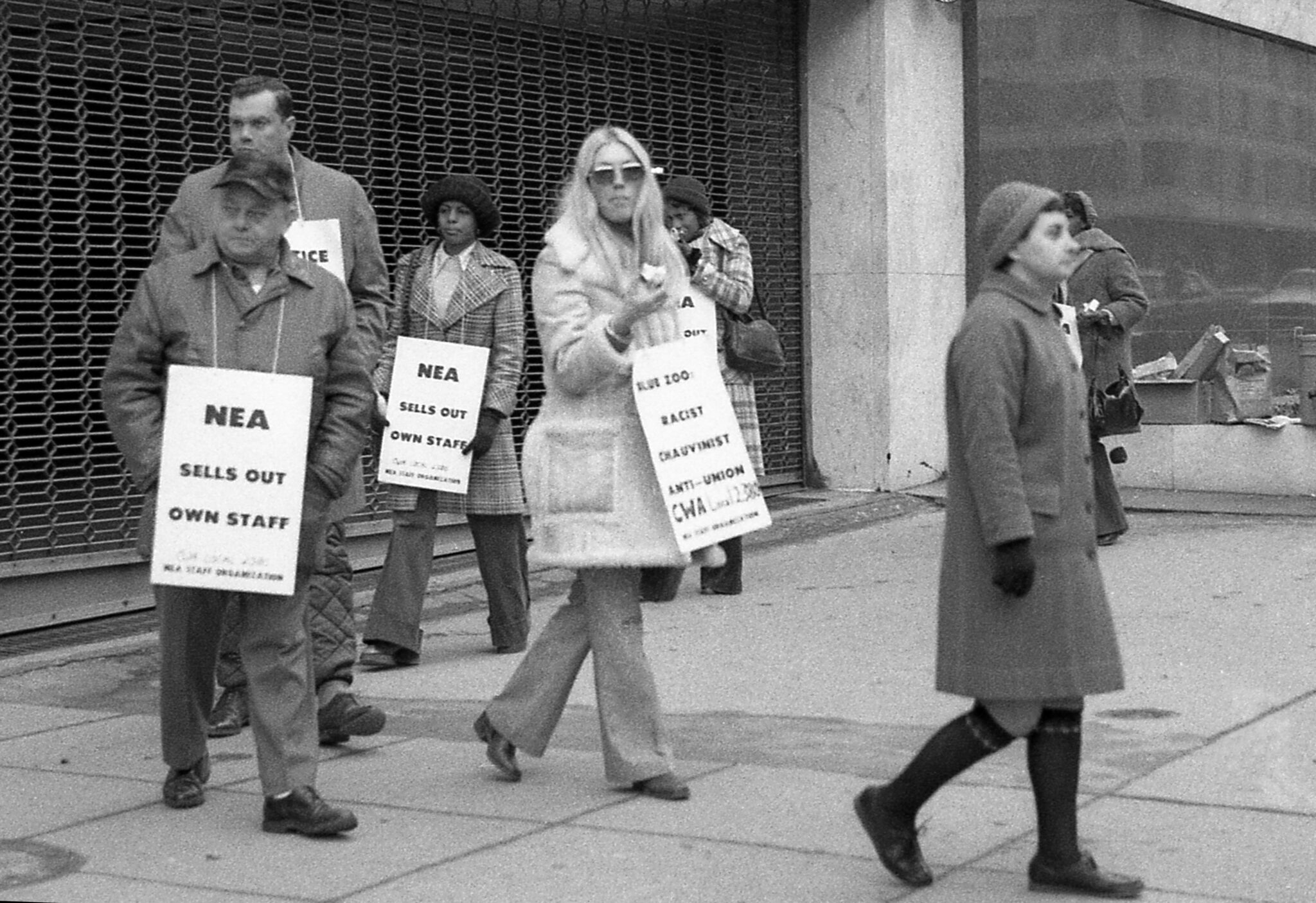
President Biden canceled a speech at the National Education Association’s (NEA) annual convention in Philadelphia after the union’s staff went on strike on Friday. The 350 members of the National Education Association Staff Organization (NEASO) initiated an unfair labor practice (ULP) strike against the teachers’ union management on day two of the four-day NEA convention. NEASO contends the NEA made unilateral changes to its employees’ contracts, engaged in wage theft by revoking holiday overtime, and failed to provide requested information on $50 million of outsourcing to contractors. In support of its position, NEA staff filed two ULP complaints with the National Labor Relations Board (NLRB).
“NEA has abandoned its union values with its actions at the bargaining table,” said NEASO President Robin McLean. “NEA would rather cancel a multi-million-dollar convention than comply with labor law.” An NEA spokesperson denied NEASO’s allegations: “We have crafted in good faith a proposal for our NEASO staff to address their expressed interests while ensuring the longer-term health of our organization and the needs of our members.” In response to the strike, Biden canceled a speech scheduled for today in front of thousands of teachers at the NEA convention. “President Biden is a fierce supporter of unions and he won’t cross a picket line,” his campaign said in a statement.
On Friday, the U.S. Court of Appeals for the District of Columbia Circuit signaled the NLRB may be largely insulated from the demise of Chevron—the landmark Supreme Court decision, overruled last week by Loper Bright Enterprises v. Raimondo, that instructed courts to defer to reasonable agency interpretations of ambiguous statutes. In the first federal appeals court ruling on an NLRB order since Loper Bright, the D.C. Circuit reaffirmed its longstanding position that Board interpretations are entitled to a “very high degree of deference.” A court sets aside a Board order, the D.C. Circuit maintained, only “when it departs from established precedent without reasoned justification, or when the Board’s factual determinations are not supported by substantial evidence.” The D.C. Circuit’s decision reflects Darin’s forecast of the NLRB’s place in the post-Chevron judicial order. The Supreme Court has deferred to reasonable Board interpretations in dozens of cases since 1938, cultivating a body of NLRB-deference precedent that long predates the 1984 Chevron decision.
Last week, a Wisconsin judge struck down provisions of Act 10, the Scott-Walker-era Wisconsin law that stripped collective bargaining rights from most of the state’s public workers and caused public sector union density to plummet from 50.3 percent in 2011 to 20.1 percent in 2023. Act 10 exempted municipal police, firefighters, and state troopers from its restrictions on public sector collective bargaining, while limiting the collective bargaining rights of Capitol Police, UW Police, and conservation wardens. Dane County Circuit Judge Jacob Frost found that distinction lacked a rational basis and therefore violated the Equal Protection Clause of the Fourteenth Amendment. The decision is a win for the state’s public sector labor unions, including AFSCME and SEIU, who brought the lawsuit in November 2023.





Daily News & Commentary
Start your day with our roundup of the latest labor developments. See all
October 14
Eleventh Circuit overturns ERISA exhaustion rule; DHS finalizes removal of automatic renewal for work permits; AFGE challenges SSA over flexible scheduling policy.
October 13
Chicago hotel workers remain on strike; a coalition of Democratic states sues the Labor Department over canceled unemployment insurance grants; the Federal Labor Relations Authority establishes a new mediation framework for federal worker disputes.
October 12
Workers at the Obama Foundation begin organizing; MLB submits its latest collective bargaining agreement proposal; Brigham & Women's nurses postpone strike.
October 11
UAW President Shawn Fain succeeds in his reelection bid, and Spanish unions call for a general strike.
October 9
DHS proposes a $100k fee for the foreign grad employment program; Trump suspends tech company access to green card program; and private equity perpetuates poor working conditions for home care workers.
October 8
NLRB judge finds UPS unlawfully restricted union insignia; Harvard graduate workers authorize second strike; OSHA orders Union Pacific to pay $300,000 in damages in whistleblower case.